A modern fence does more than mark a boundary. It sets the tone for your entire yard, blending clean lines with materials that feel intentional. Whether you lean toward warm wood, cool metal, or a mix of both, the right fence can make your outdoor space look finished without feeling fussy.
These 29 modern fence ideas show how simple shapes and thoughtful finishes turn a practical structure into a design feature. From slatted screens to integrated gates, each look keeps the fence as the hero while the surroundings stay simple and supporting. You’ll see how horizontal lines, dark tones, and natural textures create a calm, contemporary feel that works with any setting.
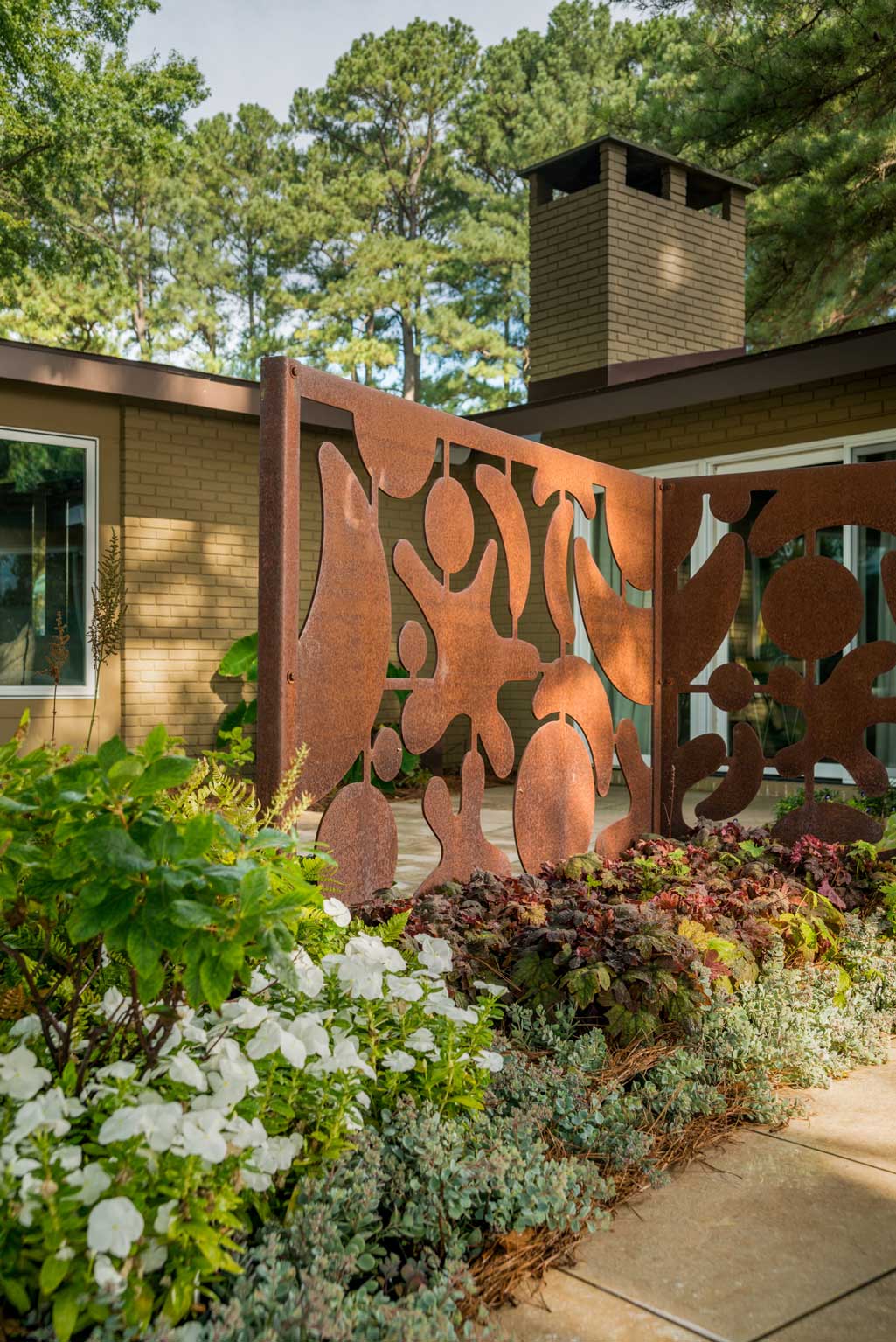
01 / 30Abstract Rusted Metal Screen for Mid-Century, Office-Safe Version
An abstract rusted metal screen brings mid-century modern lines to a garden without blocking the view. The organic shapes in the rusted finish pick up the warm browns in the brick house and the whites of the stone, so the fence reads as part of the landscape rather than a barrier. The open pattern lets daylight filter through, which keeps the garden planting from feeling boxed in. For a house with strong architecture, a decorative screen like this works as a fence element that adds texture without competing with the structure itself.
02 / 30Geometric Cut-Out Metal and Wood Fence Panels, Close-Up Take
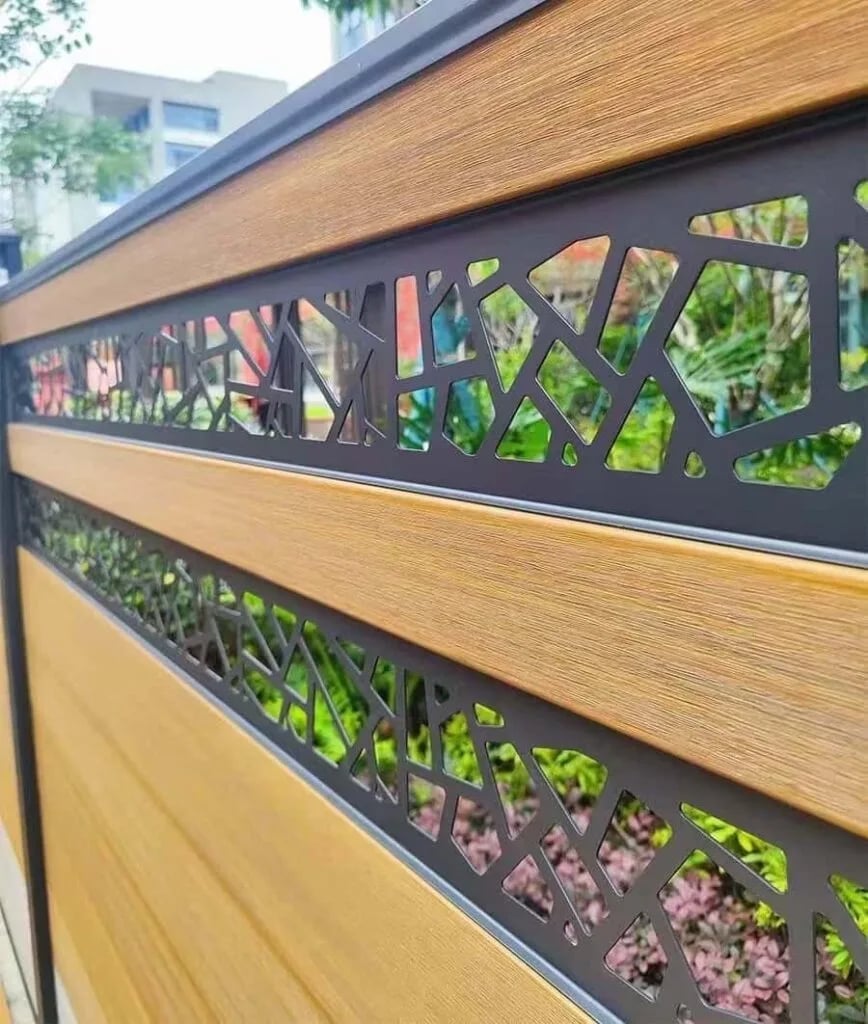
A geometric cut-out panel in metal and wood is a fence detail that rewards close looking. The dark gray metal frame holds the wood tones in place, while the cut-out pattern breaks up what could be a solid surface. In daylight, the contrast between the warm wood and the cool metal reads as intentional, not accidental. The green plants behind the panel soften the geometry just enough to keep the fence from feeling like a purely industrial element. For a front yard where the house is simple, this kind of patterned panel adds architectural interest without a full redesign.
03 / 30Horizontal Slatted Black Metal Fence, Office-Safe Version
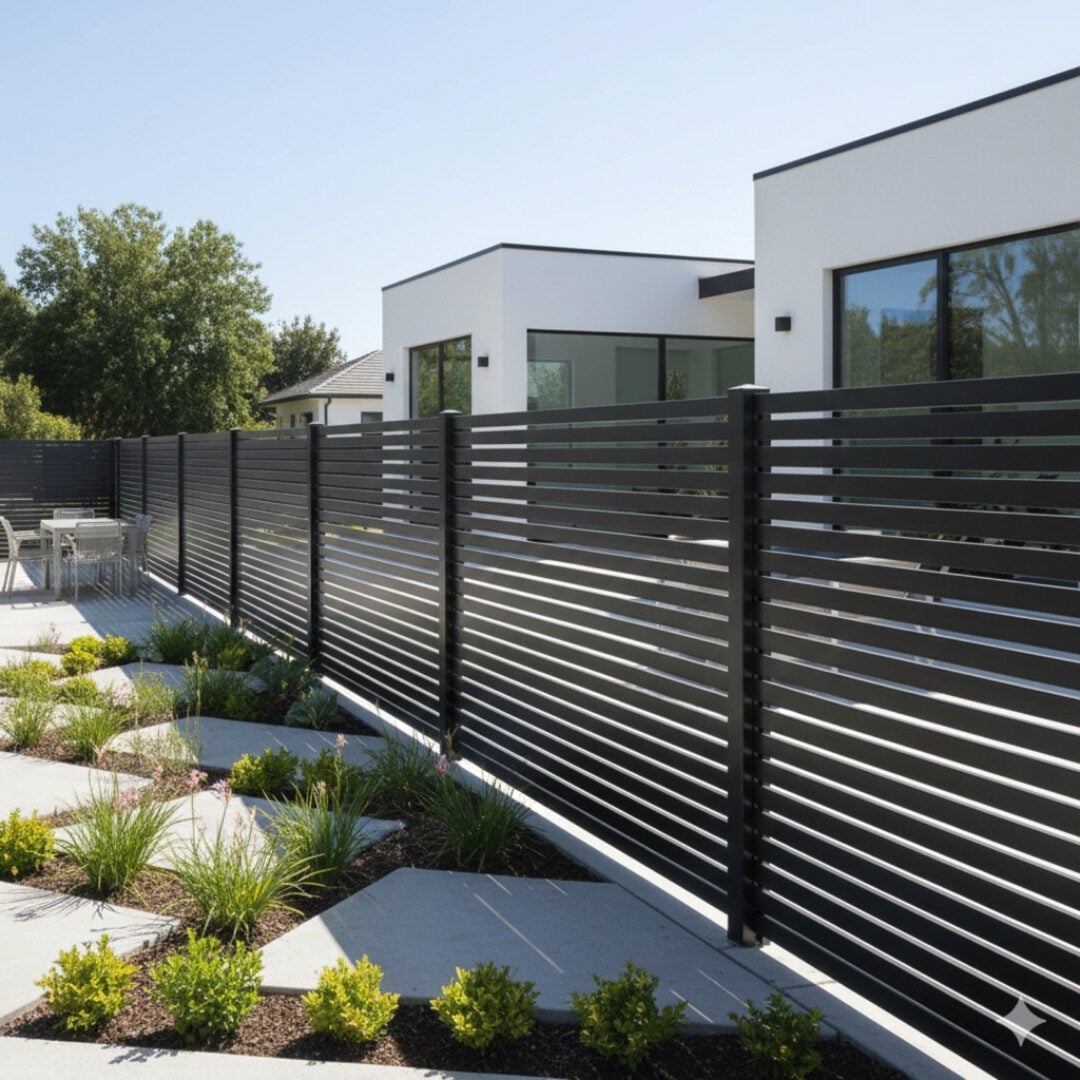
Can a black metal fence keep a backyard from feeling closed in? This horizontal slatted fence manages it by pairing the dark finish with a clean, open layout. The black horizontal slats run along the boundary, but the gaps between them let the eye travel through to the garden beds beyond. Concrete pavers at the base anchor the fence to the ground without adding visual weight.
The open layout works because the fence does not try to hide the yard; it defines the edge while the greenery does the screening. The grass and plants in front of the fence soften the transition from hardscape to garden, so the boundary line feels deliberate rather than harsh. For a modern backyard where privacy matters but the space is modest, this setup uses the fence as a frame for the plants, not a wall against them.
04 / 30Slatted Wood Fence Mounted on a Concrete Wall
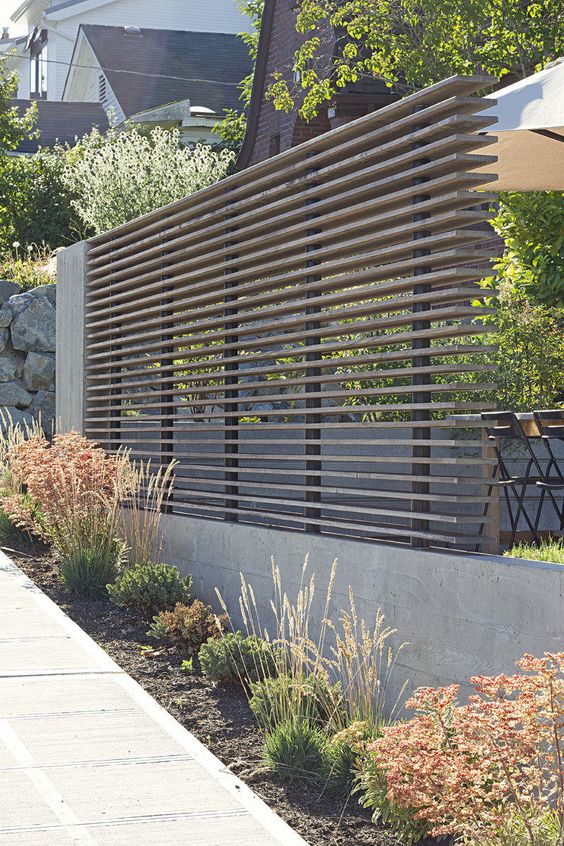
A concrete retaining wall already handles the heavy work of holding back soil, so a slatted wood fence mounted on top can focus on looks alone. The horizontal wood slats run along the sidewalk edge, with the concrete wall forming a solid base that keeps the wood off damp ground. Ornamental grasses in front soften the transition, mixing warm wood tones with green and pink foliage. For a yard on a slope, this setup solves two problems at once: the wall manages the grade, and the fence defines the boundary without needing extra posts deep in the dirt.
05 / 30Dark Gray Horizontal Slat Fence by the Poolside
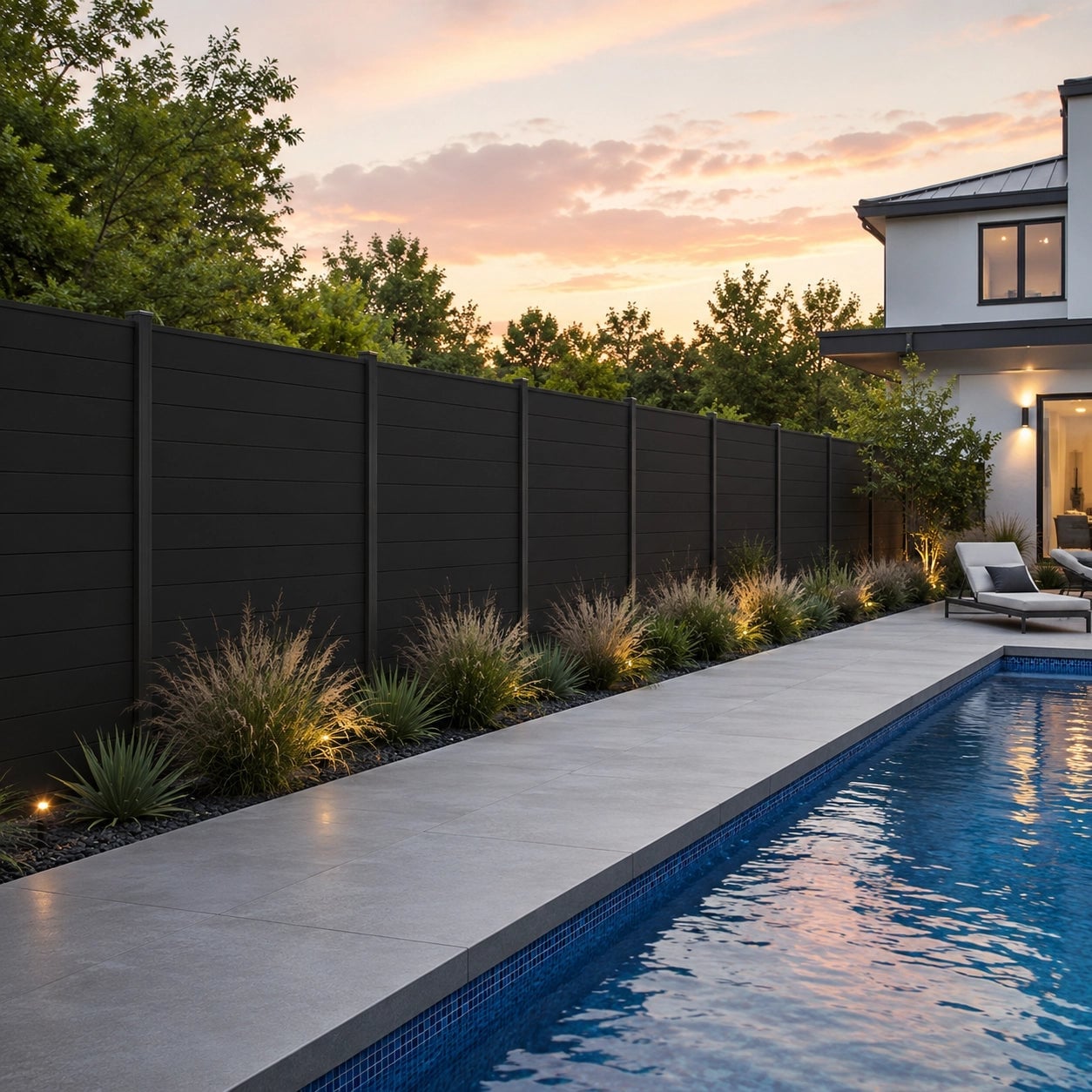
A dark gray horizontal slat fence by the pool needs a simple palette. The aluminum slats in matte dark gray match the lounge chair frames, while the pool water and white concrete deck keep the contrast clean. Evening landscape lights pick out the horizontal lines without spilling into the seating area, so the fence acts as a backdrop. The dark finish absorbs the low light, which helps the blue water and white tile stand out. For a pool yard where the fence needs to recede, keeping the palette to gray, blue and white keeps the space calm.
06 / 30Illuminated Horizontal Wood Slat Fence in a Backyard
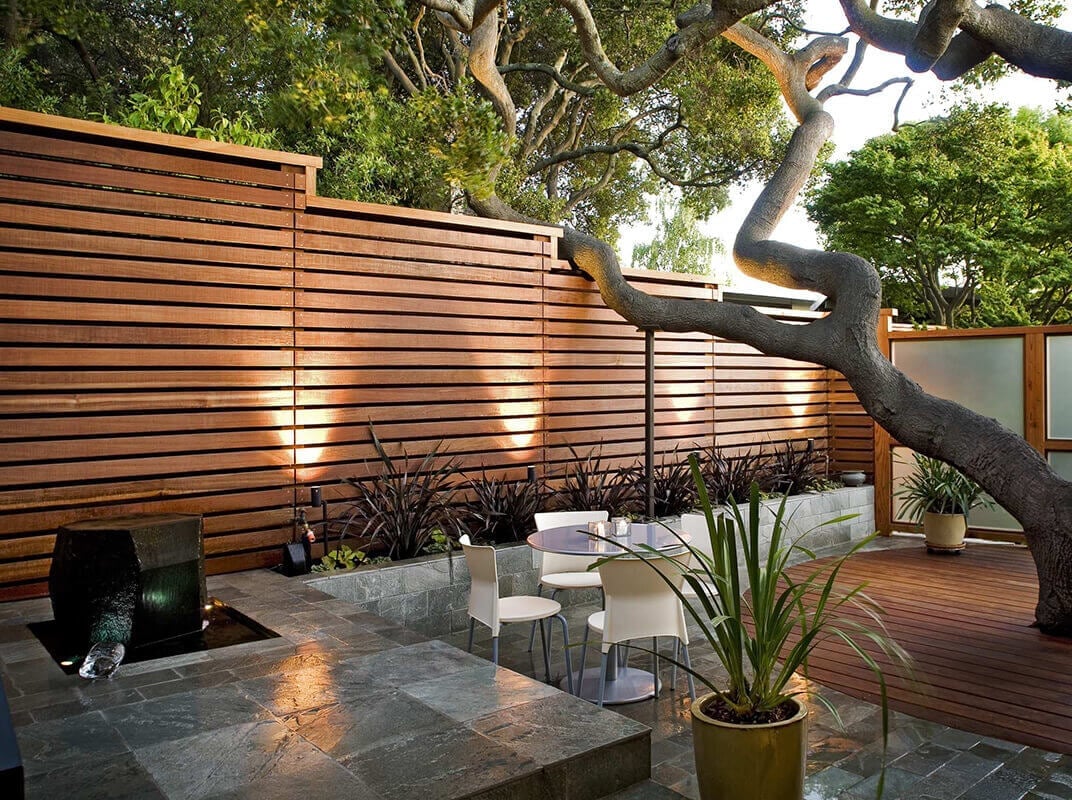
String lights get all the attention, but a fence with built-in lighting changes the whole backyard after dark. The warm wood tones of the horizontal slats catch the glow of accent lights mounted along the structure, creating a dramatic backdrop rather than a flat dark wall. Modern furniture on the patio and deck stays in shadow, letting the fence read as the main feature. The palette of gray and green from surrounding plants keeps the scene grounded. For a similar approach, ask an electrician to install low-voltage strip lighting along the top or bottom rail of an existing wood fence. It avoids the tangle of extension cords and gives the yard a finished look that works from spring through fall.
07 / 30Slatted Wooden Fence with Climbing Plants on a Patio
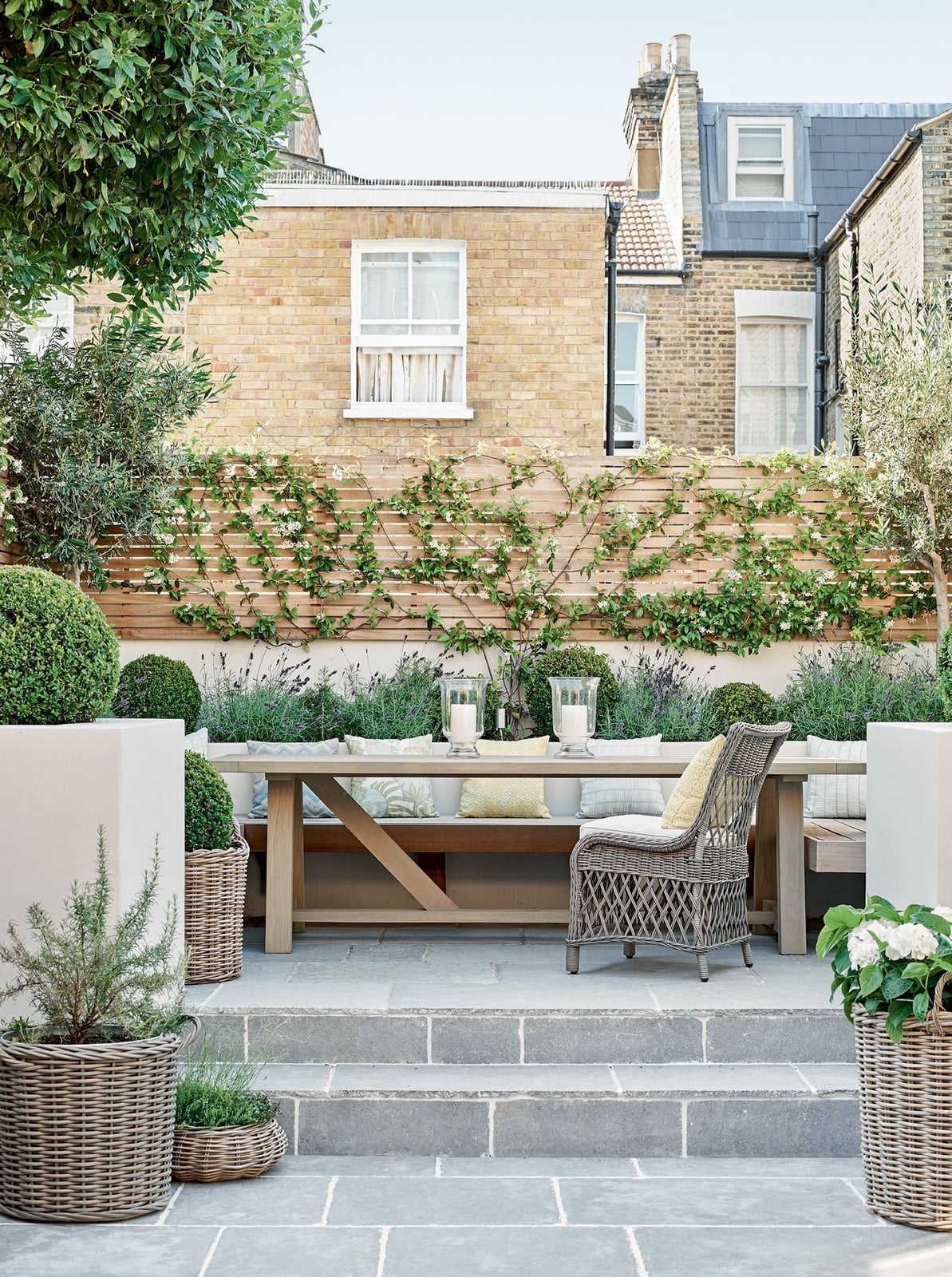
The horizontal slats already give the fence a clean line, and climbing plants soften that edge without hiding it. On this garden patio, the natural wood tones sit behind a dining table and bench, with planters at the base encouraging vines to weave through the gaps. The result is a living screen that adds privacy and texture. For renters, a freestanding trellis panel in the same warm wood finish can lean against an existing fence or wall. Choose a climbing plant suited to your USDA zone, and you get the same layered look without altering the structure.
08 / 30Dark Gray Horizontal Slat Fence Bordering a Patio
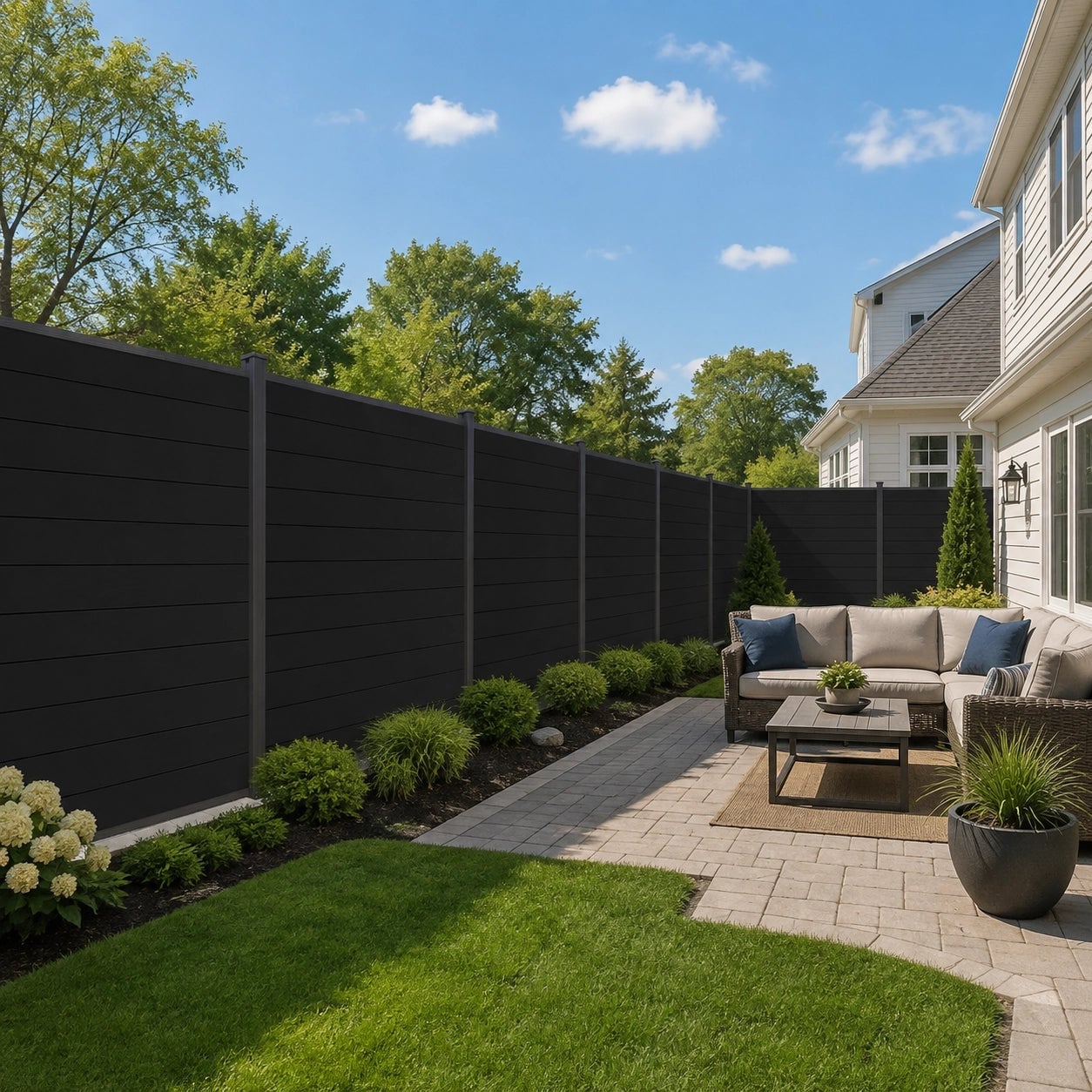
This fence does one job well: it defines the edge of the patio without closing it in. The dark gray horizontal slats run along the boundary, matching the tone of the outdoor sofa and letting the green garden and beige stone take visual priority. Aluminum construction keeps the profile slim, so the fence reads as a line rather than a wall. The layout works because the fence follows the patio’s edge and stops where the garden begins, creating a natural transition. Keep the fence color darker than the seating and lighter than the planting. The contrast makes the space feel larger.
09 / 30Integrated Slatted Wood Screens on a Modern Facade
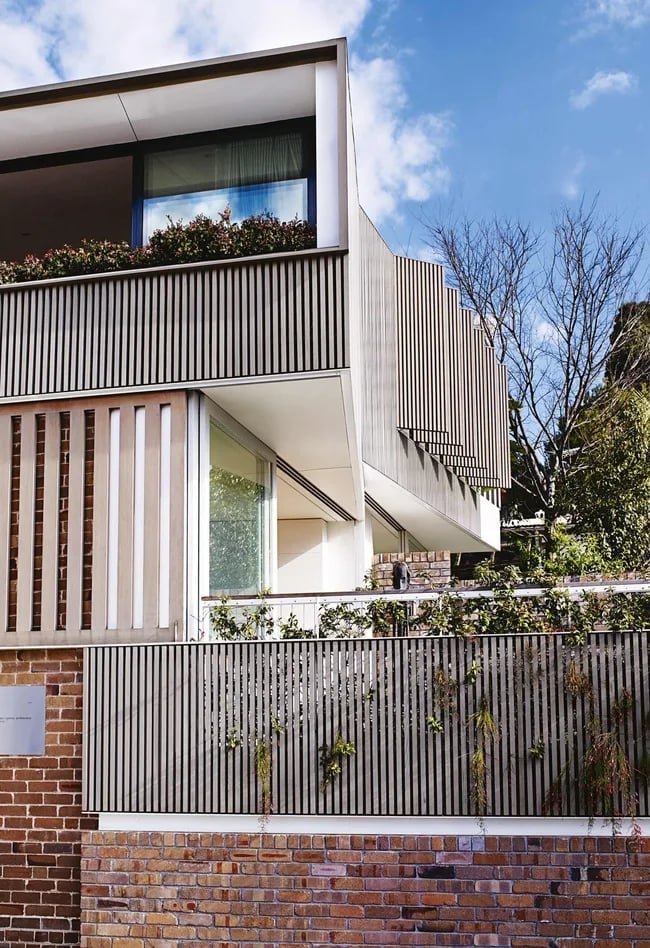
Can a fence be part of the house? These slatted wood screens wrap around the exterior, blending fence with facade. The curved wood elements break up the straight lines of the modern architecture, adding warmth against gray brick and glass. Bright sun casts changing shadows through the slats, so the house itself becomes part of the outdoor space. The integration means the screens provide privacy without a separate fence line. For a new build or major renovation, ask your architect about extending the siding material into the landscape. It unifies the property and removes the visual break between house and yard.
10 / 30Horizontal Wood Slat Fence with Black Metal Posts
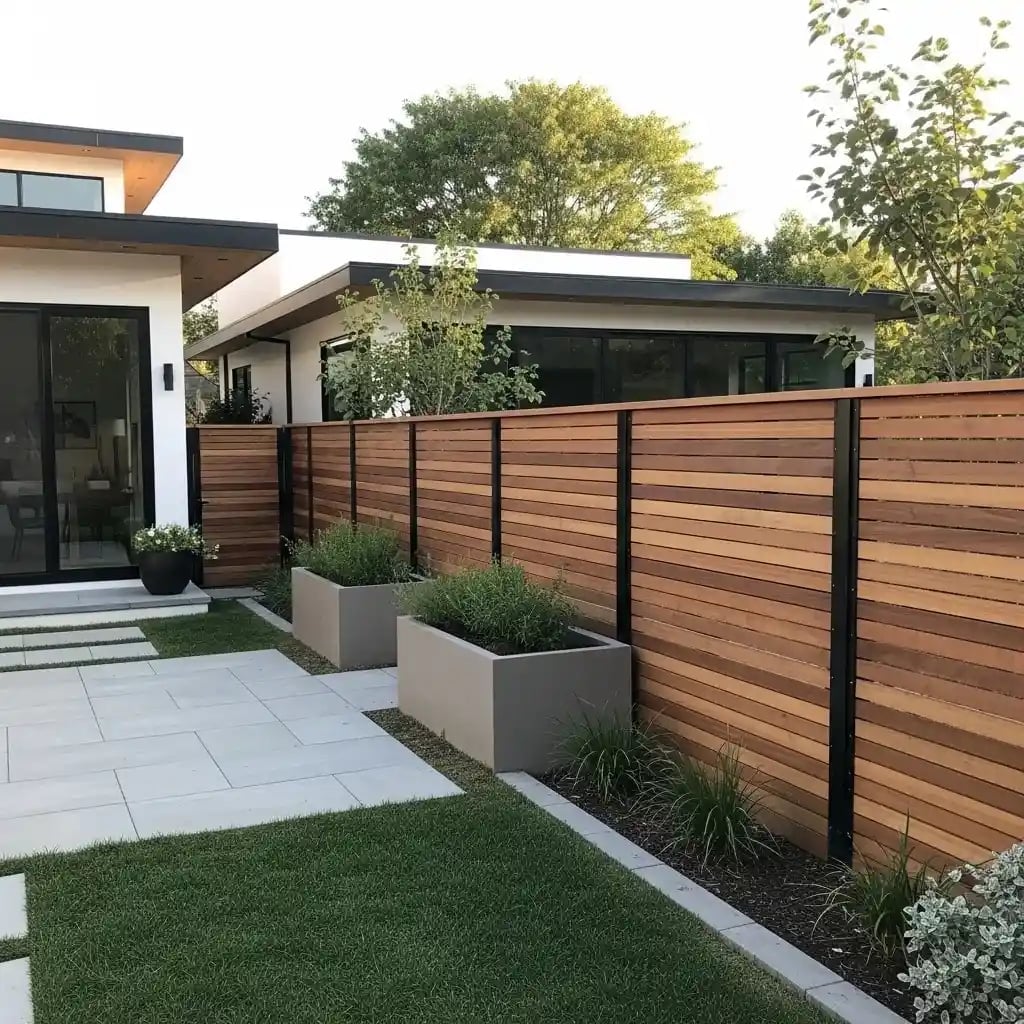
The wood slats run horizontally, but the black metal posts are what give this fence its structure and rhythm. The posts sit at regular intervals, breaking the long wood span into defined sections. Concrete planters at the base echo the dark metal tones and anchor the fence to the ground. The combination of warm wood and cool black metal keeps the design from feeling too rustic or too industrial. For a straightforward update, swap standard wood posts for powder-coated metal ones on your next fence repair. The thinner profile lets more light through and sharpens the overall line.
11 / 30Muted Teal Painted Horizontal Wood Fence
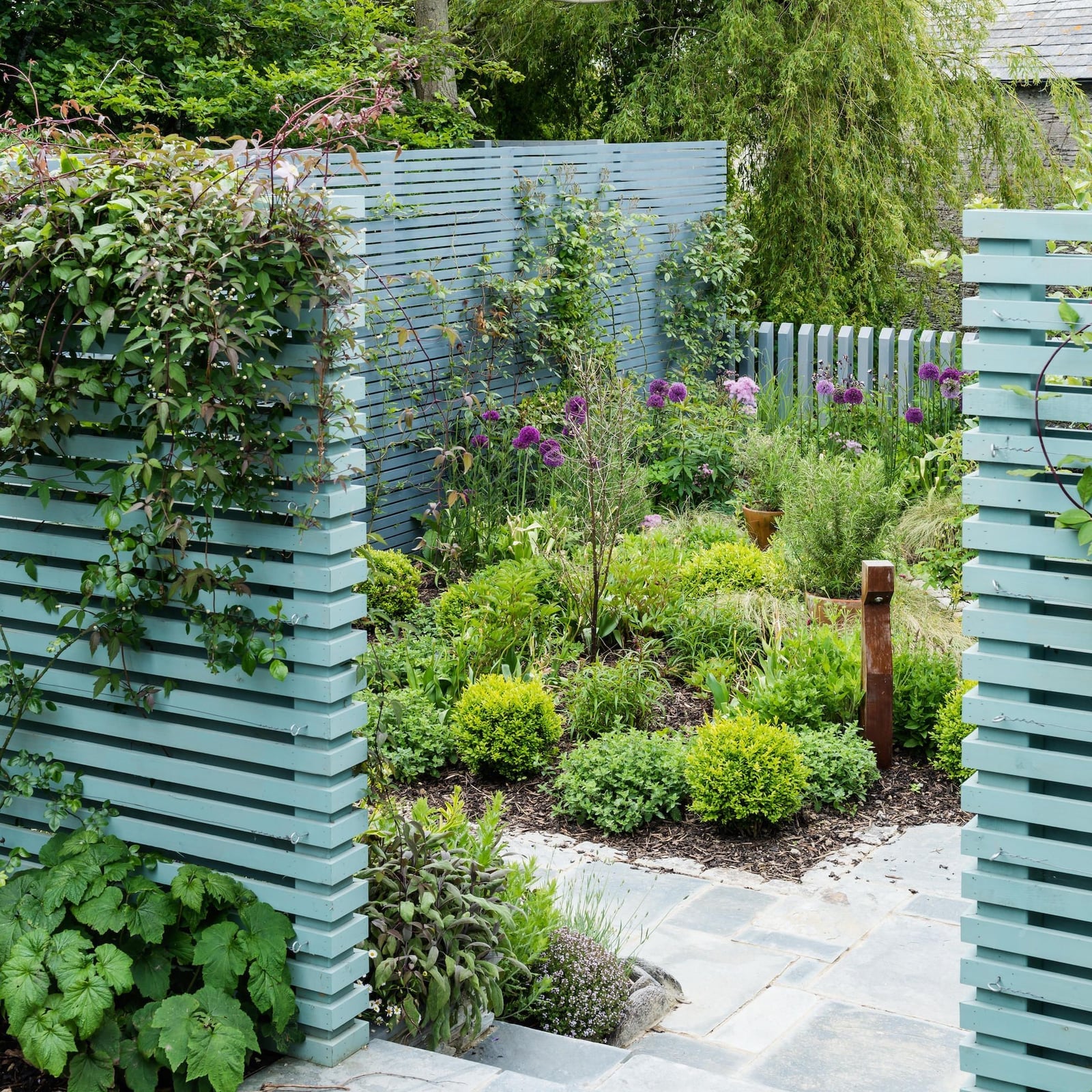
A painted fence can set the whole garden palette without touching a single plant. This muted teal horizontal wood fence runs along the boundary, while stone pavers in natural gray keep the ground neutral. The teal leans toward sage rather than bright blue, so it reads as an earthy accent instead of a bold statement. Green foliage nearby picks up the same undertone, making the whole garden feel coordinated. The palette rule here is simple: pick one color for the fence, then echo it in the plants. That keeps the fence from competing with the greenery and lets the garden itself do the decorating.
12 / 30Sleek Dark Gray Horizontal Slatted Fence with Pathway Lighting
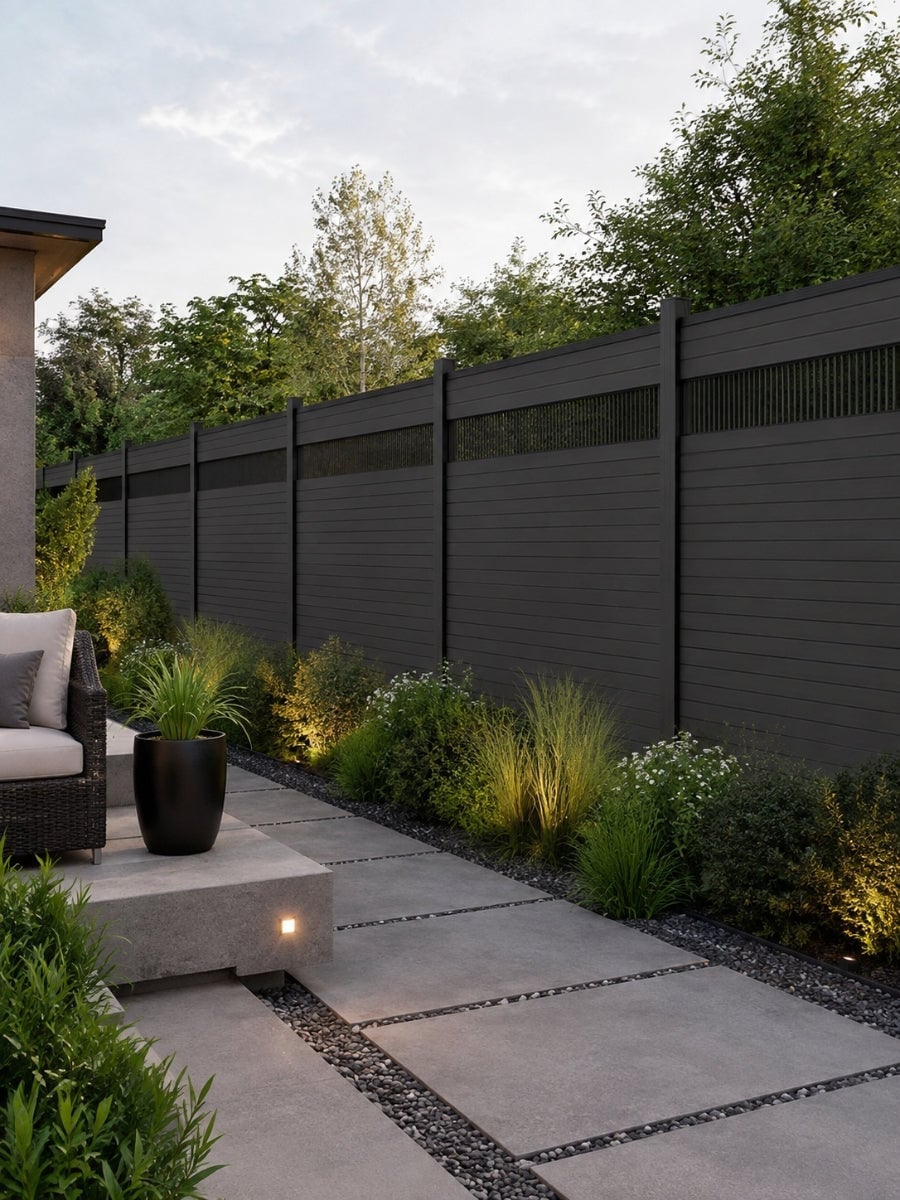
A dark fence can disappear at night if there is no light to define it. This sleek dark gray horizontal slatted fence avoids that by running low landscape lighting along the concrete pathway beside it. The lights cast a soft glow upward across the slats, so the fence becomes a textured wall instead of a dark void. An outdoor sofa sits on the gravel beyond the path, but the fence stays the main visual anchor.
Aim the lights at the fence itself, not away from it. Upward grazing light emphasizes the horizontal lines and keeps the backyard from becoming a black box after sunset. The pathway becomes both a walkway and a lighting fixture for the whole space.
13 / 30Modern Horizontal Wood and Black Metal Gate
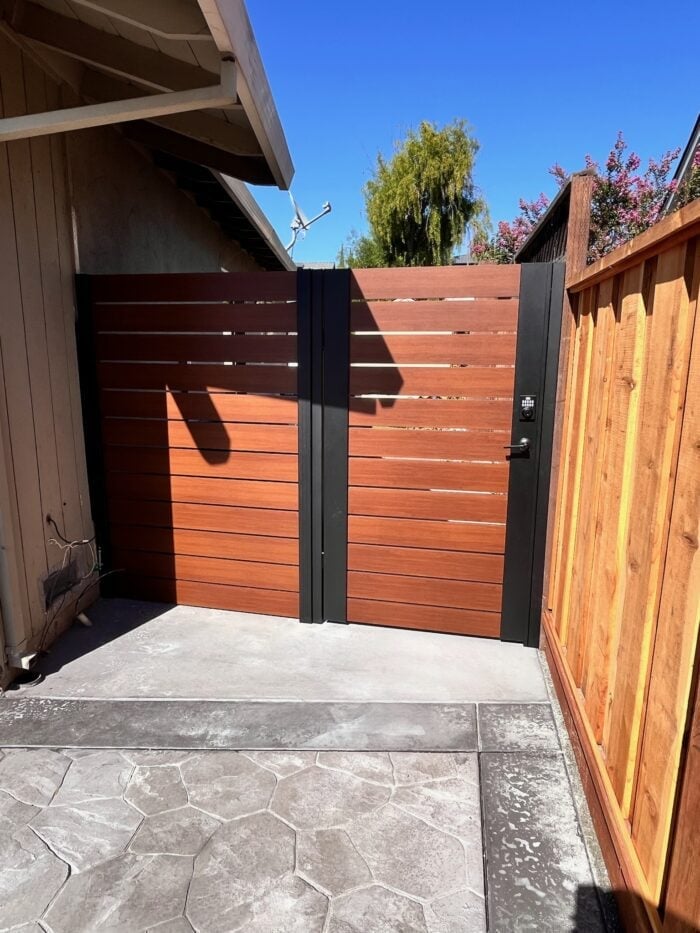
The gate uses horizontal wood slats set into a black metal frame, with the metal posts continuing into the adjacent fence. That shared material makes the gate feel like part of the fence rather than an afterthought. The strong daylight casts sharp shadows across the slats, which adds depth to what could otherwise read as a flat surface. A concrete wall behind the gate keeps the entryway compact and clean. The wood tones warm up the black metal, so the combination works for anyone who wants a modern look without going fully industrial.
14 / 30Horizontal Wood Slat Fence with Black Metal Gate and Tall Grasses
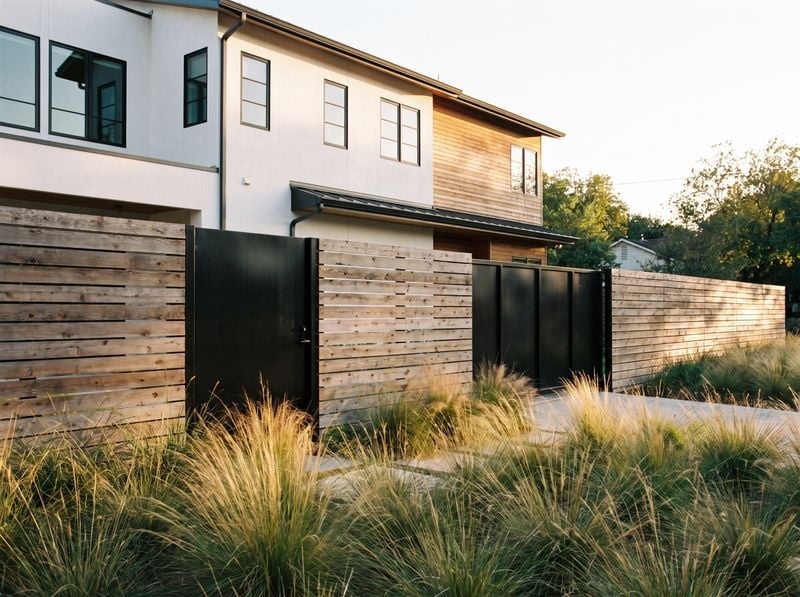
This front yard layout uses a horizontal wood slat fence and a black metal gate to create a clear entry point, with tall ornamental grasses softening the transition. The golden hour light hits the slats and the gate at an angle, so the shadows fall across the stone path rather than straight down. That makes the fence line feel deeper than it is. The grasses rise above the top of the slats, which breaks the horizontal line just enough to keep the yard from looking too rigid. For a similar setup, place the tallest plants near the gate to frame the entrance without blocking it.
15 / 30Black Horizontal Slat Fence with Minimalist Seating
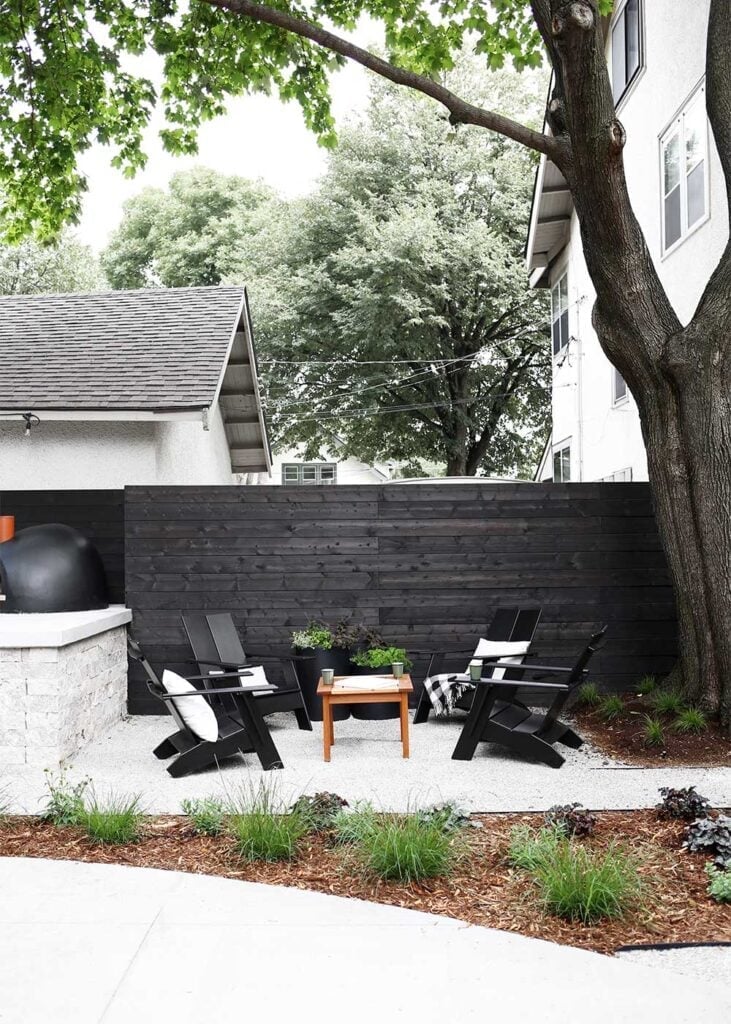
A solid black horizontal wood fence can dominate a small backyard, so the seating needs to stand up to it. Here, two black Adirondack chairs and a small wood table sit on gravel against the fence, with a stone path leading to them. The chairs match the fence in color, so the seating area reads as part of the fence rather than furniture placed in front of it.
That is the trick with a dark fence in a compact space: let the furniture follow the same palette. White or light wood chairs would pop against the black slats, but matching black keeps the eye moving along the fence line instead of stopping at each piece. The wood table adds just enough warmth to keep the setup from feeling like a solid black wall.
16 / 30Curved Slatted Wood Facade Elements in Modern Architecture
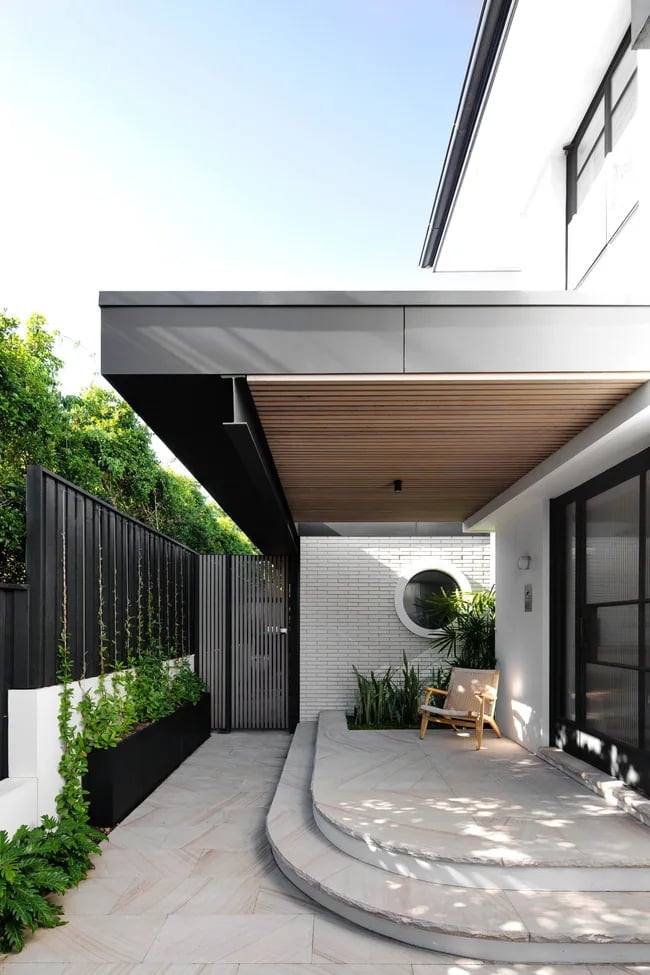
Curved slatted wood elements turn a flat facade into a surface that shifts with the sun. The wood screens wrap around the exterior, bending in a gentle arc that breaks the rigid lines of the metal and glass structure. Bright daylight casts changing shadows through the slats, so the wall reads as deeper than it is. For a modern house where the street side feels too exposed, a curved wood screen adds privacy without blocking light or views. The natural wood tones warm the gray brick and white trim, making the fence feel like part of the architecture rather than an add-on.
17 / 30Horizontal Wood Fence with Integrated Bamboo for Privacy
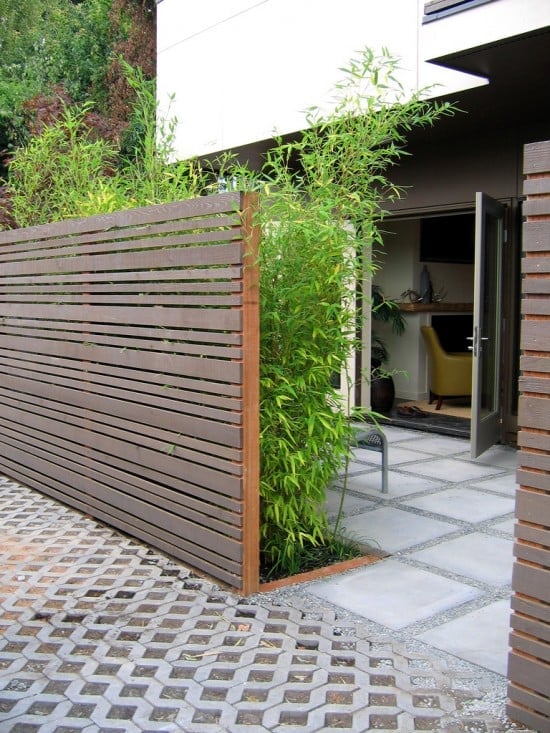
A horizontal wood fence can only block so much on its own, but adding bamboo directly in front doubles the privacy without rebuilding anything. The bamboo grows in a narrow bed between the fence and the patio, its vertical stalks breaking up the horizontal wood slats. The brown wood and green bamboo share a natural palette, so the combination looks like a planned design. For renters who cannot alter the fence itself, planting a row of bamboo in large concrete planters along the base creates the same layered screen. The roots stay contained in the planters, and the stalks can be trimmed to keep them below the top of the wood.
18 / 30Slatted Wood Fence with Geometric Design and Water Feature
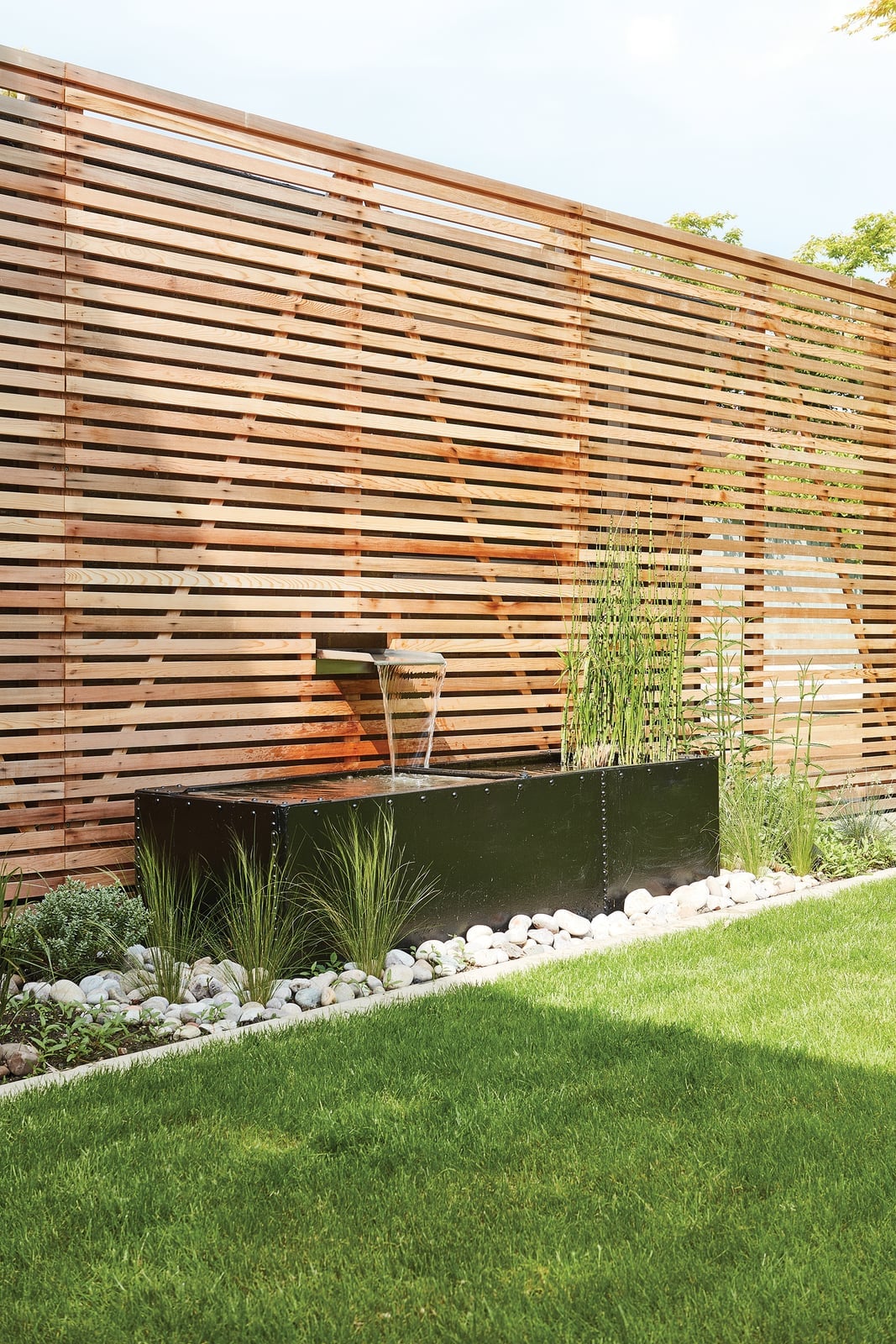
A slatted wood fence with a geometric water feature works differently from a fence that just runs straight across the yard. The horizontal wood slats keep the boundary clean, while the water feature sits at the base in a black metal planter with clean right angles. The sound of moving water adds a layer that the fence alone cannot provide, making the garden feel cooler and more enclosed without closing it in.
The geometric planter breaks the long horizontal line of the slats, giving the eye a place to rest. The black metal of the planter echoes the dark tones in the stone path, so the garden reads as a connected space rather than separate zones. For a yard where the fence runs on for too long without a visual pause, adding a water feature at the base creates a natural break in the line.
19 / 30Modern Horizontal Wood Fence at Home Entryway
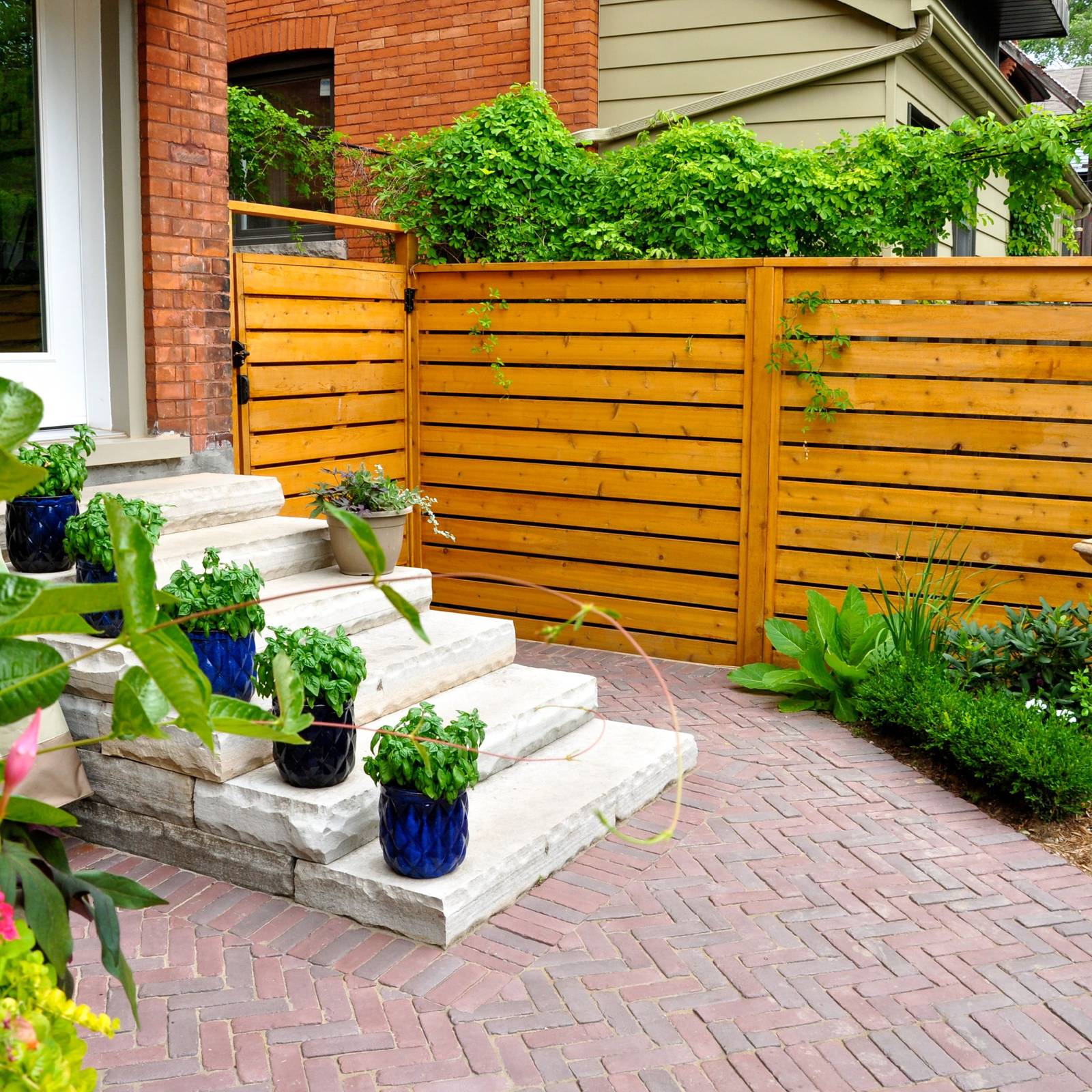
A horizontal wood fence at the entryway sets the tone for the whole property before anyone reaches the front door. The warm wood tones run in clean lines alongside the brick facade, with stone steps leading up from the path. The fence acts as a guide rather than a wall, keeping the sightline open toward the house and the greenery around it. For a front yard that needs definition without a solid barrier, this layout works because the fence stays low enough to see over while still marking the boundary between the walkway and the planted beds.
20 / 30Slatted Wood Pergola with Vertical Garden Wall
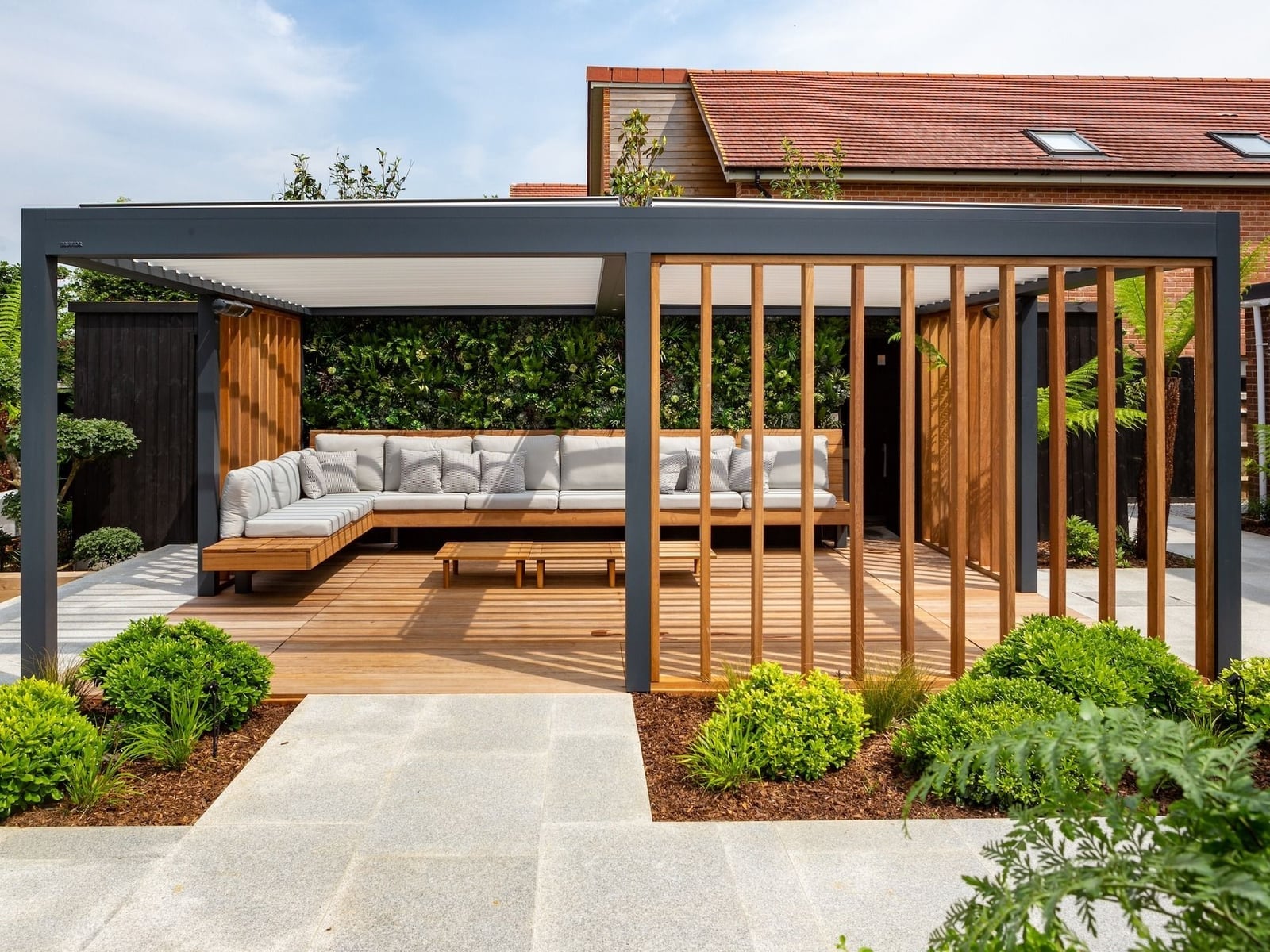
A slatted wood pergola paired with a vertical garden wall makes a patio feel enclosed without losing the open air. The gray metal frame of the pergola supports wood slats overhead, while the integrated green wall along one side adds privacy at eye level. A sectional sofa sits beneath the structure, and the natural light filters through the slatted screens to keep the seating area bright. What makes the scale work is the vertical garden matching the height of the pergola supports, so the whole setup reads as one piece rather than a canopy floating above a separate planter. That proportion keeps the patio from feeling top-heavy or cramped.
21 / 30Dark Gray Aluminum Fence with Horizontal Slats
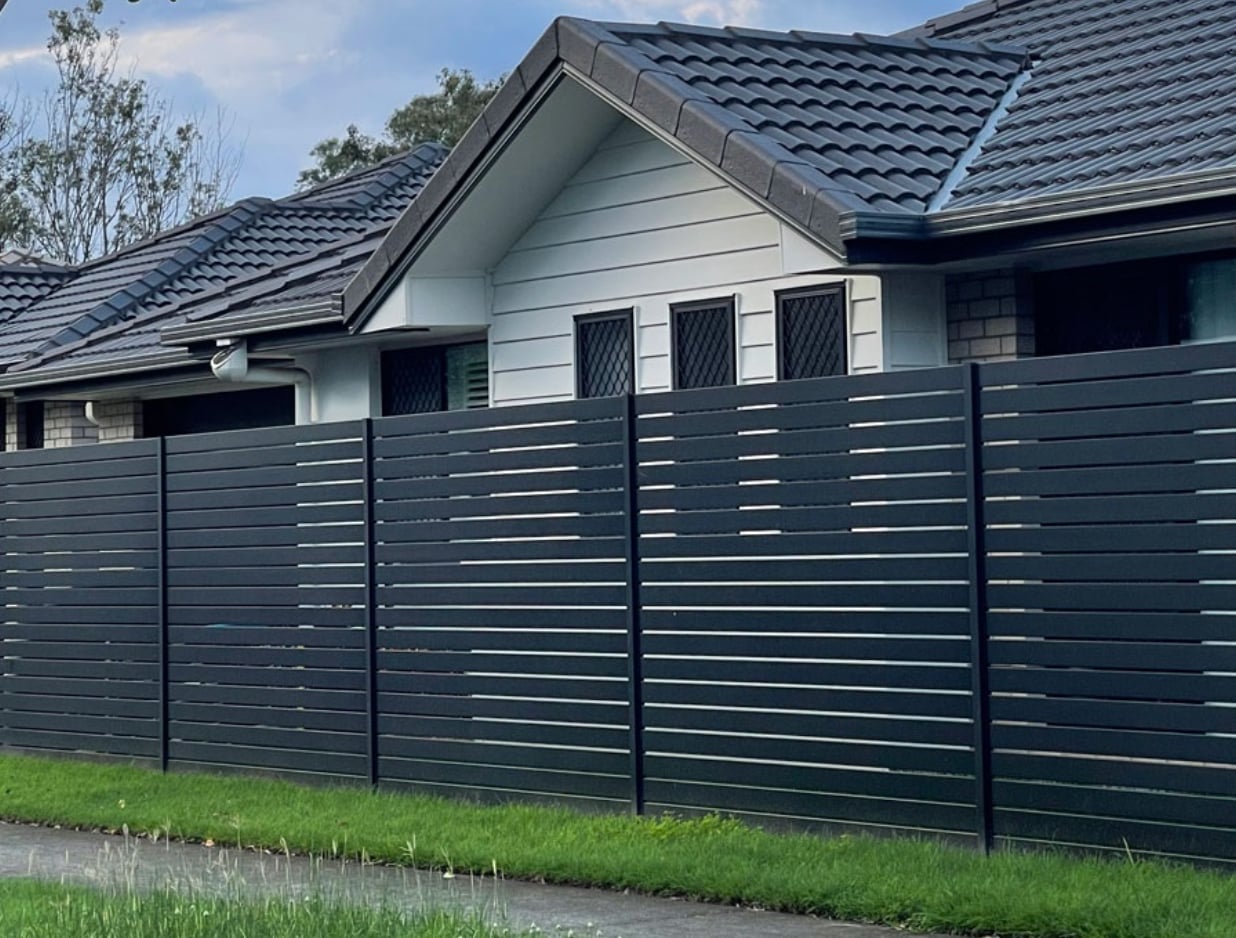
A dark gray aluminum fence with horizontal slats keeps the boundary line clean while the house and yard do the talking. The matte finish reads as a neutral plane, so a white modern house and green grass stay the main event. Aluminum won’t warp or rot the way wood can in wet climates, and the slat spacing lets light through without giving up privacy. For a front yard where the architecture is the focal point, a fence that recedes into the background is the practical choice.
22 / 30Lit Horizontal Slatted Wooden Fence in Backyard at Dusk
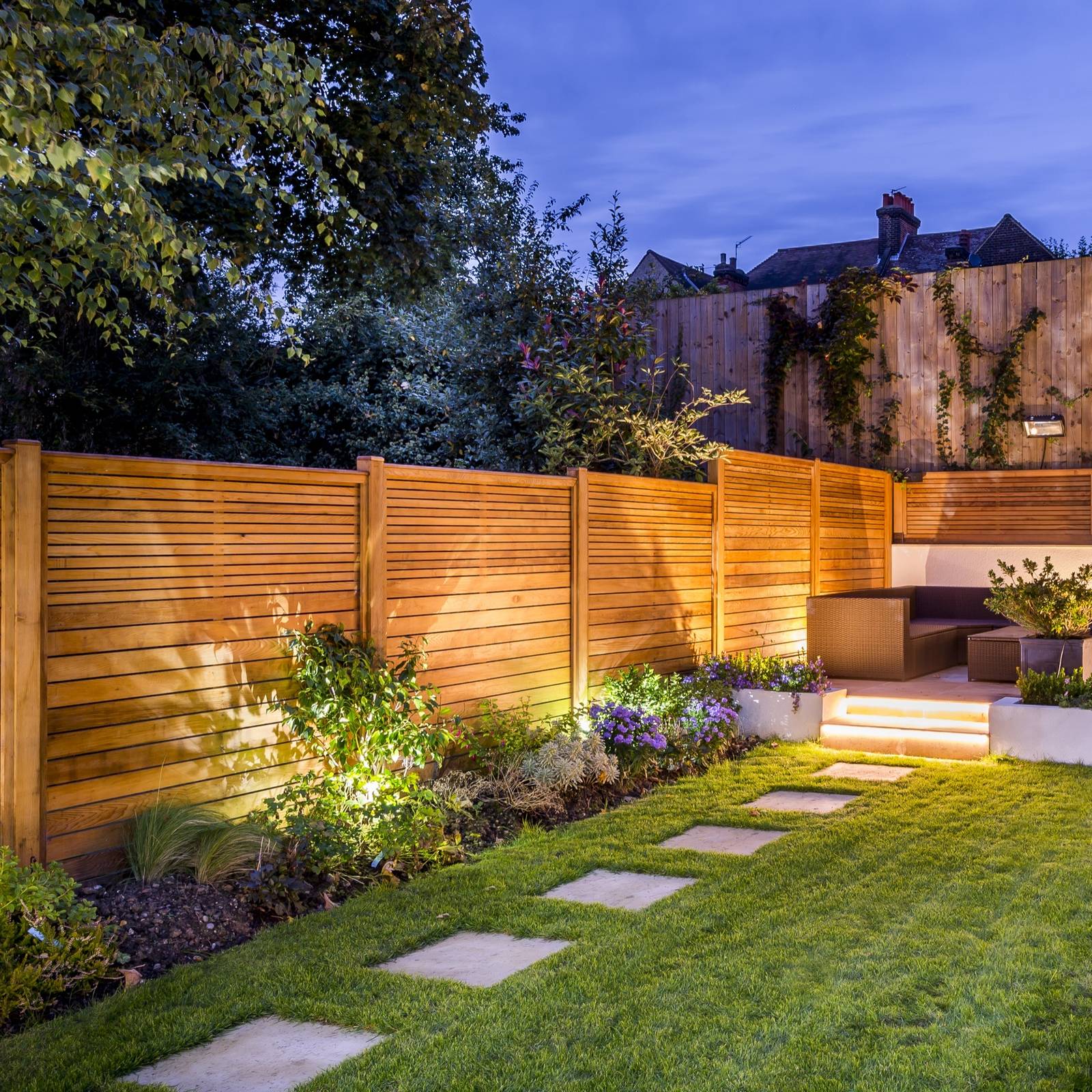
Warm wood tones on a horizontal slatted fence catch integrated garden lights at dusk, turning the backyard boundary into a soft glow rather than a hard edge. The light washes across the slats, not straight out, so the seating area and stepping stones stay usable without glare. It is a lighting trick that makes a roomy lawn feel enclosed without feeling closed in.
23 / 30White Horizontal Slat Fence Integrated into Stucco Wall
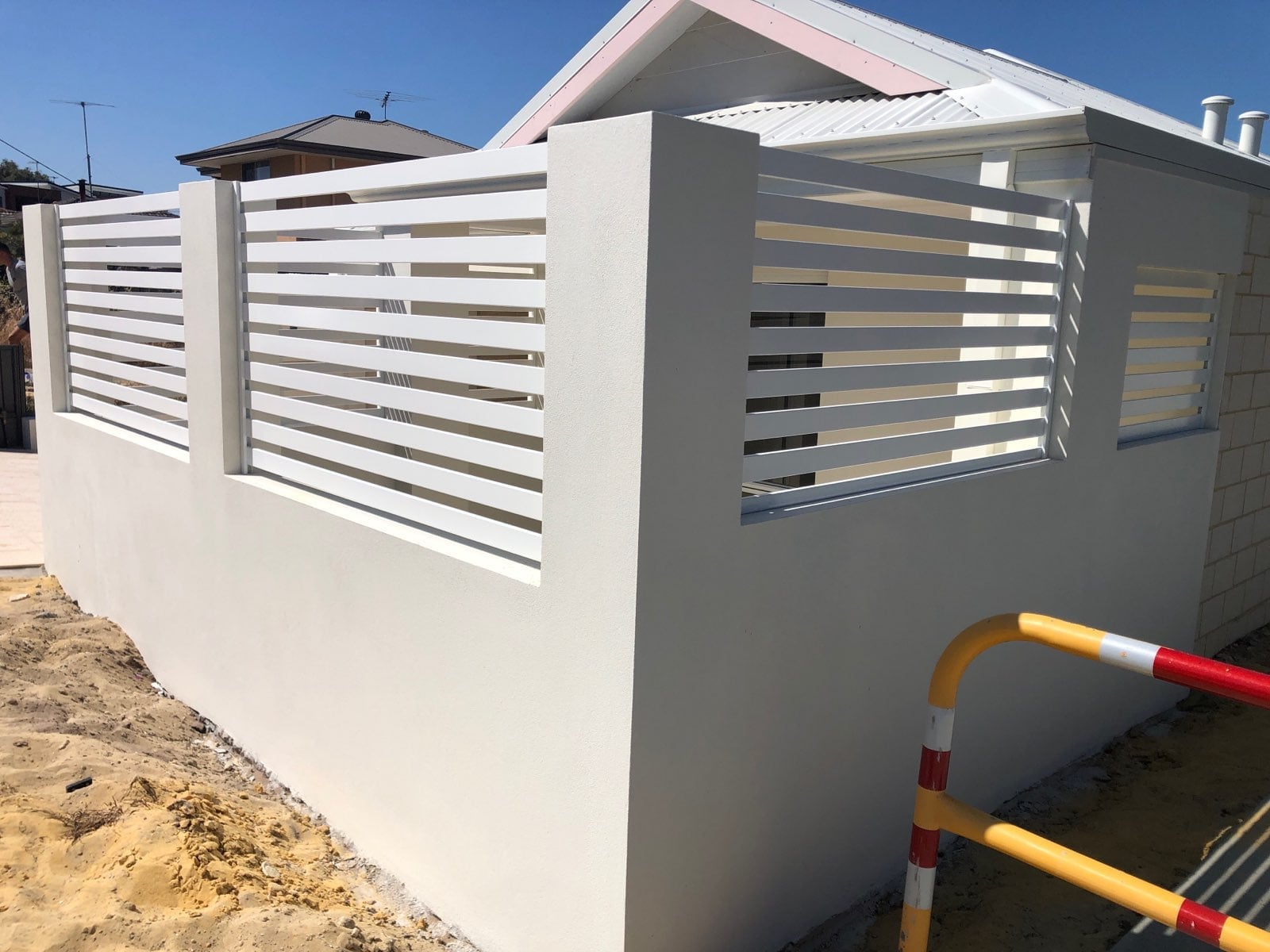
A white horizontal slat fence that meets a stucco wall erases the line between fence and house. The same cream-white palette across both surfaces makes the metal slats look like a deliberate extension of the wall rather than an add-on. For a front yard where the architecture is minimal, this kind of material match keeps the eye moving smoothly instead of stopping at a transition. It is a detail that works best when the stucco and fence finish are tuned to the same undertone.
24 / 30Dark Horizontal Slatted Fence Along a Garden Path
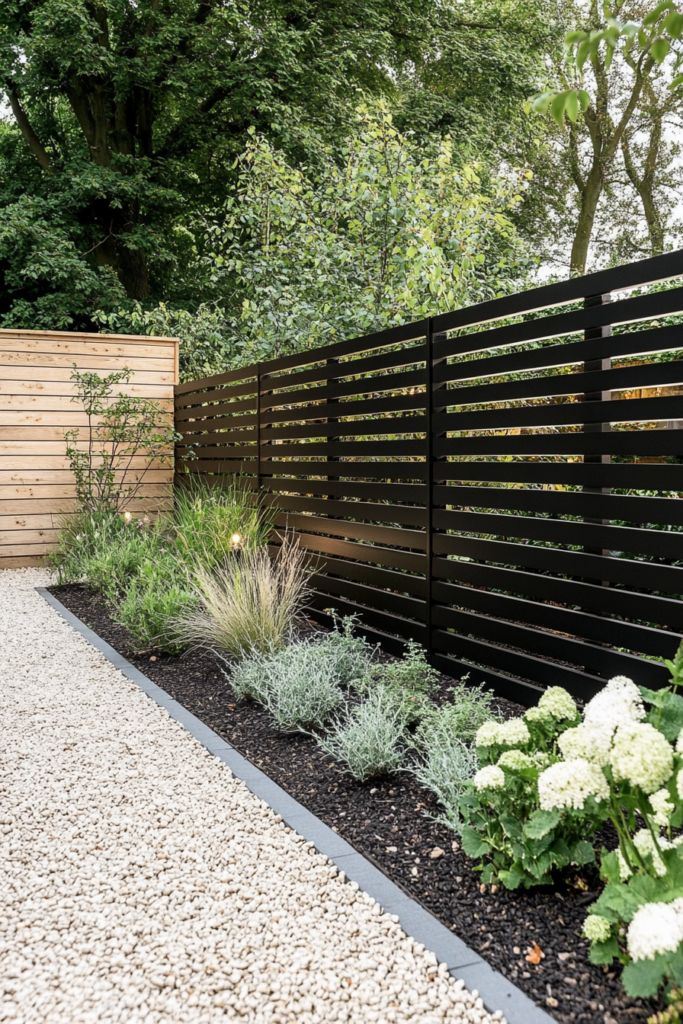
A dark horizontal slatted fence reads differently along a garden path than it does across a wide lawn. Against gravel and stone, the black wood acts as a visual anchor, drawing the eye forward along the walkway instead of stopping it. Subtle garden lights at the base pick out the slat edges, so the fence stays present without dominating. The contrast between dark wood and green planting keeps the path from feeling like a tunnel, even in a narrow stretch.
25 / 30Modern Horizontal Wood Fence with Black Metal Gate, Close-Up Take
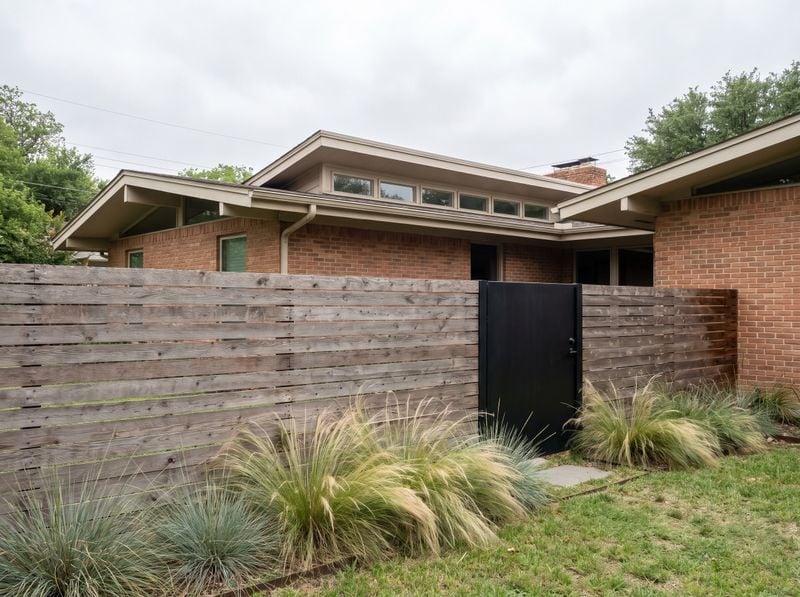
The close spacing of horizontal wood slats on this modern front fence creates a rhythm that a solid panel cannot match. Against the black metal gate, the natural wood tones read as warm and layered, not rustic. Overcast daylight softens the contrast, so the fence and gate sit together as a single composition rather than competing for attention. It is a palette that works for an entryway where you want privacy without a fortress feel.
26 / 30Sleek Black Fence with Horizontal Wooden Slats
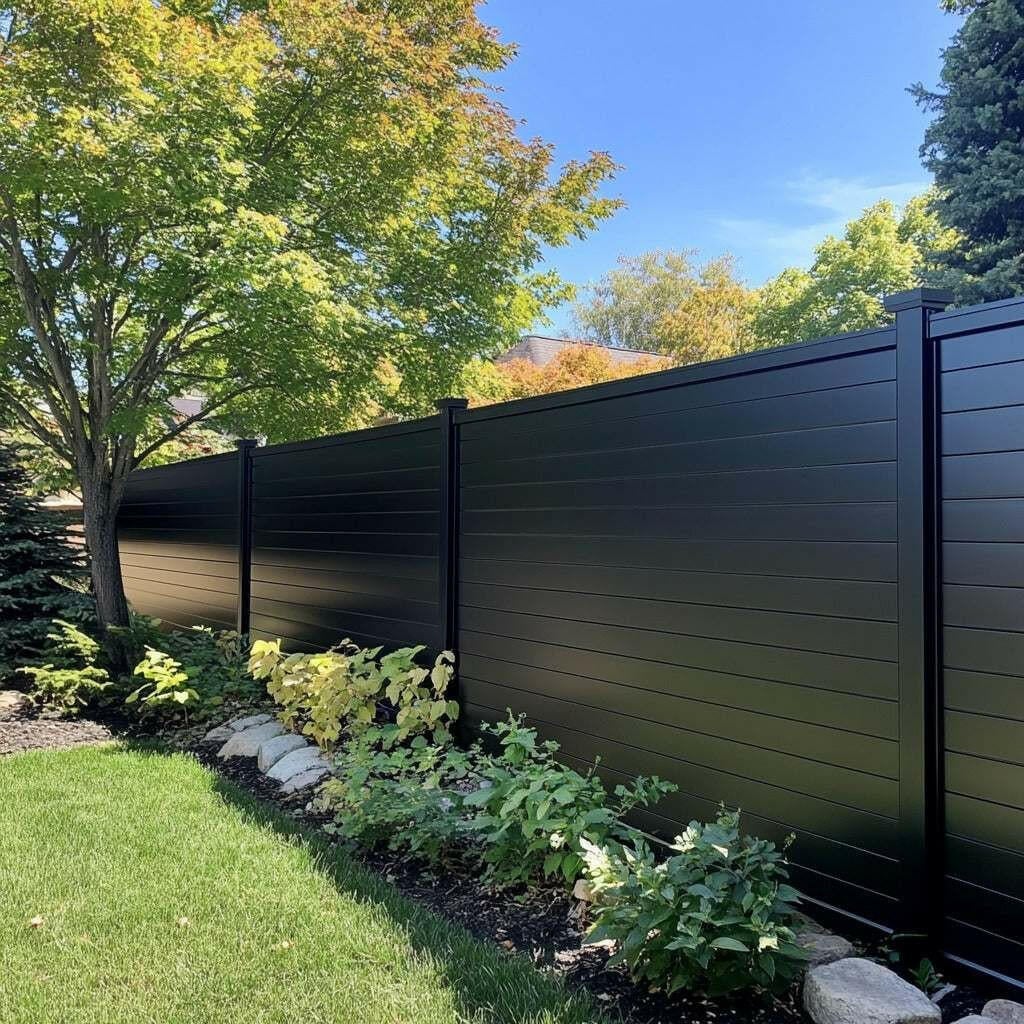
A black fence with horizontal wooden slats is a straightforward way to add modern curb appeal without a full rebuild. The dark finish recedes into the landscape, letting the greenery in front of it stand out. The wood slats bring warmth that a solid metal panel would skip, and the gap between each board keeps the fence from feeling like a wall. For a similar look on a tighter timeline, ask about pre-finished black aluminum slat panels with a wood-grain emboss. They read as wood from a few feet away but skip the staining and sealing that real wood demands each year. The result is the same clean line across the yard, just with less upkeep over time.
27 / 30Modern White Fence with Vertical Panels and Wood Inlays
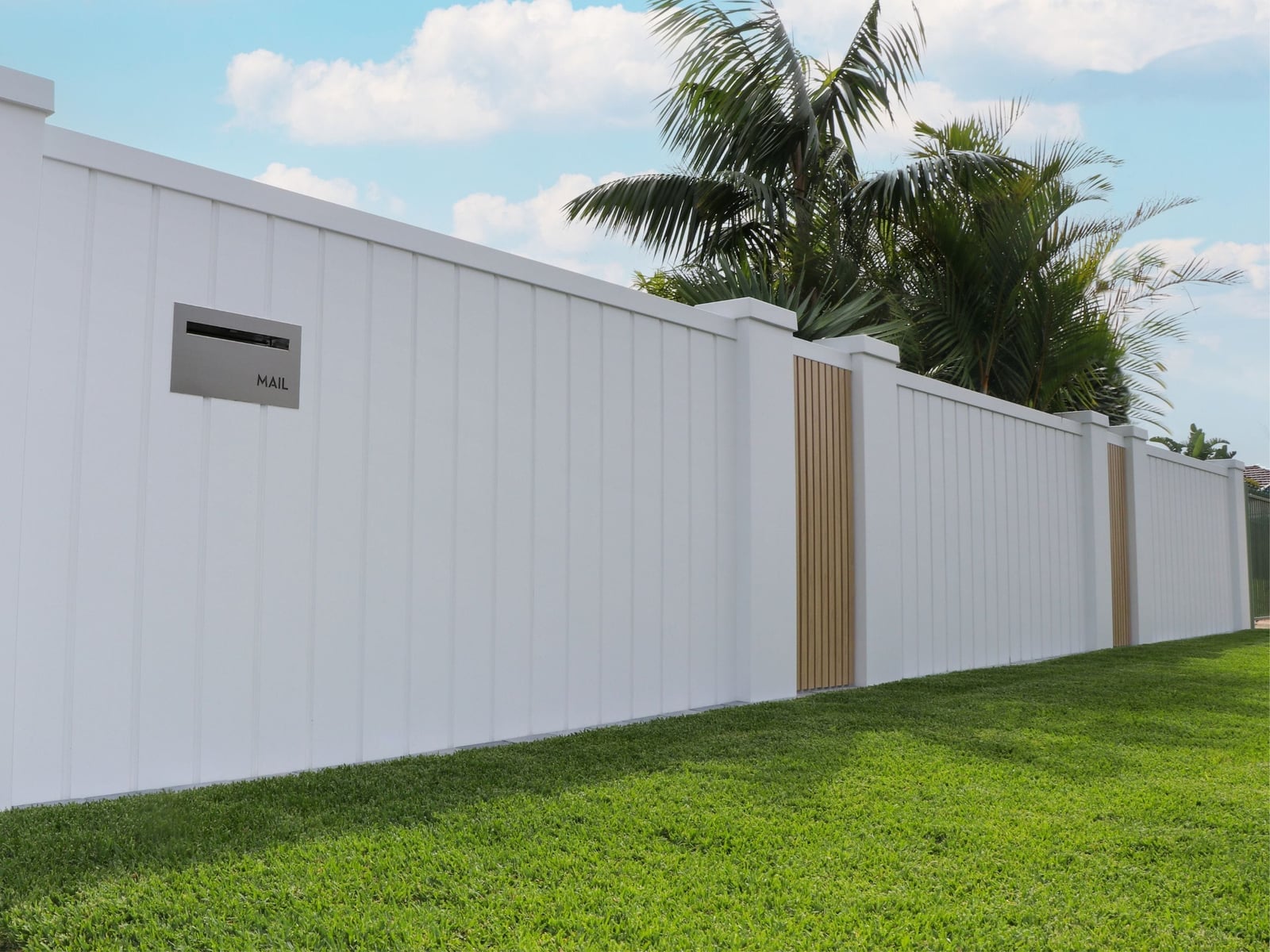
A white fence often reads as traditional, but this version with vertical panels and slim wood inlays shifts it into modern territory. The white sections keep the boundary bright and open, while the wood strips break up the surface just enough to add texture. An integrated mailbox built into the paneling shows how the fence can pull double duty without looking cluttered.
For renters or anyone hesitant to commit to a permanent structure, freestanding composite lattice panels in white offer a similar effect. They sit on the ground without posts or concrete, and the vertical lines echo the paneled look. Adding a few thin wood strips to the face with outdoor construction adhesive mimics the inlay detail without cutting into the original material. When it is time to move, the panels come down in minutes and leave no trace on the property line.
28 / 30Horizontal Slatted Wood Fence in Sunset Light
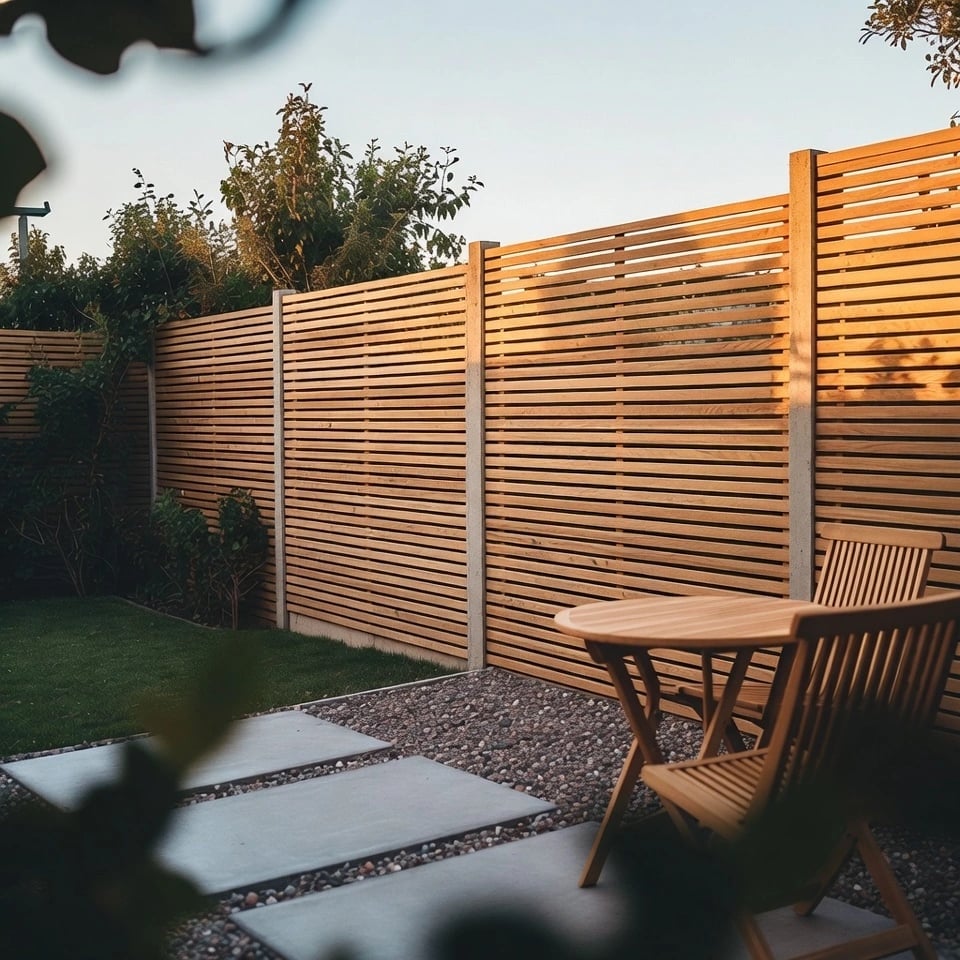
The warm light at sunset turns a horizontal slatted wood fence into a backdrop that shifts throughout the evening. The low angle catches the grain of the wood and casts long shadows through the gaps, making the fence feel deeper than it is. A simple wooden table and chairs placed along the fence line turn that glow into a natural dining spot. The key is to keep the fence untreated or oiled rather than painted, so the wood can reflect the changing light instead of fighting it.
29 / 30Modern Horizontal Slat Wooden Fence Under Construction
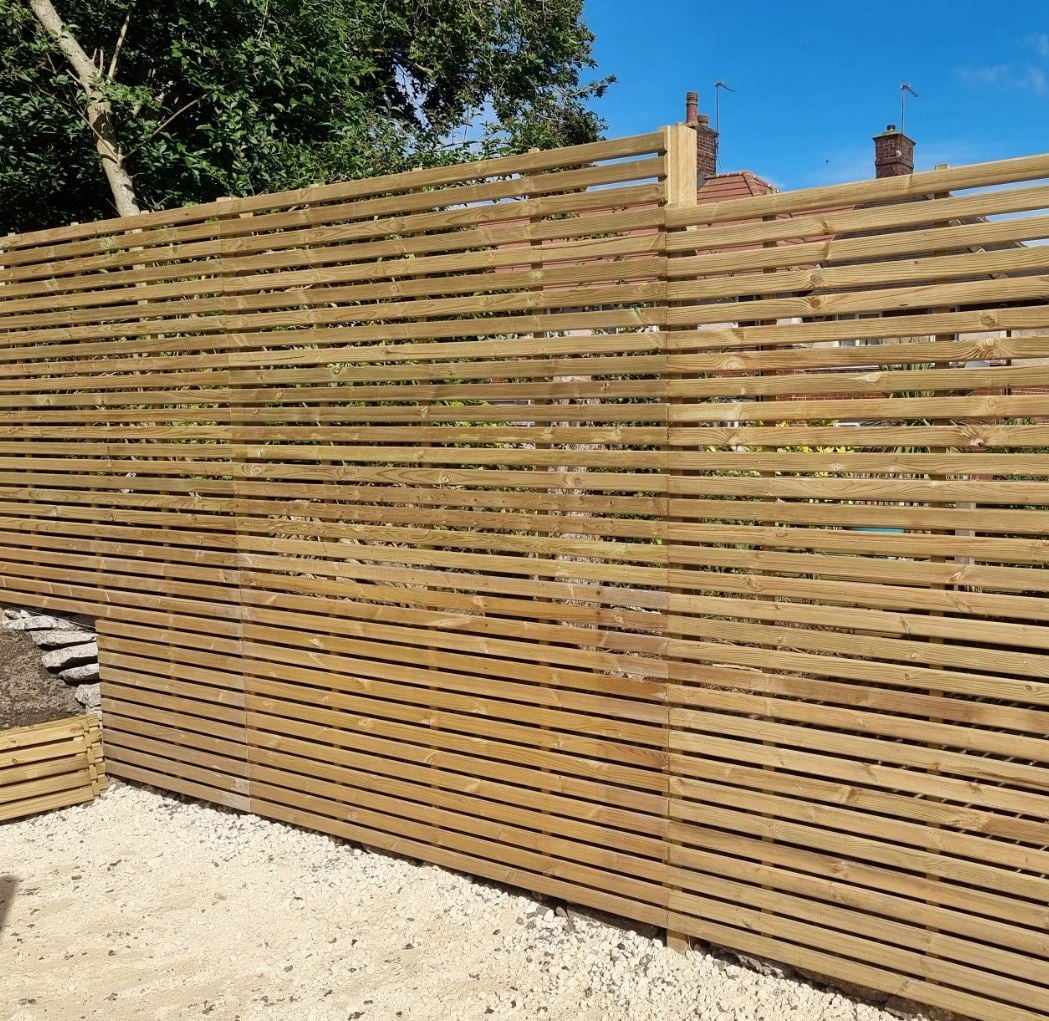
A horizontal slat fence under construction reveals what makes it last: the spacing between boards and the material underneath. In this setup, the wood slats sit on a gravel base rather than bare soil, which keeps moisture from wicking up into the ends of the boards. That gap also allows air to circulate behind the fence, reducing the rot that traps water against solid panels. The stacked lumber nearby suggests the build uses cedar or a similarly rot-resistant species, which holds up longer in ground contact without chemical treatment. For anyone planning a new fence, laying a gravel trench before the posts go in adds years to the lifespan of the wood.
30 / 30Final Thoughts
A modern fence works best when its lines stay clean and its materials feel grounded. Across these 29 ideas, the common thread is simplicity: horizontal slats, dark metals, and wood tones that don’t compete with the landscape. Whether you choose a rusted screen for character or a sleek black gate for contrast, the fence becomes the anchor. Before you commit, check your local zoning rules and talk to a contractor about setbacks and height limits. If you’re renting, consider a freestanding panel system that doesn’t require permanent posts. The takeaway is straightforward: let the fence lead, and the rest of the yard will follow.