A garden is more than plants. It is a room without walls, and the art you place there sets the mood.
These 26 garden art ideas prove that outdoor decor can be as personal and deliberate as anything inside your home. From sculptural metal pieces to upcycled finds, expect a range of looks that add character to beds, paths, and fences.
01 / 27Illuminated Metal Spheres for Contemporary Garden Ambiance
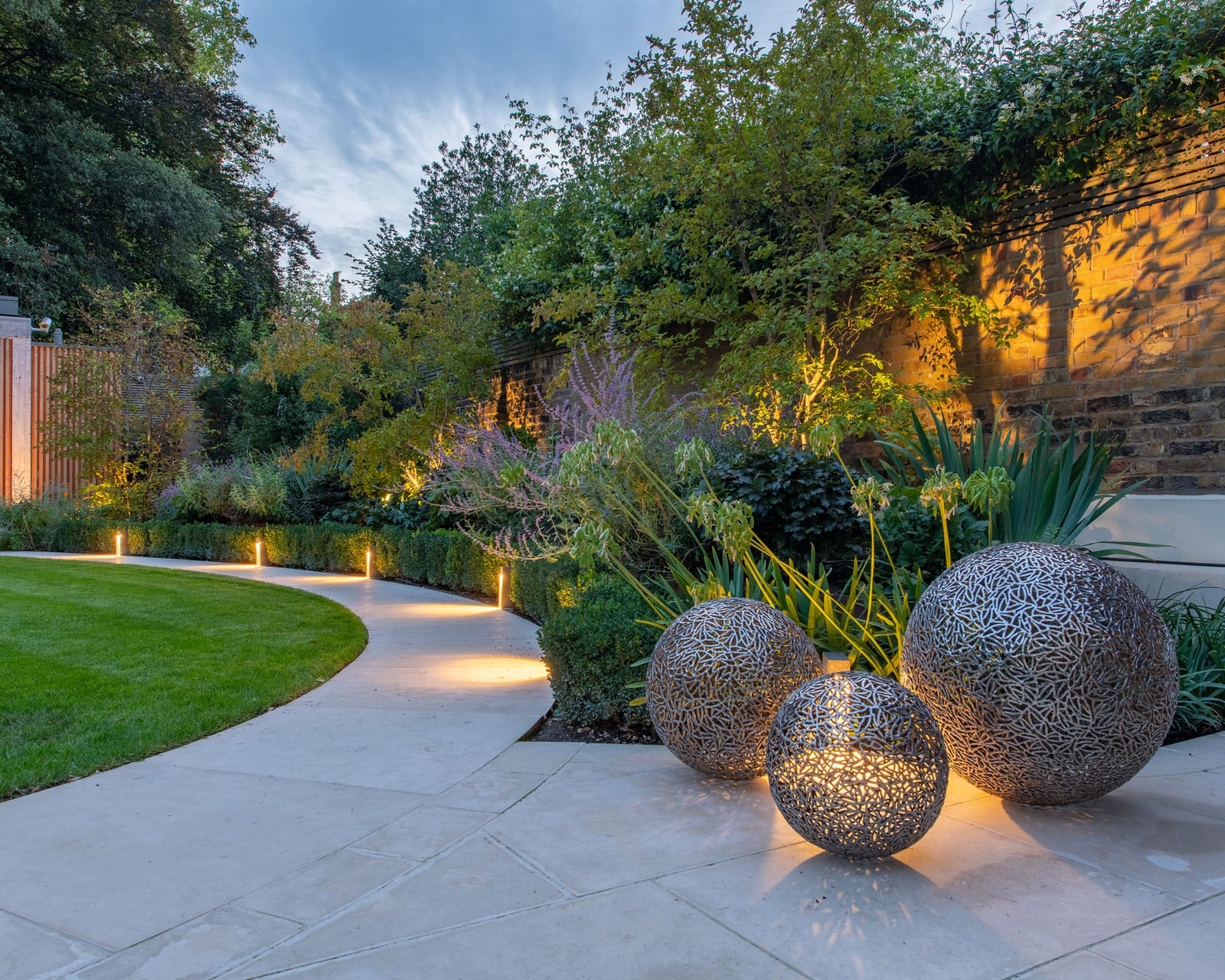
Three large patterned metal spheres glow along a paved pathway, their warm accent light turning a simple evening garden into a staged experience. The contemporary garden palette of grey and green lets the illuminated forms do the talking, while pathway lights guide the eye from one sphere to the next. A room-mode read of the whole space shows that the layout is what makes the idea work: the spheres are spaced like punctuation along the walk, not crowded into a corner.
02 / 27Reflective Sculpture as a Modern Garden Focal Point
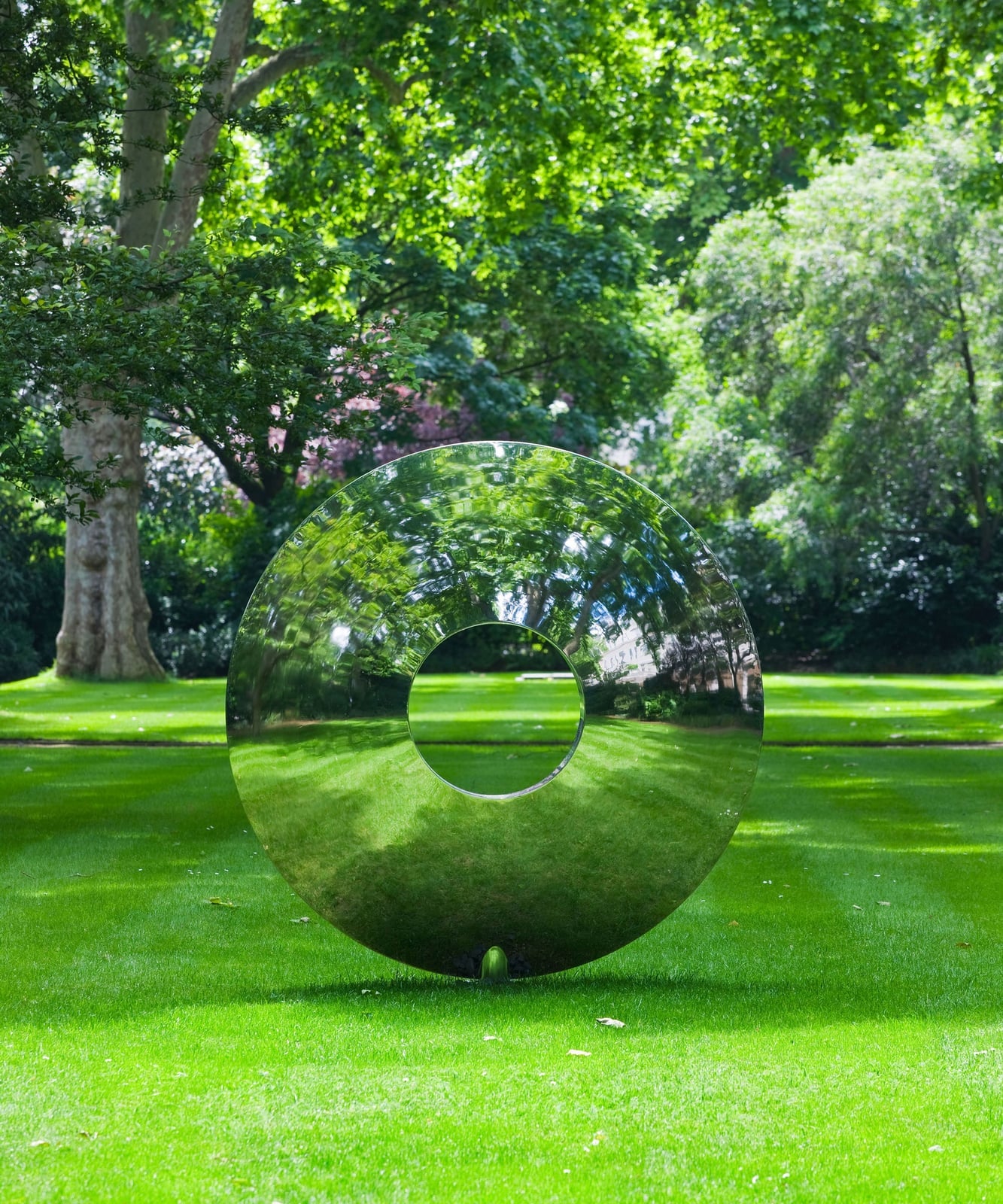
A large circular metal sculpture sits centered in the lawn, and that placement is the whole point. The modern garden palette of green and silver is clean and deliberate, with dappled daylight catching the reflective surface so the piece shifts as clouds move. The sculpture is the anchor of the room, not a decoration added later. The palette defines the look: green from the grass and trees, silver from the metal, and nothing else to break the ratio. If you are looking for a single piece to give a roomy lawn a sense of purpose, this is the approach.
03 / 27Weathered Driftwood Sculptures for a Natural Garden Path
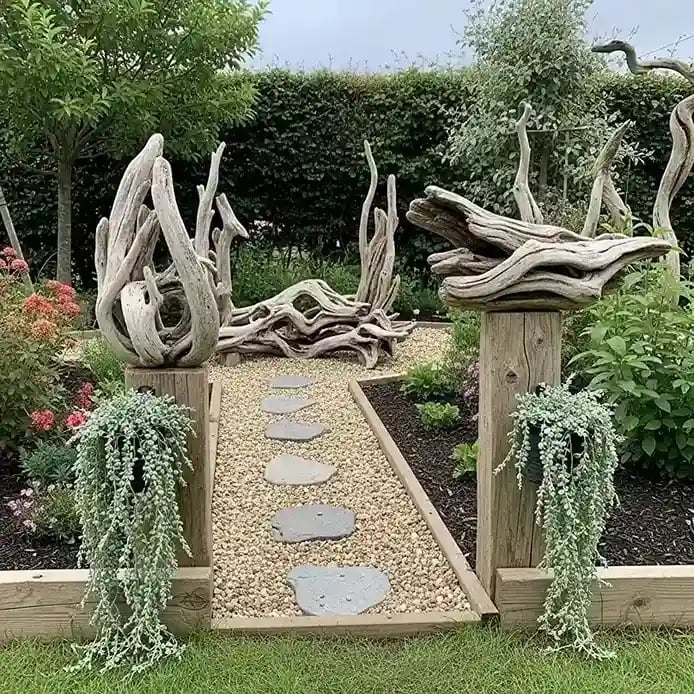
What do you do with a gravel path that feels too bare? Multiple driftwood sculptures arranged along it offer a natural answer. The palette is grey, green, and beige, with the weathered wood matching the stone and gravel so the art does not fight the setting. The room mode view shows the sculptures as a collection, not a single hero piece, which lets the eye travel down the path from one form to the next.
The material is the idea here. Driftwood brings texture and an organic line that cut stone cannot imitate. The overcast daylight flattens shadows so the grain and curves stay visible without harsh contrast. For a garden path that needs some structure, this approach uses what is already on the ground to support the art.
04 / 27Abstract Bronze Sculpture in a Formal Garden Setting
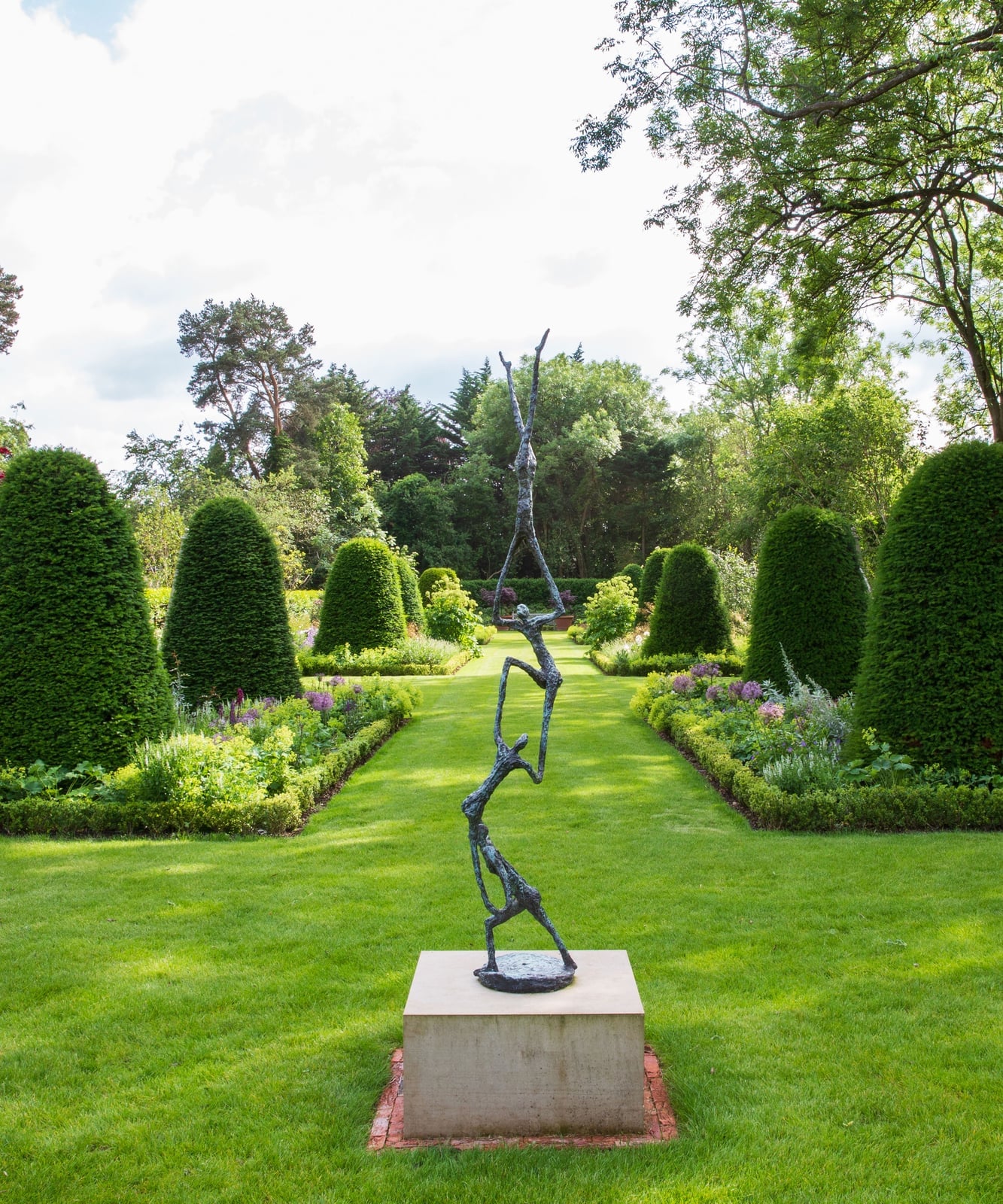
An abstract bronze sculpture takes the center of a paved path, with manicured hedges framing it on both sides. The formal garden scale is what makes this work: the sculpture is large enough to hold its own against the hedges but does not block the sightline. The bronze reads as a warm accent against the green and stone palette, and the overcast light softens the metal so it does not glare. A single well-proportioned piece can define a room without needing anything else.
05 / 27Textured Metal Art Enhancing Contemporary Garden Design
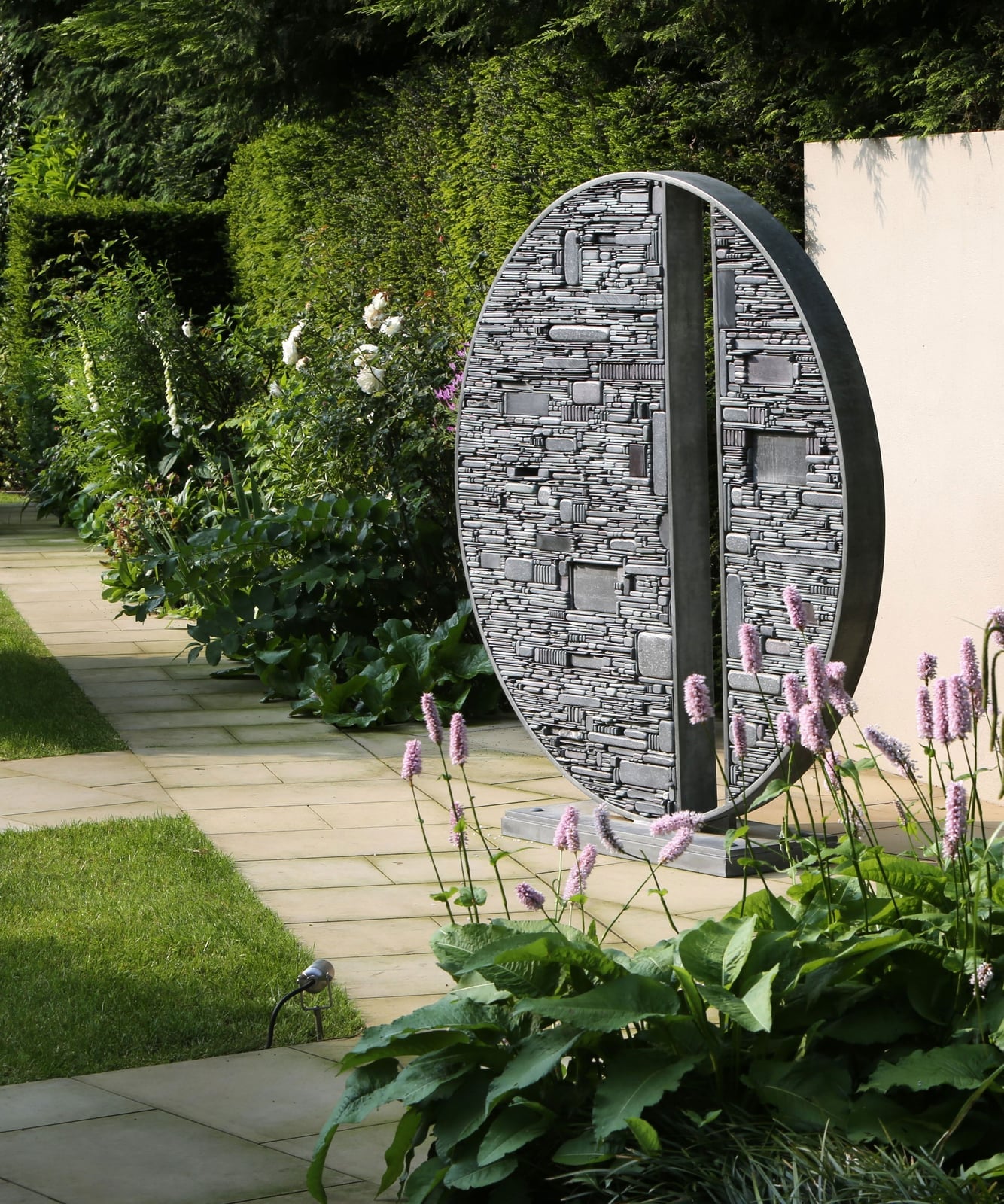
Large circular textured metal art matches the material to the setting in a contemporary garden. The palette of grey, green, and pink softens the industrial look, while the intricate surface catches soft daylight and changes as you move past it. The room mode view places the sculpture beside a path and hedge, so it works as a destination within the garden rather than a centerpiece. Textured metal holds up to weather but still looks intentional, and the pink notes in the palette keep it from feeling cold.
06 / 27Glossy Decorative Spheres for a Modern Outdoor Space
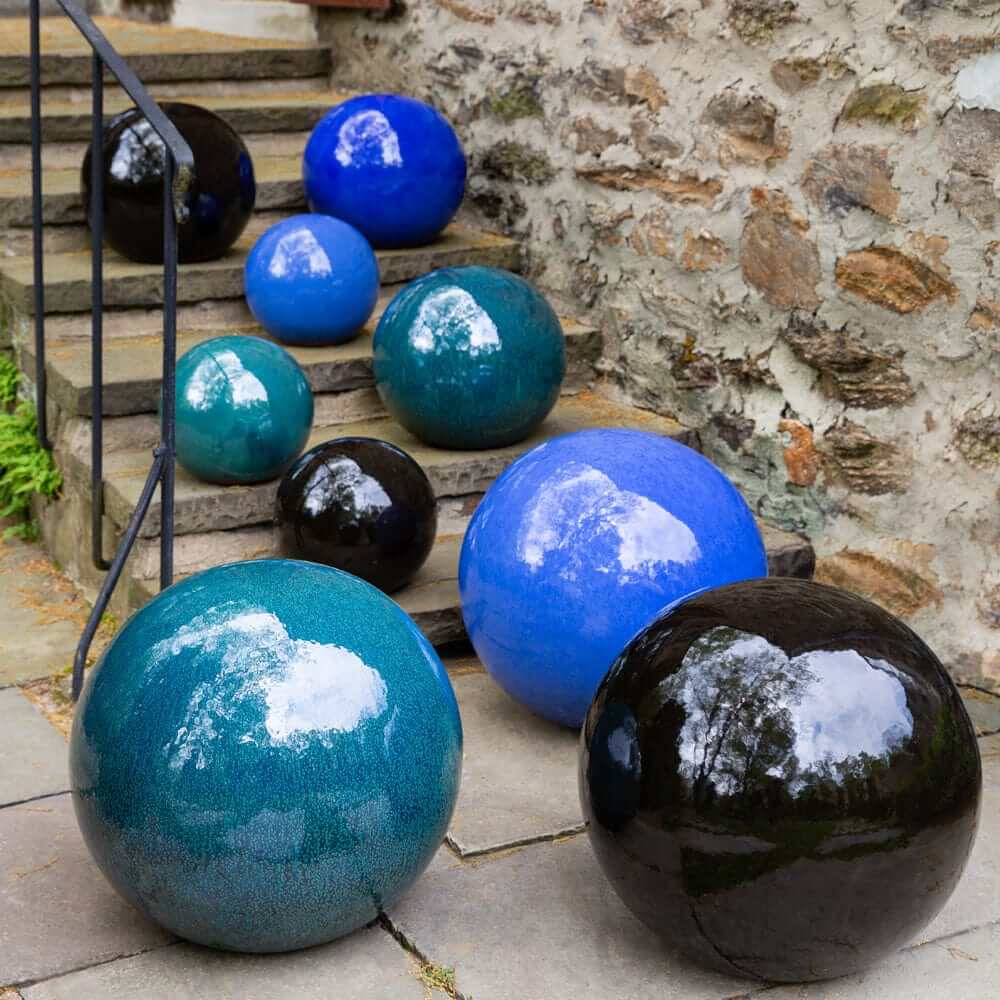
A cluster of oversized glazed ceramic spheres brings a modern edge to a garden path. The glossy finish reflects the sky and surrounding plants, so the palette shifts with the daylight. Here, a mix of blue, teal, and black spheres is arranged at the base of a set of steps, some resting on the ground and a few perched on the top tread. The reflective surfaces catch the eye. This is a palette trick: a single bold hue repeated in a few different values keeps the arrangement cohesive. Choose one color family and vary the depth of the tones. The glossy glaze means the pieces will act as focal points even when they share space with flowering plants.
07 / 27Vibrant Mosaic Garden Stakes for a Pop of Color
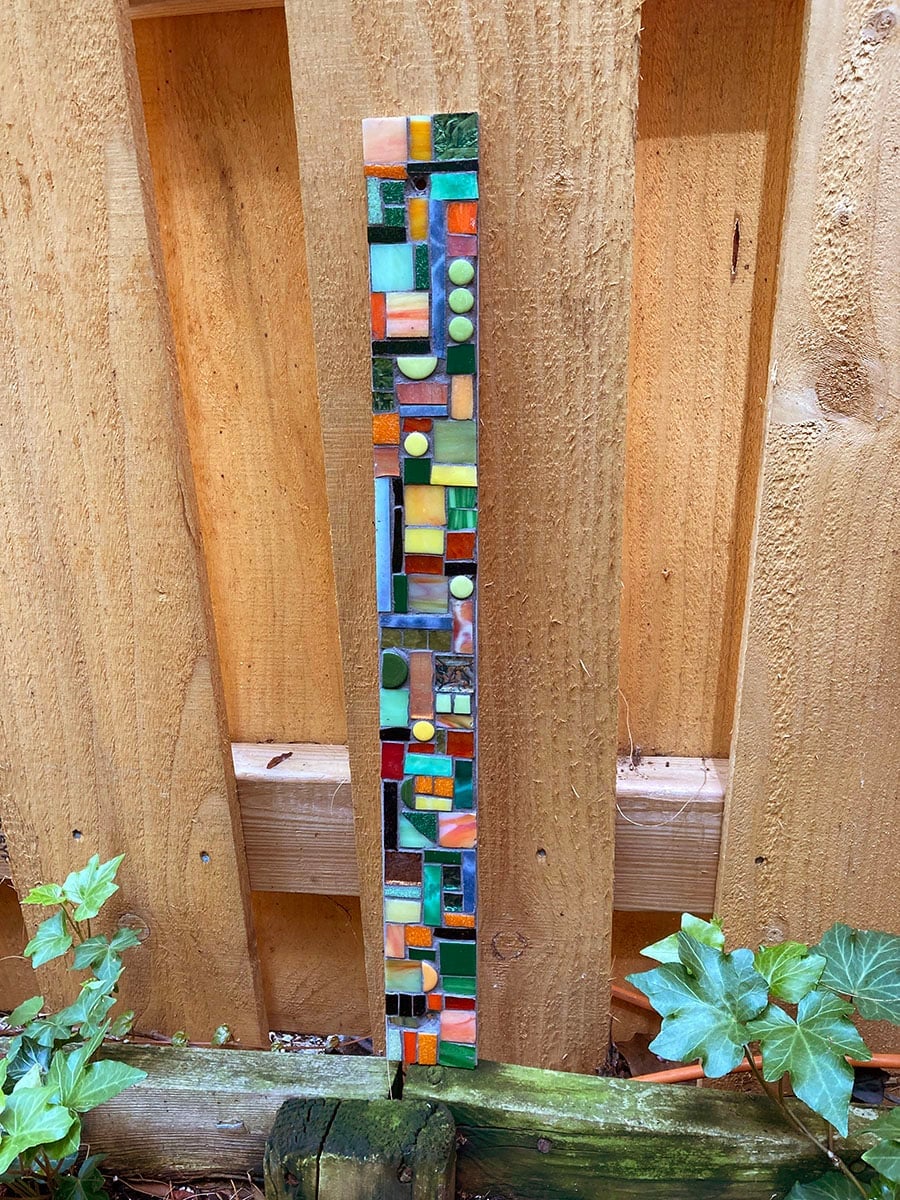
A tall wooden stake covered in a mosaic of glazed tile sits against a plain fence, its surface a patchwork of orange, blue, and green glass. The pattern is dense and irregular, so the stake looks like a small sculpture. For renters or anyone who cannot dig post holes, a stake like this is a flexible solution: it pushes into soil or sits in a pot and comes out without a trace. The palette requires a neutral fence behind it to let the mosaic hold the color weight.
08 / 27Eclectic Garden Fence Art Gallery
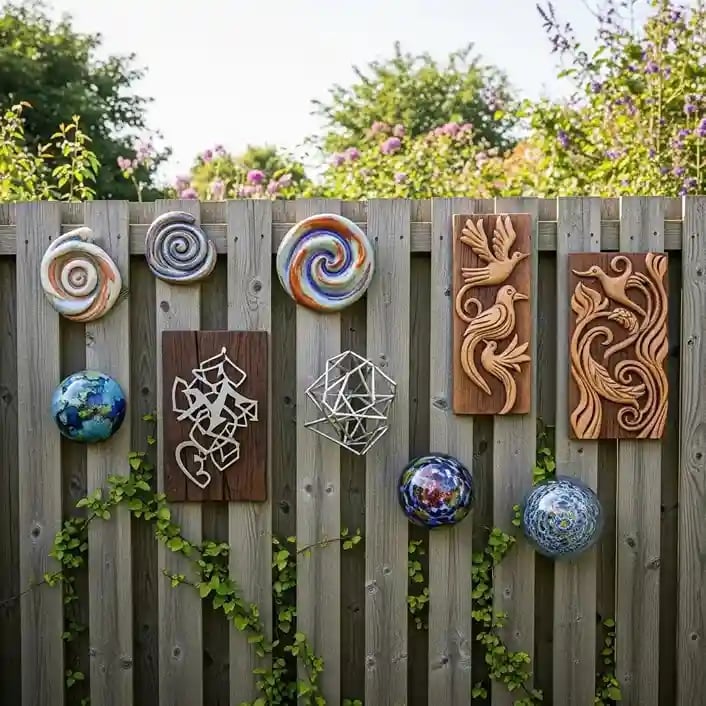
A wooden fence becomes a gallery wall with a mix of ceramic spirals, carved wood panels, and small glass orbs. The arrangement is dense but not symmetrical, and the natural wood tones of the fence keep the collection from feeling chaotic. What makes this work is the variety of textures: smooth glass next to rough-hewn wood, matte ceramic against a woven detail. The styling rule here is to vary the material but keep the color palette tight. Blue, white, and orange appear across multiple pieces, which ties the group together even when the shapes are unrelated. A fence-mounted gallery works well in narrow side yards where ground space is limited.
09 / 27Upcycled Glass Lamp Part Sculpture on a Garden Fence
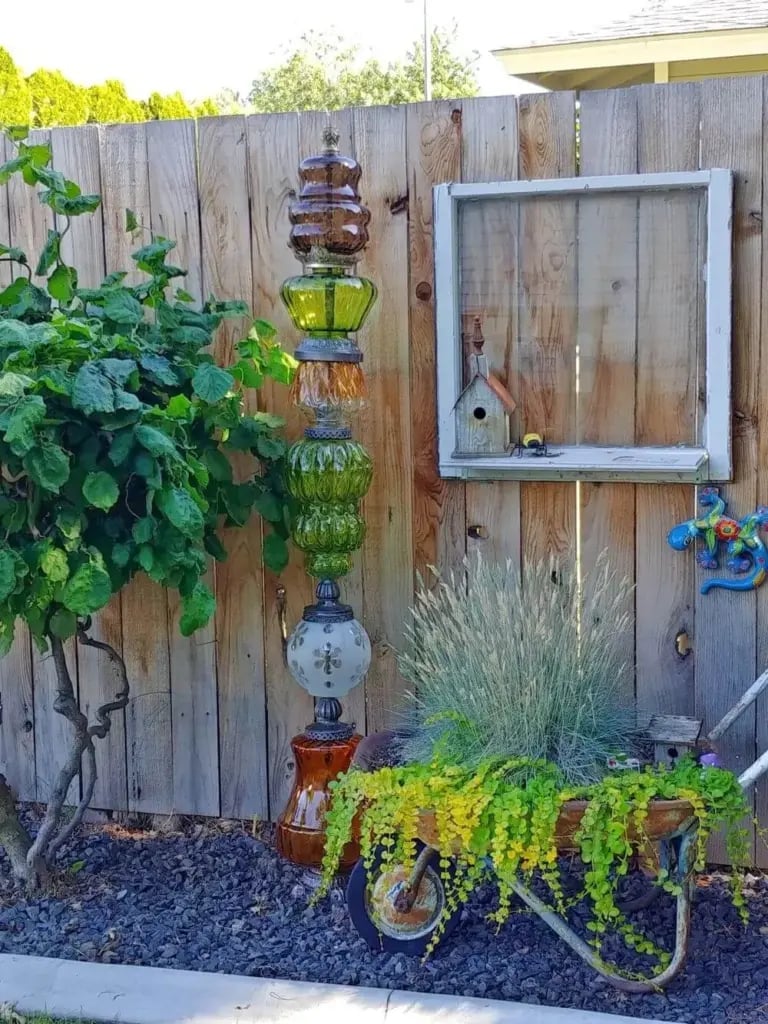
What happens when a glass lamp shade outlives its fixture? Stack several of them together and mount the result on a fence. Here, a column of amber, clear, and green glass shades rises from a wooden bracket, with a small trailing plant spilling from the top. The glass catches daylight and casts colored shadows on the fence boards. Below it, a weathered wheelbarrow planter holds more greenery, grounding the vertical piece. The materials question is straightforward: glass and metal hold up well outdoors as long as the mounting hardware is rust-resistant and the glass is thick enough to handle a gust of wind. A wooden fence provides a stable backing, but a post or a sturdy trellis would work the same way.
10 / 27Circular Glass Shard Art for Garden Beds
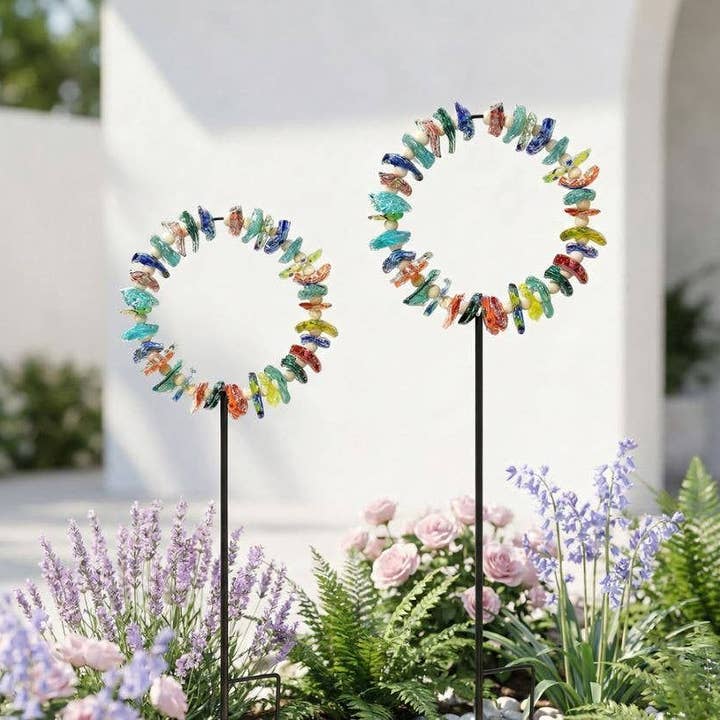
A series of metal stakes topped with concentric glass circles rises from a planted bed, the glass tinted in bright multicolor tones. The circles are open in the center, so light passes through them and the foliage behind stays visible. The scale is compact: the stakes are short enough to tuck among low perennials without overwhelming them. This kind of piece works as a color accent in a bed that is mostly green. Because the glass is mounted on metal stakes, it lifts the color above the soil line, where it catches the sun rather than sinking into the leaf cover.
11 / 27Whimsical Bottle Cap Flower Art
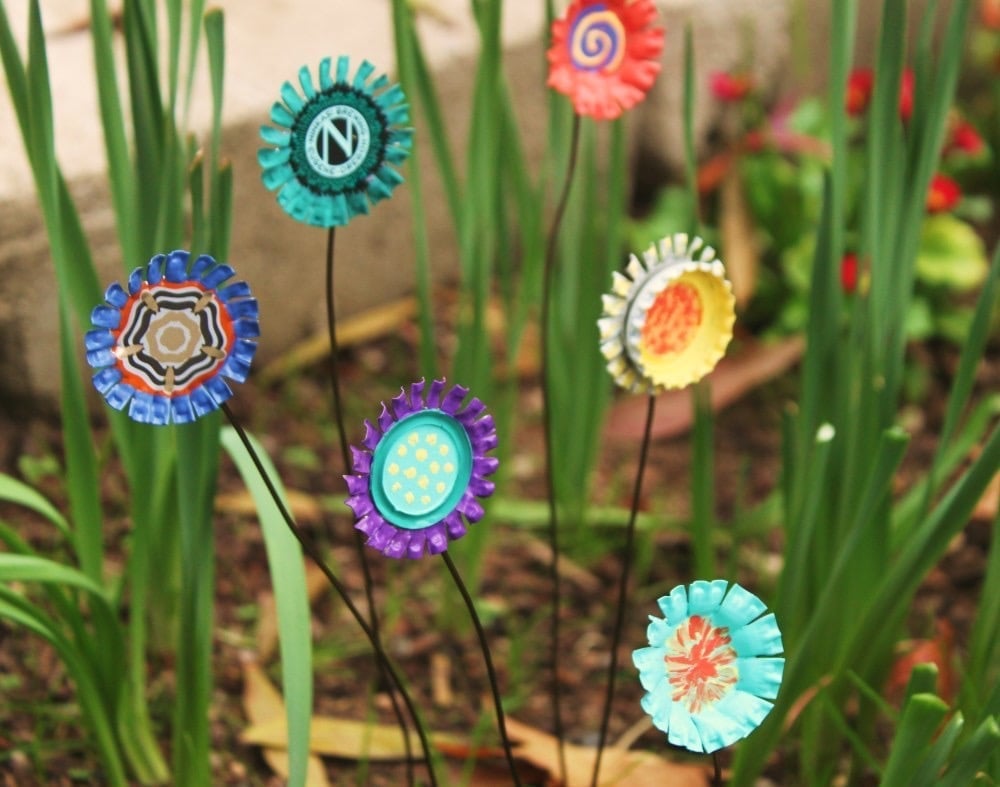
To arrange whimsical garden art, treat it like real planting by spacing the pieces so each one gets its own pocket of air and light. These recycled bottle cap flowers on metal stems use a palette of teal, red, yellow, purple, and blue, with colors repeated in the surrounding garden blooms for a playful effect. The plastic bottle caps and metal stems hold up to weather, but a lighter material means they shift in a strong wind, so push the stems deeper into the soil or add a small stone at the base for ballast.
12 / 27Folk Art Totem Poles in a Lush Garden
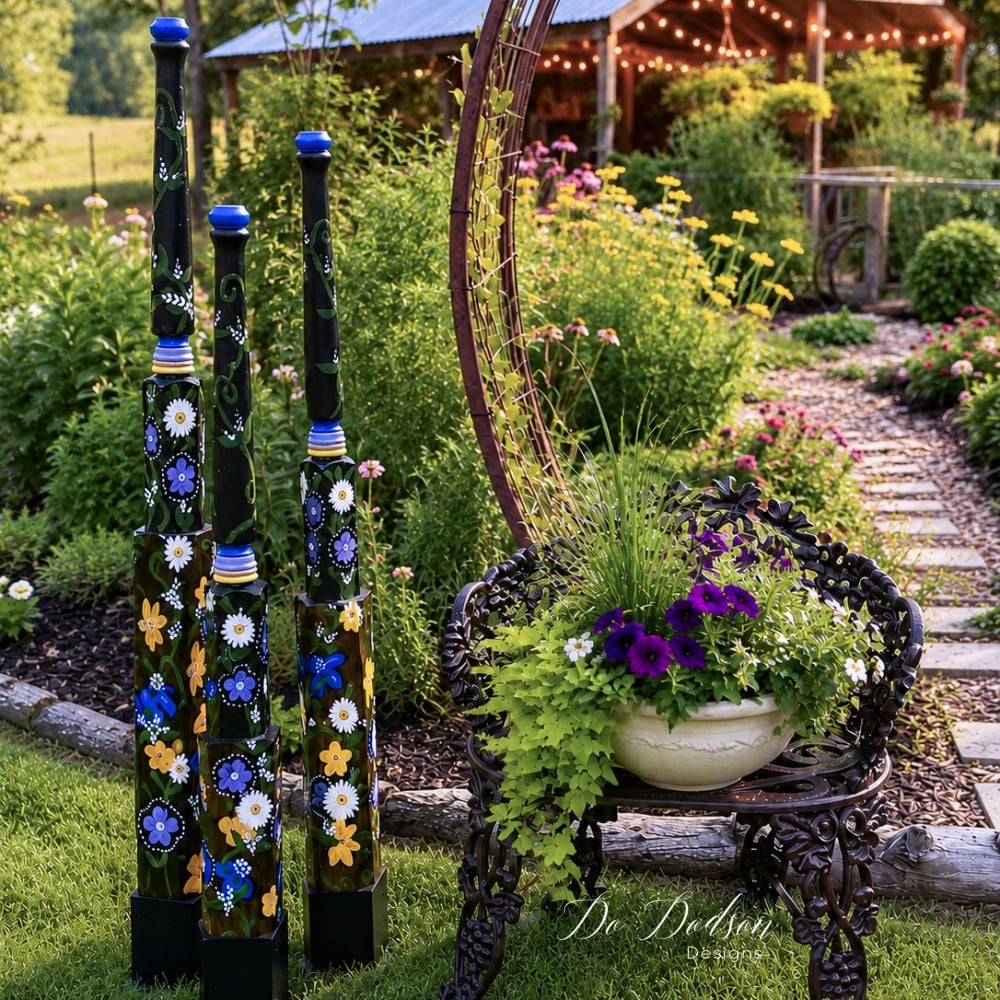
For a garden that leans formal, a single carved obelisk feels right. For one that wants energy and story, folk art totem poles make a stronger argument. This trio of painted wooden poles, black, blue, white, and yellow, stands in a roomy lawn beside an ornate bench, and the arrangement works because the vertical lines echo the tree trunks behind them.
The palette here is what holds the scene together. The bright yellow and blue pull the eye without fighting the green foliage, while the black outlines keep each figure distinct. What breaks the typical folk art look is the spacing: the poles are set far enough apart that each reads as its own character, not a single cluttered stack. If you place totems, give them room to breathe.
13 / 27Whimsical Bird-Shaped Metal Garden Stakes
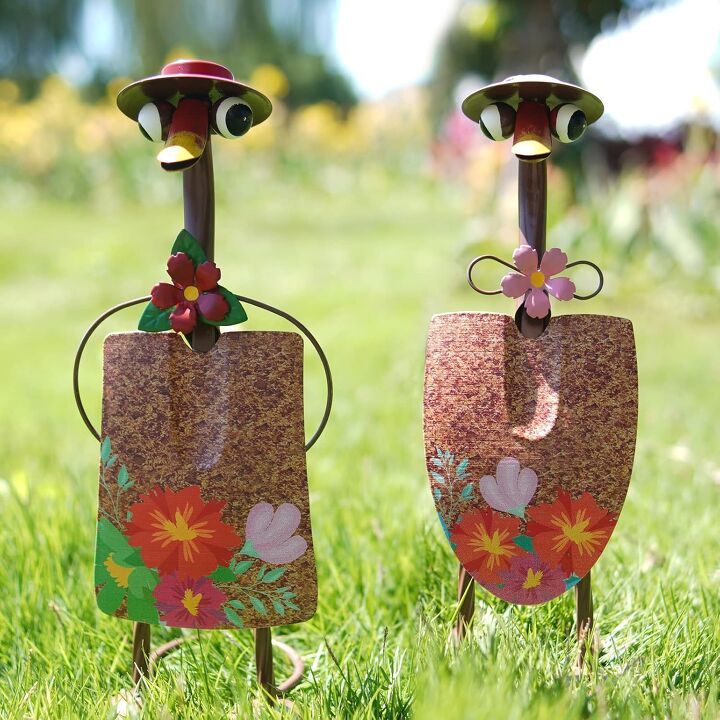
The design detail worth noting here is the shovel blade body, which turns a utilitarian shape into a creature. Two metal garden stakes shaped like birds, one with a red body and pink wings, the other with a green body and brown wings, stand in a bright grassy lawn. The painted metal finish catches the sun without glaring, so the figures stay readable from across the yard. For a similar look without a metal shop, find an old garden trowel and attach a painted wooden bird head at the handle end.
14 / 27Modern Face Planters on Garden Steps
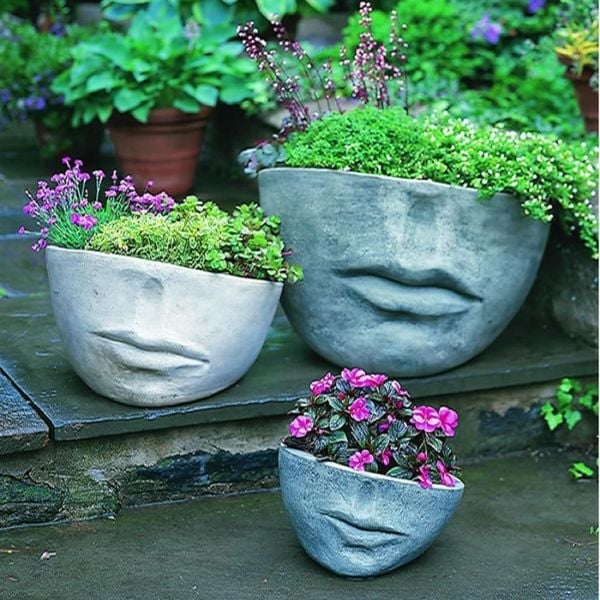
These concrete planters with face features are straightforward in their appeal: they ask you to look twice. Arranged on garden steps in a palette of grey, white, green, and pink, they work because the faces face outward toward the path, not up at the house. Daylight hits the contours of the concrete, creating shadow lines under the brow and cheek that change through the afternoon. That shifting expression is the point. If you want a similar effect, look for planters with a pronounced brow ridge or deep-set eye shape, and set them where morning or late light casts a long shadow.
15 / 27Stacked Terracotta Pots for Whimsical Garden Displays
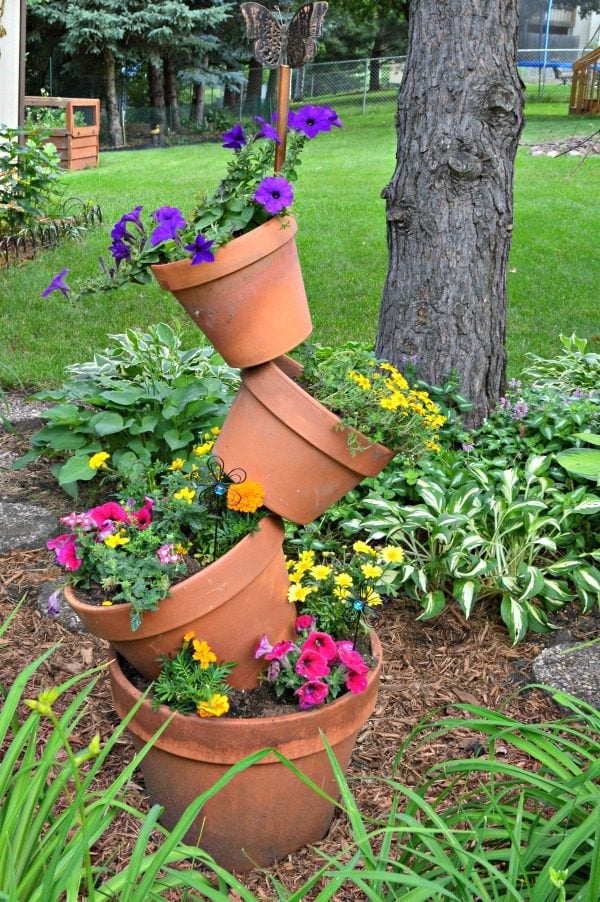
To store garden pots you plan to stack, nest them by size before you seal the drainage hole on the topmost one. This cluster of stacked terracotta pots rises from a garden bed with pink, yellow, and purple flowers spilling over each rim, topped by a small butterfly stake. The vertical arrangement saves ground space and turns a collection of mismatched pots into a single sculpture.
The taper of terracotta pots naturally allows stacking because each rim is slightly wider than the base of the one above. To keep the stack stable, angle each pot slightly off center so the flowers trail down the sides, and use a thin layer of soil between pots to grip the next layer. A pull on the top pot will tell you if the whole thing needs a dab of adhesive at the contact points.
16 / 27Natural Arbour as an Enchanting Garden Pathway Feature
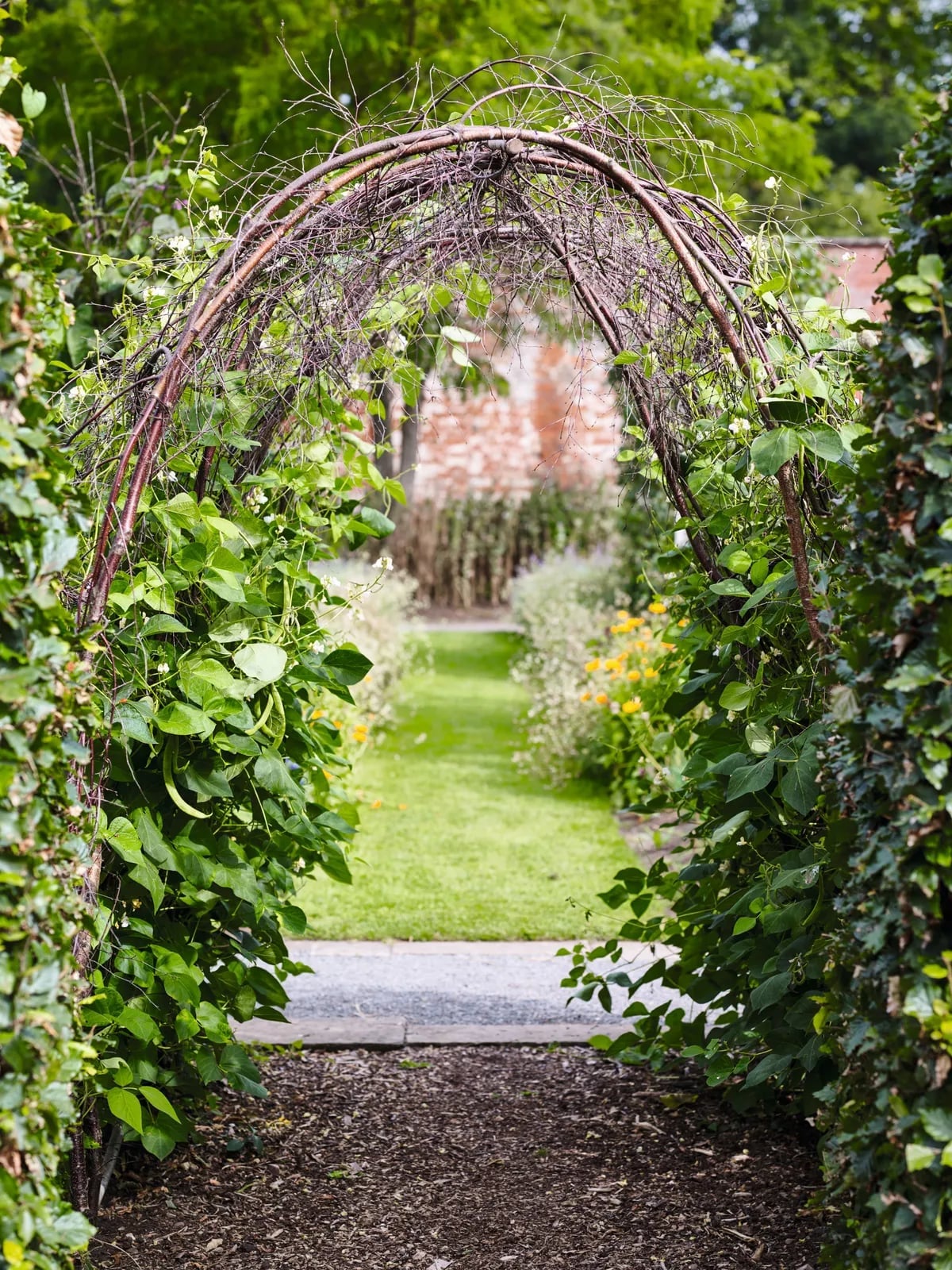
A natural arbour built from rough-hewn wood and woven vine turns a simple garden path into a destination. The structure frames the view ahead, drawing the eye through an arch of climbing plants before the path opens again. Stone underfoot and soft daylight keep the scene grounded. The arbour becomes the anchor, and everything else, the foliage, the path, the grey-green palette, stays simple around it. A layout like this works best when the path leads somewhere visible from the start, so the arch acts as a gateway.
17 / 27Zen Garden Metal Art with Buddha Face
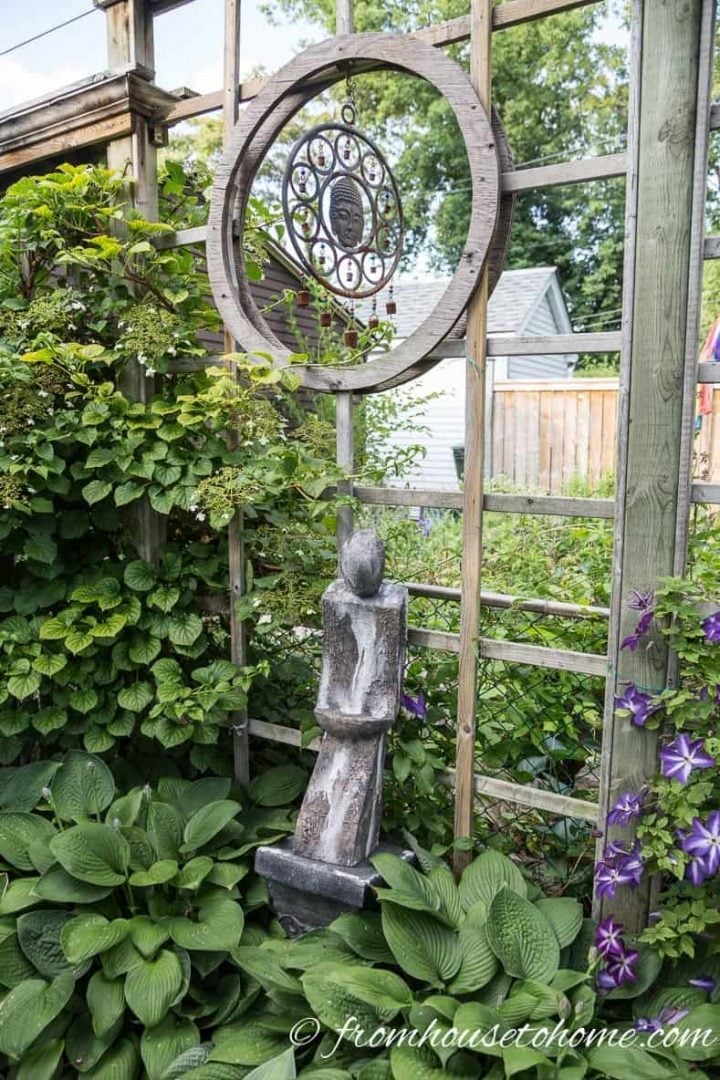
A practical rule for zen garden art: the fewer materials in view, the calmer the space feels. A circular metal piece with a buddha face mounted on a wooden trellis anchors this compact garden. A stone figure at the base and dappled daylight complete the scene without clutter. The style relies on restraint, grey, green and natural wood keep the palette quiet, while the metal art provides the only graphic contrast. What breaks the calm is anything glossy or brightly colored. Renter-friendly version: hang the metal art on a freestanding trellis or shepherd’s hook so no permanent mounting is needed.
18 / 27Upcycled Glass Bottle Tree Sculpture
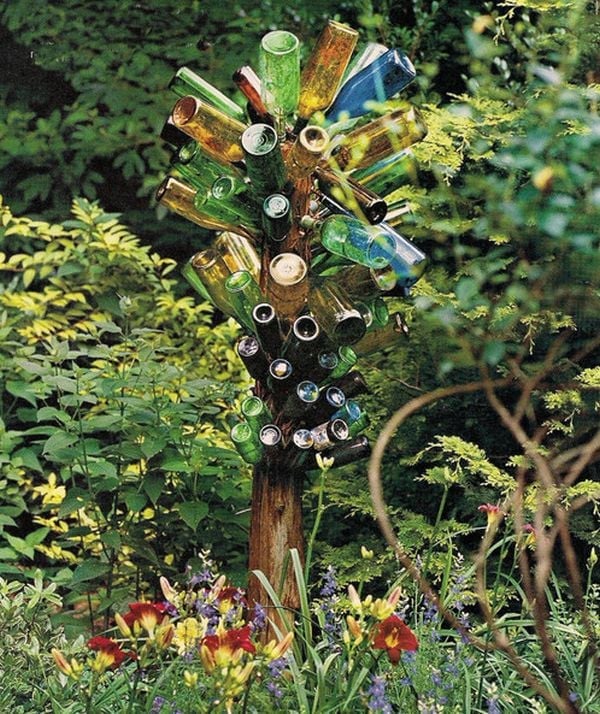
A bottle tree is not a bottle tree unless the glass reflects daylight. Compared to a painted metal sculpture, this version uses recycled bottles in green, blue, amber and brown arranged on a wooden frame to mimic a tree. The colors come from the glass itself, not from a finish that can peel or fade. Placed among foliage, the sculpture looks both playful and permanent.
The material choice matters here because glass reflects and refracts daylight in a way that painted surfaces cannot match. The wood base weathers naturally over time, while the bottles stay bright as long as they remain intact. For a garden that leans whimsical, this is a low-cost way to add height and color without introducing anything that needs annual upkeep.
19 / 27Textured Moss and Bark Wall Art for Natural Gardens
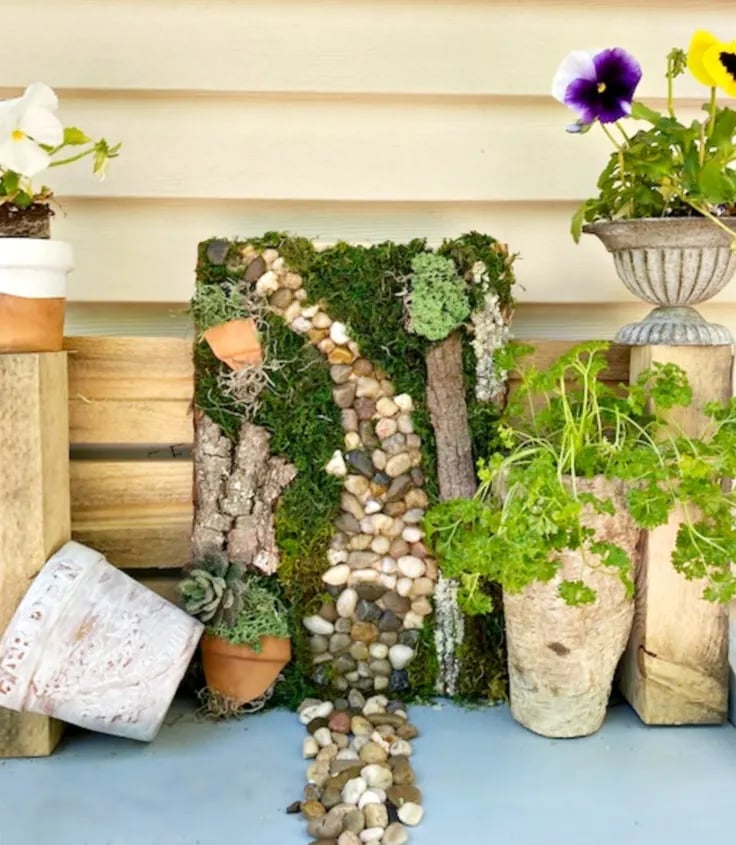
A moss wall panel mounted on a wooden surface brings the texture of a forest floor to a vertical garden. Pebbles at the base and bark accents reinforce the rustic palette of green, brown and grey. The moss surface is the standout, dense, uneven and deeply organic against the flat wood backing. This kind of natural wall art suits a shaded corner where living moss can stay damp between rains. For drier climates, preserved moss is a reliable swap that keeps the same look without watering.
20 / 27Fused Glass Heart Art in Garden Beds
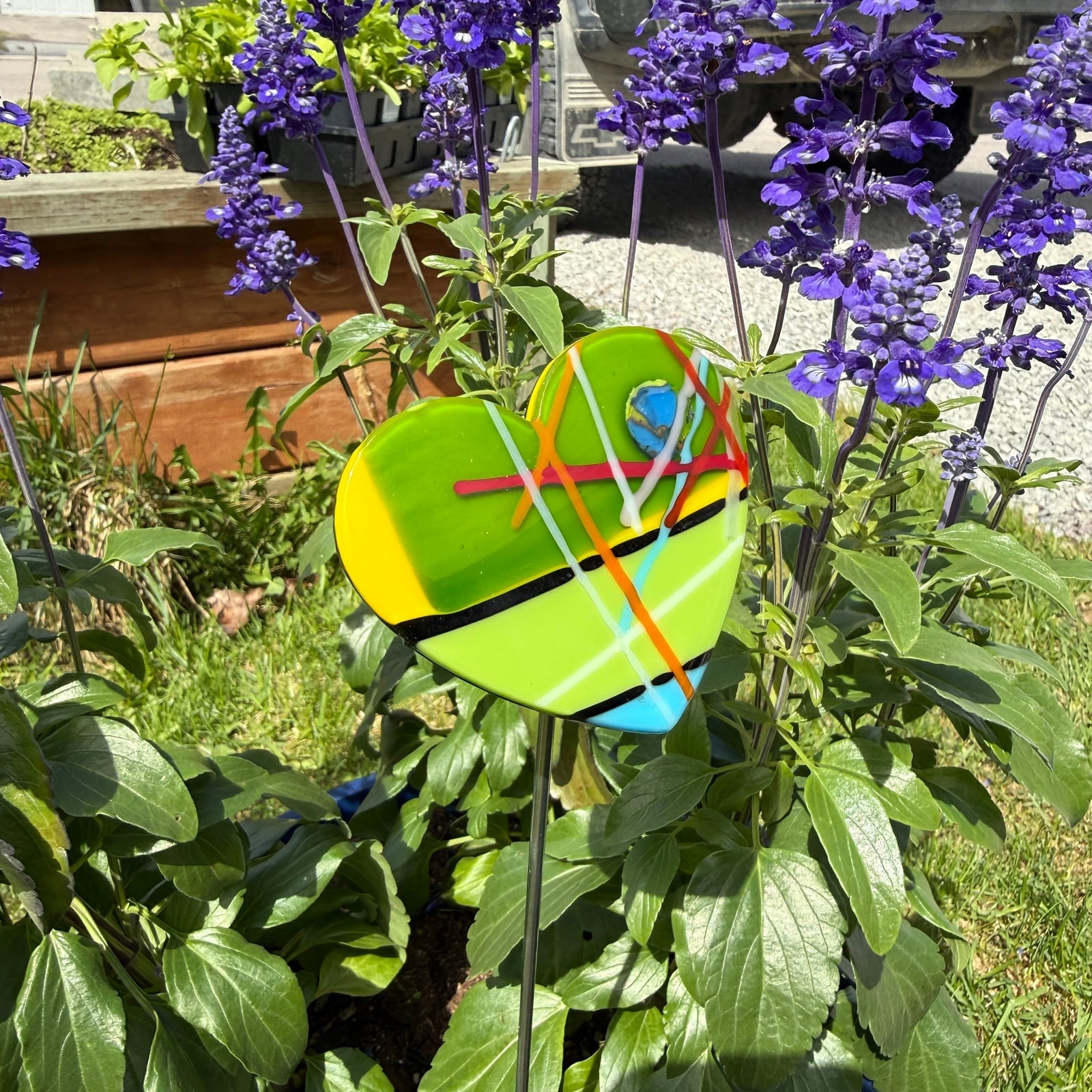
A heart-shaped fused glass garden stake is a compact detail that works because of its palette. Yellow, blue, orange and pink against a green garden bed create a deliberate color pop. The bright daylight helps the glass look translucent and layered, not flat. Scale matters: a stake this size fits a small bed or the front edge of a border without overwhelming nearby plants. For renters, a glass stake pushes into the soil with no digging or permanent hardware needed.
21 / 27Rusted Metal Sculpture as an Industrial Garden Centerpiece
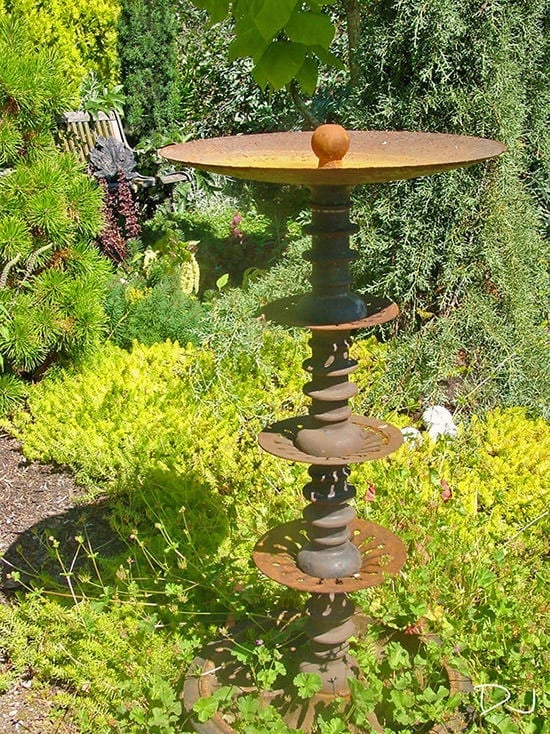
In a garden, where the palette is already green, a rusted metal sculpture adds a color you didn’t know you needed. The oxidized surface appears as a warm, earthy orange-brown, a tone that pairs naturally with stone pathways and low-lying greenery. This is a materials-first approach: the sculpture’s multi-tiered form becomes the centerpiece not by size alone but by its textured, weathered finish. Bright daylight catches every flake and crevice, making the metal look less like decay and more like deliberate patina. The surrounding planting is kept simple so nothing competes with the sculpture’s industrial silhouette. It is a look that ages well because it starts aged.
22 / 27Eclectic Bottle Art in a Rustic Planter
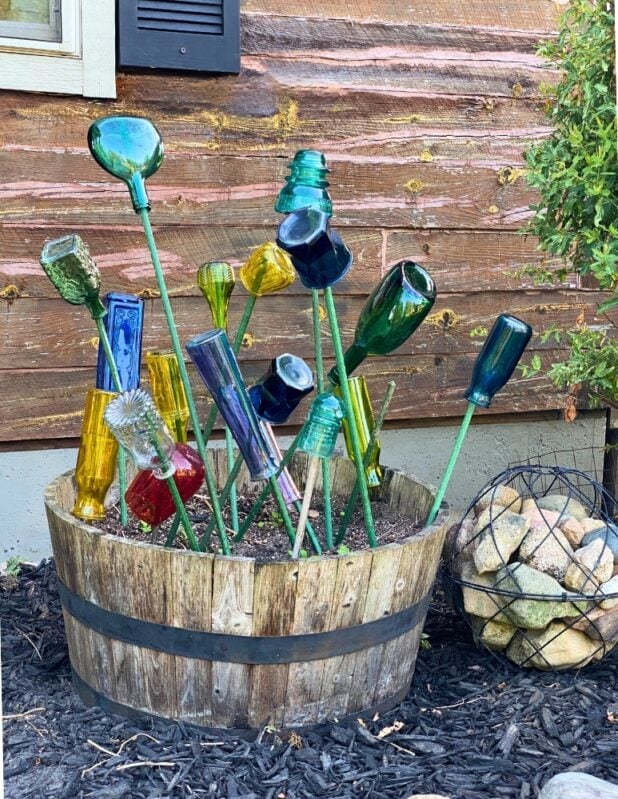
Colorful glass bottles on stakes rise from a wooden barrel planter, turning a simple container into a small gallery. The palette mixes clear, green, and blue glass, which catch daylight and cast colored shadows onto the surrounding stone. The arrangement feels casual but deliberate: the bottles are grouped so the tallest ones sit near the center, and the shorter ones spread outward. It is an easy way to add height to a low planting without blocking the view.
23 / 27Vibrant Folk Art Fence Mural
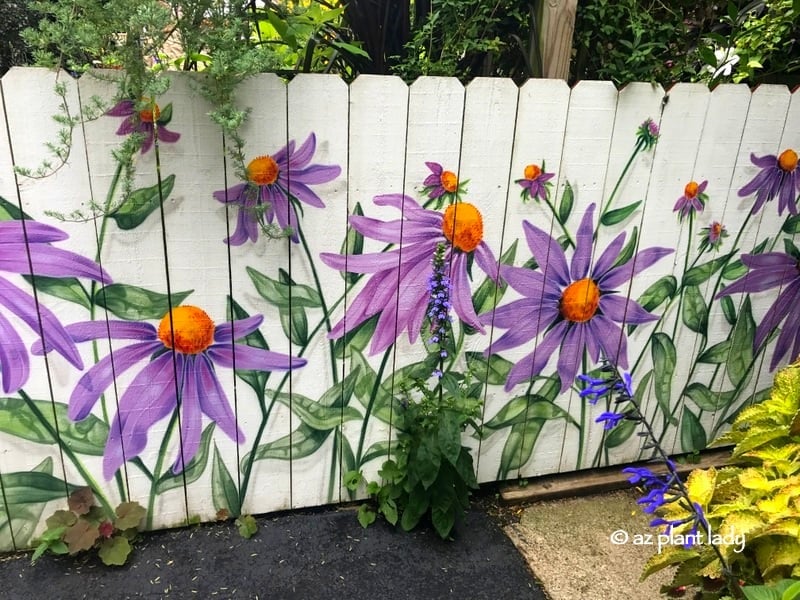
A garden fence can serve as a vertical canvas. Here, large painted flowers in white, purple, green, and orange cover the wood panels, turning a plain barrier into the garden’s main attraction. The folk art style uses bold outlines and flat color, so the mural reads clearly from a distance. The palette is the hero element: the bright blooms stand out against the fence’s natural wood tone, and the repetition of flower shapes gives the whole wall a rhythm. This approach requires exterior-grade paint and a primed fence surface to last.
24 / 27Traditional Tiered Stone Fountain with Angel Accent
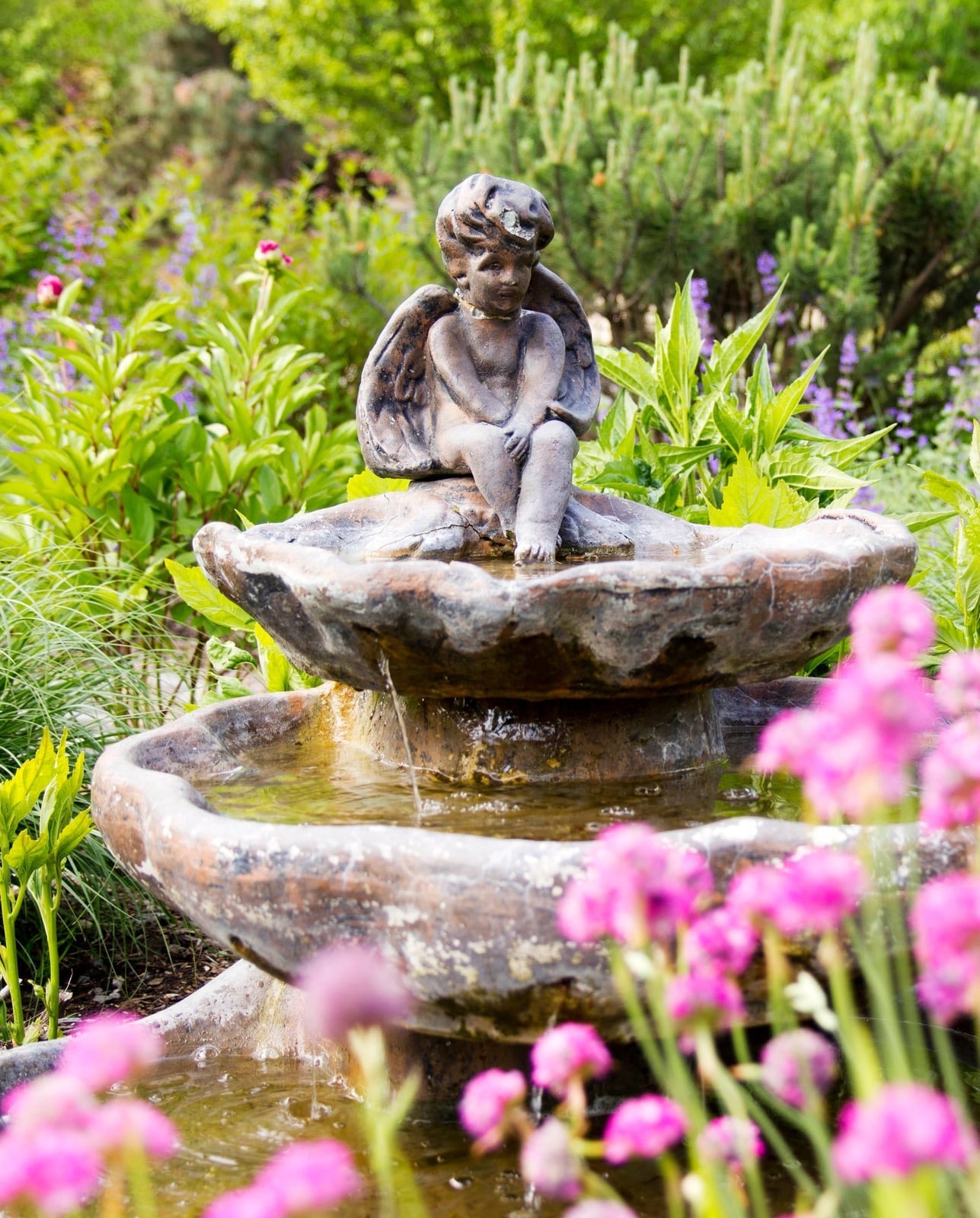
A compact tiered fountain with an angel figure at the top offers a quieter alternative to a large water feature. Where a big pond might overwhelm a small garden, this stone fountain fits into a corner or against a wall, relying on its vertical tiers to draw the eye upward. The water moves from one basin to the next, creating a soft sound that masks street noise. The angel accent adds a formal, almost classical note, while the surrounding pink and green plants soften the stone’s grey. Daylight glints off the moving water, so the fountain works as both a visual and auditory anchor for the garden.
25 / 27Abstract Wooden Sculpture for Modern Gardens
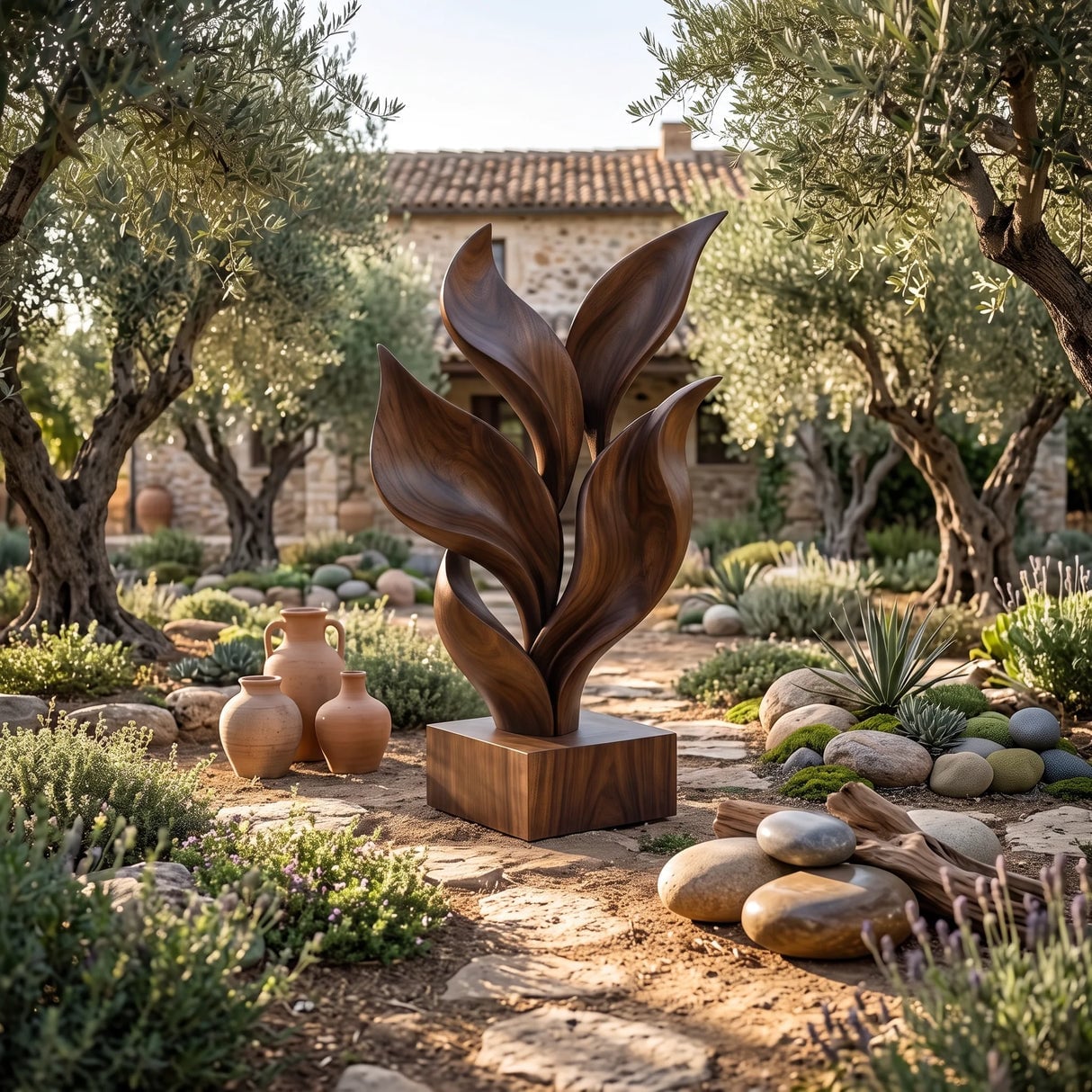
A large abstract wooden sculpture with a flowing, dynamic form sits on a paved path, surrounded by terracotta vases and gravel. The wood’s natural brown tones warm the cool stone and green foliage, while the sculpture’s curved shape contrasts with the straight lines of the path. This is a piece that asks for room to breathe: the wide garden view shows how the open space around the sculpture lets the eye follow its lines without interruption. It anchors the garden without blocking it.
26 / 27Ornate Picture Frame as Garden Art Display
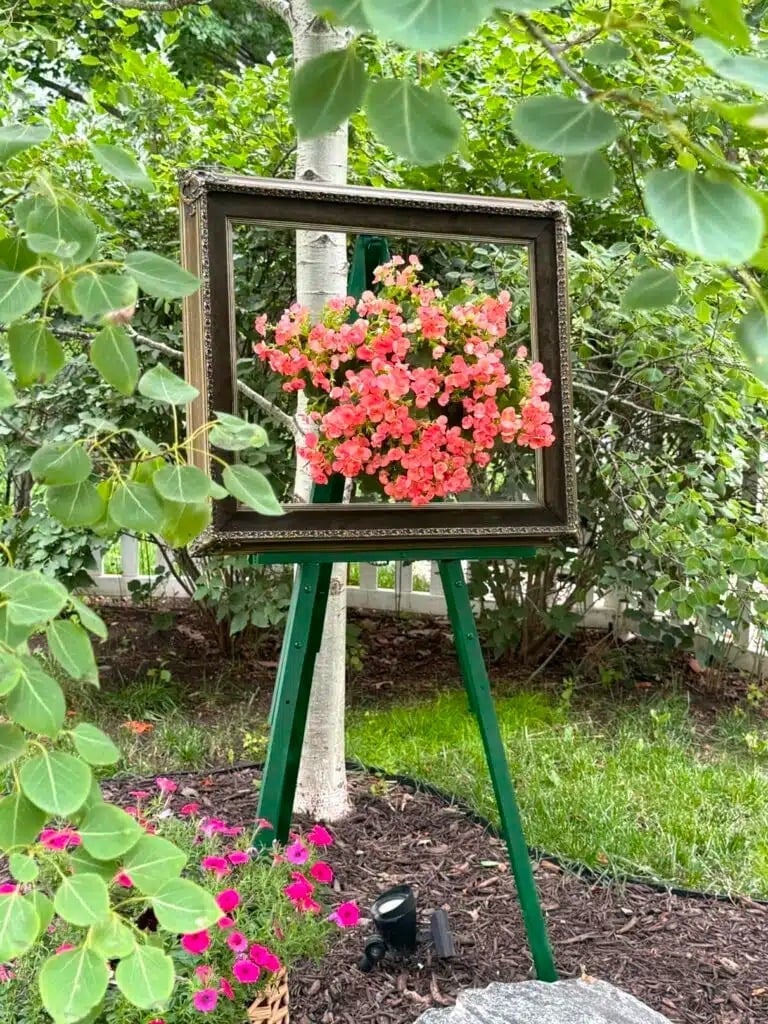
An ornate picture frame propped on an easel in the garden becomes a clever display when you see the flowers blooming right through it. The gilded wood border holds nothing but the view beyond, turning the surrounding greenery and pink blossoms into the artwork itself. This is a room-mode move: the whole garden becomes the composition, with the frame and its metal stand as the only deliberate props. The eclectic, whimsical feel lands because the frame is ornate enough to contrast with the natural setting, yet the dappled daylight softens any formality. Choose a frame with enough patina or wear that rain and sun won’t ruin the finish; an antique-shop find with its original chipped gilding works better than something brand new. The looks that actually work here are the ones that let the garden do the painting.
27 / 27Final Thoughts
Garden art does not need to be precious or expensive. The best pieces hold up to weather and feel like they belong. Stick with materials that suit your climate: metal for modern lines, stone for tradition, glass for color that shifts with the light. A single strong form can anchor a whole bed. A cluster of small works turns a fence into a gallery. Let the garden dictate the scale and the season test the material. What matters most is that the art feels settled, not staged.