
Small bedrooms can feel incredibly cozy when every piece of furniture has a purpose and the layout is planned thoughtfully. I love how the right organization can make even a compact bedroom feel calm, comfortable, and surprisingly spacious. From streamlined bedside storage to smart vertical solutions, small spaces offer plenty of opportunities to combine practicality with beautiful design. The key is to reduce visual clutter while choosing furniture and décor that work with the room rather than against it. In this collection, I’m exploring stylish bedroom interiors that show how thoughtful layouts, layered textures, clever storage, and carefully chosen details can transform limited space. Whether you are refreshing a tiny bedroom or simply looking for ways to make your current space feel more organized, these ideas offer plenty of inspiration.
Compact Bedroom With a Floating Vanity and Full-Height Storage Wall
The first bedroom makes excellent use of a narrow footprint by placing the bed directly against a tall wood-paneled wall while keeping the remaining furniture compact. I notice a floating light-colored vanity or console beside the bed, paired with a small upholstered stool, while a large mirror visually extends the narrow side of the room. The warm wood wall, blush bedding, soft upholstered headboard, and concealed linear lighting create an intimate atmosphere without making the room feel overly busy.
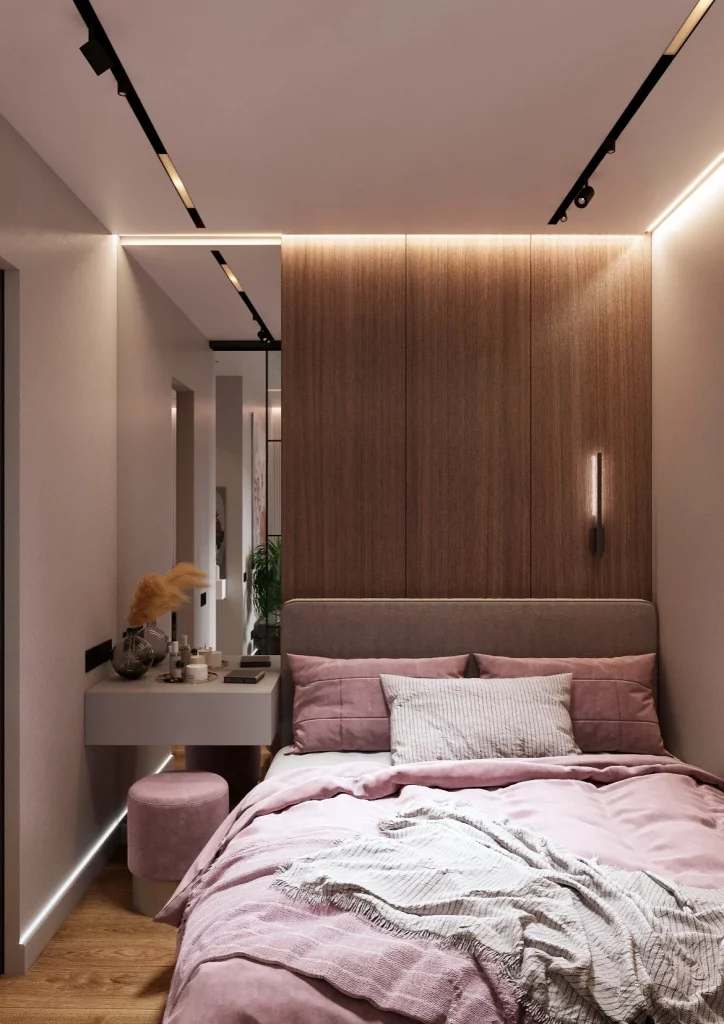
What works especially well for organization is the restrained furniture arrangement. The floating console leaves the floor beneath it visually open, while its broad surface provides a practical place for a few everyday items. The mirror beside it also helps the narrow room feel deeper. I like the way the bed remains the dominant piece instead of being surrounded by unnecessary furniture.
From my perspective, this is a strong solution for a small bedroom because it demonstrates how much can be achieved with one useful surface and a carefully planned wall. If I were recreating this look, I would keep the bedside area deliberately edited and use the available console surface only for essentials. The combination of concealed lighting, vertical wall treatment, and minimal furniture makes the entire room feel calmer and more organized.
Soft Neutral Bedroom With Mirrored Wardrobe Doors
This bedroom uses a gentle palette of cream, beige, taupe, and soft gray, with the bed positioned opposite a large wardrobe featuring tall paneled doors. A sculptural chandelier hangs centrally from the recessed ceiling, while full-length curtains frame the large window and allow abundant natural light into the room. The upholstered bed, layered bedding, bedside tables, and long light-colored surface at the foot of the bed create a polished but comfortable composition.
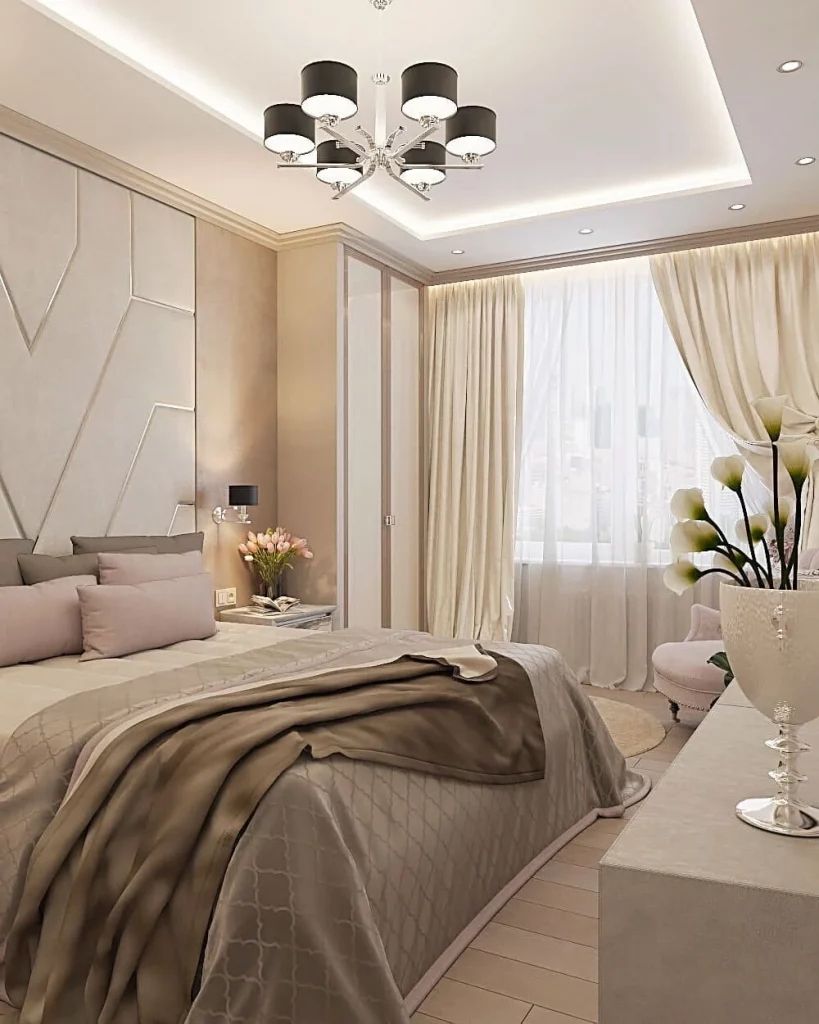
For a small room, the tall wardrobe is one of the most useful features visible here because it takes advantage of vertical space rather than spreading storage across the floor. The wardrobe doors also blend into the wall instead of competing with the bed. I find that this kind of uninterrupted vertical storage can make a compact bedroom much easier to keep visually tidy.
I would take particular inspiration from the restrained color scheme. When storage occupies a significant wall, matching or closely coordinating its finish with the surrounding room can make it feel much less imposing. The generous curtains and reflective wardrobe surfaces also contribute to the room’s airy appearance, helping the organization feel integrated into the design rather than added afterward.
Warm Wood Accent Wall With Streamlined Bedside Storage
The third bedroom centers on a dramatic horizontal wood wall behind a simple upholstered bed. Warm recessed lighting traces the top of the wall, while dark bedside tables sit neatly on either side. The bedding is predominantly white and gray, and the flooring repeats the warmth of the wall treatment, creating a cohesive and restful atmosphere.
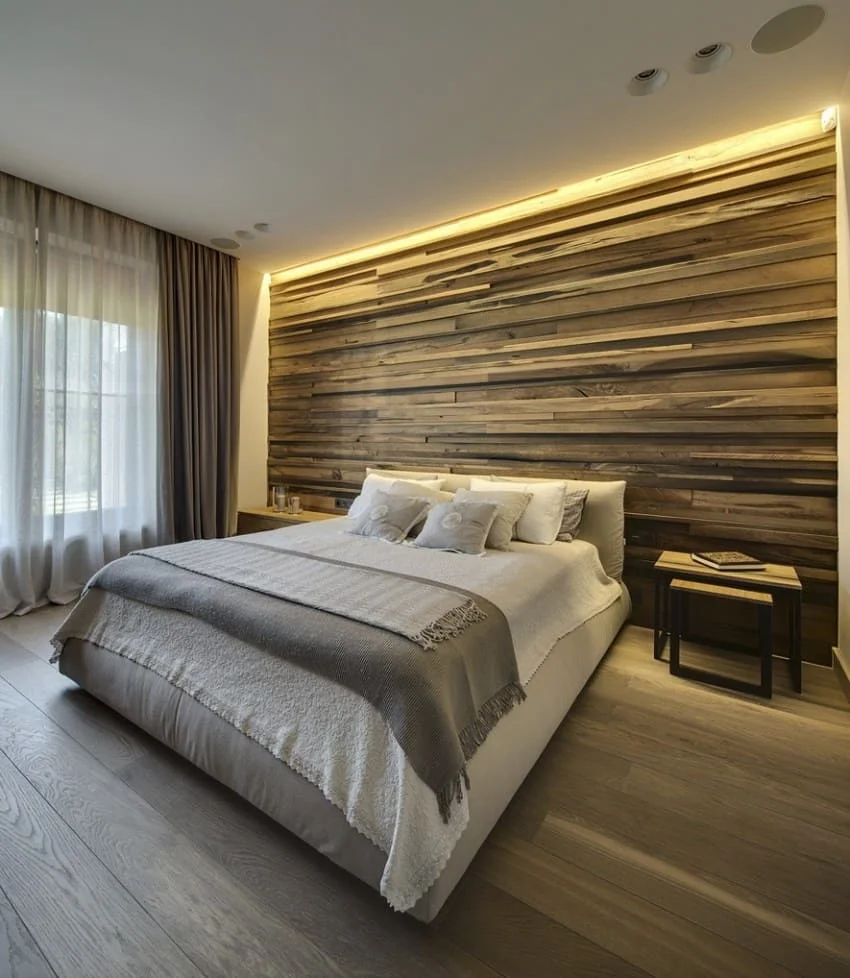
I like how little furniture is required to make this room functional. The bedside tables provide compact storage and a convenient surface without visually interrupting the large accent wall. The bed itself remains uncomplicated, so the room avoids the crowded feeling that can happen when a small bedroom contains too many competing pieces.
For me, the biggest lesson here is to let one architectural feature do most of the visual work. A strong wall behind the bed can eliminate the need for numerous decorative objects, which naturally makes organization easier. I would keep bedside surfaces almost as edited as they are shown here, because the simplicity is what allows the room to feel comfortable rather than cluttered.
Elegant Bedroom With Symmetrical Storage and Green Accents
This bedroom combines a dark upholstered bed with white bedding, taupe walls, cream curtains, and carefully placed green accents. Four framed artworks are arranged in a precise grid above the headboard, while matching bedside surfaces sit on either side. A large window brings in an impressive amount of daylight, and two green upholstered chairs add color near the window and opposite side of the room.
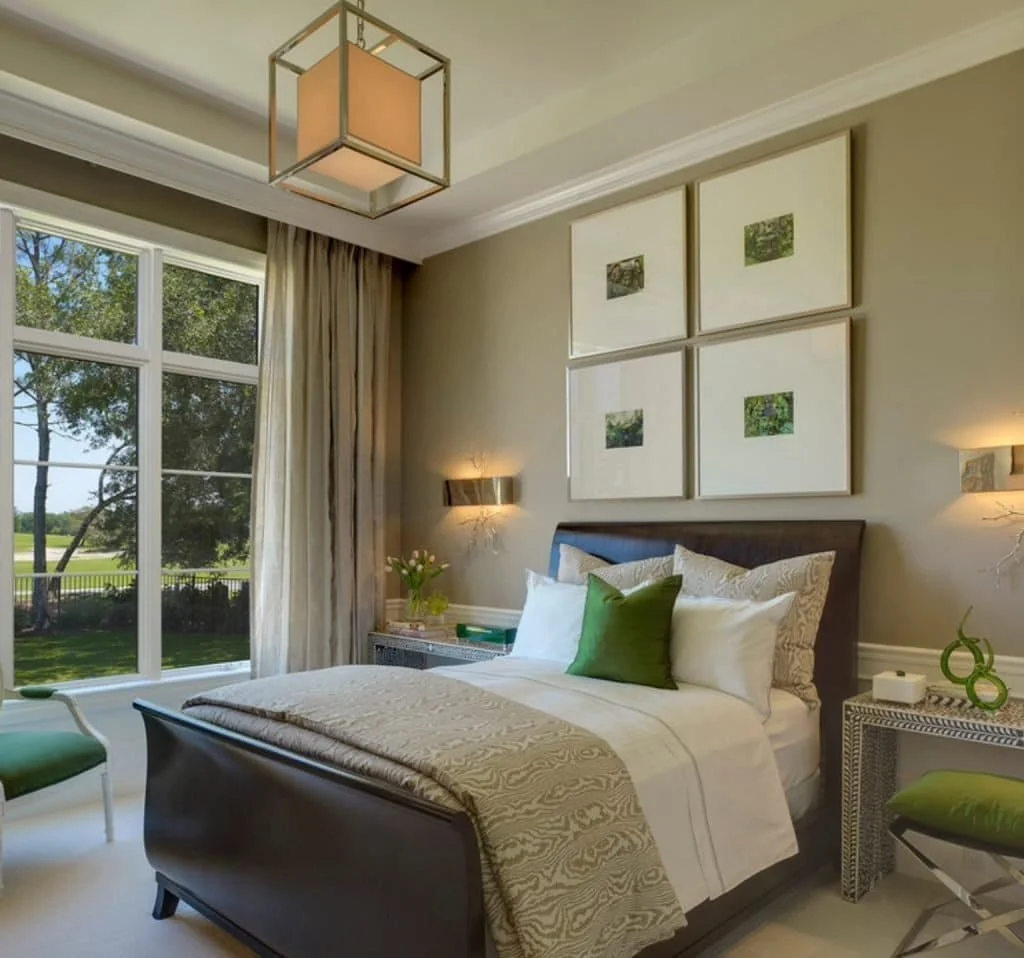
The symmetry is particularly effective from an organizational perspective. The two bedside areas are balanced, the artwork is aligned, and the bed sits clearly within the room’s visual center. Even though several accessories are present, the arrangement feels orderly because everything has a defined position.
I would use this image as an example of why organization is partly visual. A room does not necessarily need to contain less; it needs a sense of structure. The matching bedside placement and carefully aligned artwork create that structure here. For a compact bedroom, I would prioritize symmetry wherever the architecture allows it because it immediately gives the space a more composed appearance.
Cozy Taupe Bedroom With Layered Lighting
The fifth bedroom has a warm taupe and cream palette with a large upholstered bed placed beneath a broad decorative wall treatment. A patterned upper section adds interest above the bed, while small recessed lights illuminate the wall below it. Matching bedside tables and lamps frame the bed, and a dark rug anchors the furniture against the floor.
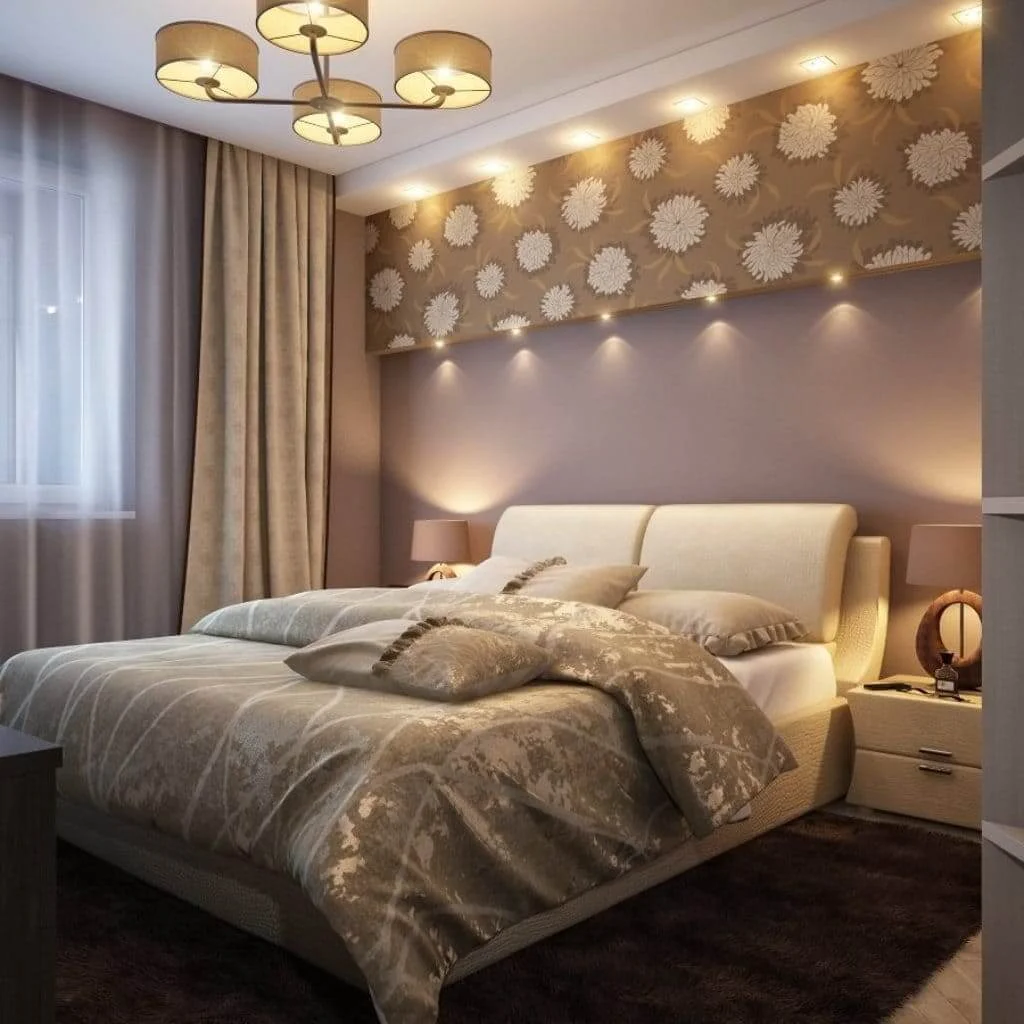
The organization feels effective because the room has a very clear central zone. The bed, bedside tables, lamps, and wall treatment work together as one composition, leaving the furniture arrangement easy to understand. The bedside tables offer useful surfaces without introducing unnecessary pieces, while the large rug visually gathers the sleeping area into a defined zone.
I especially like the layered lighting because it allows the bedroom to remain visually calm even when the main ceiling fixture is not being used. In a small bedroom, I would rather have a few purposeful lighting sources than several unrelated lamps and accessories. This photograph reminds me that a well-organized room can feel cozy simply because its lighting, furniture, and surfaces are visually coordinated.
Small Bedroom With Emerald Headboard and Dedicated Desk
This compact bedroom takes a much more colorful approach, pairing a deep green channel-tufted headboard with coral accents, a striped bedcover, and warm wood flooring. A small desk is built into the shelving area on the right, creating a practical workspace without requiring a separate office zone. The room also includes a compact bedside cabinet, a slim chair, and a large rug beneath the bed.
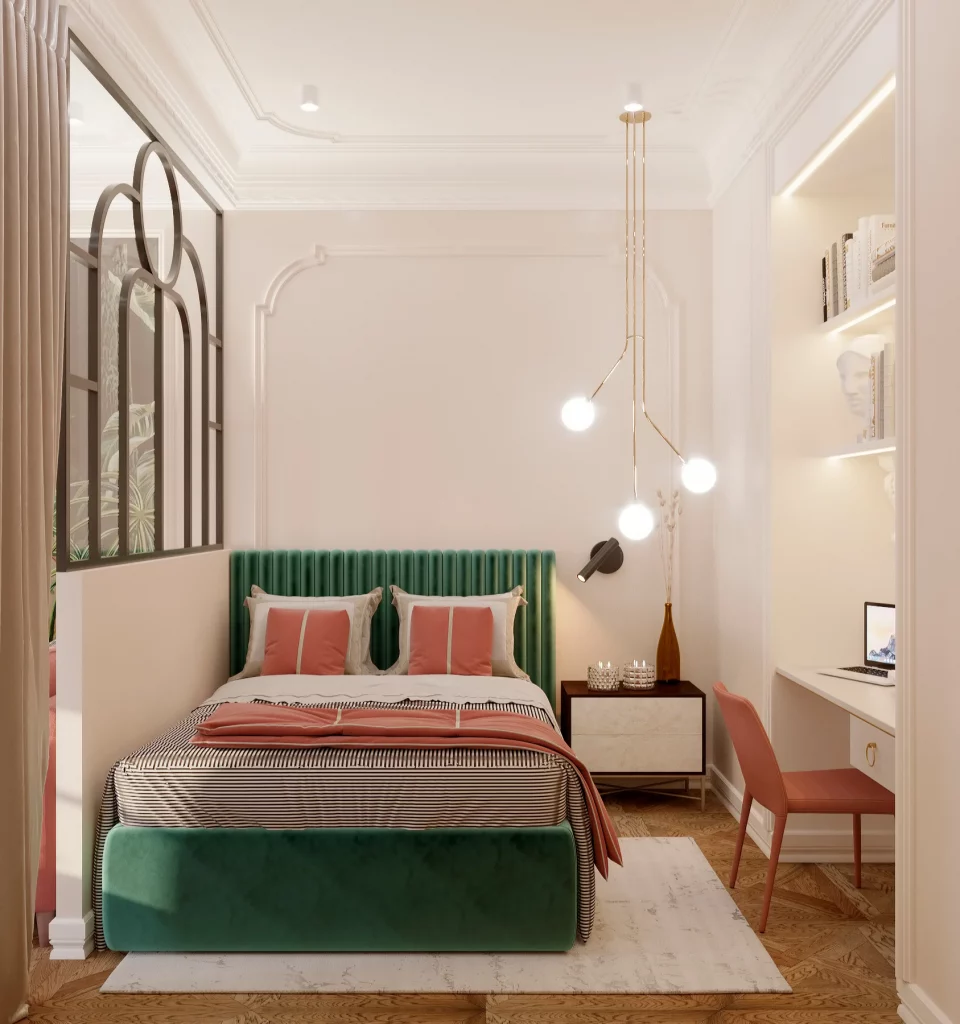
For me, the built-in desk is the standout organizational feature. Instead of adding a freestanding work table that would take up more floor space, the design incorporates a useful working surface directly into the wall cabinetry. The open shelving above provides space for books and objects, while the compact arrangement keeps the center of the room available for movement.
This is exactly the kind of solution I would consider when organizing a small bedroom that needs to serve more than one purpose. A sleeping area and workspace can coexist when the desk is integrated into an existing wall. I also like the way the strong green headboard establishes a visual focal point, allowing the rest of the room to remain relatively simple despite its mixture of colors and patterns.
Cool Gray Bedroom With Minimalist Bedside Furniture
The seventh bedroom is enveloped in cool gray tones, from the walls and curtains to the upholstered bed and bedding. A tufted headboard adds texture, while three framed typographic artworks are arranged above it. Two hanging pendant lights flank the bed, and a compact two-drawer bedside cabinet provides storage on one side.
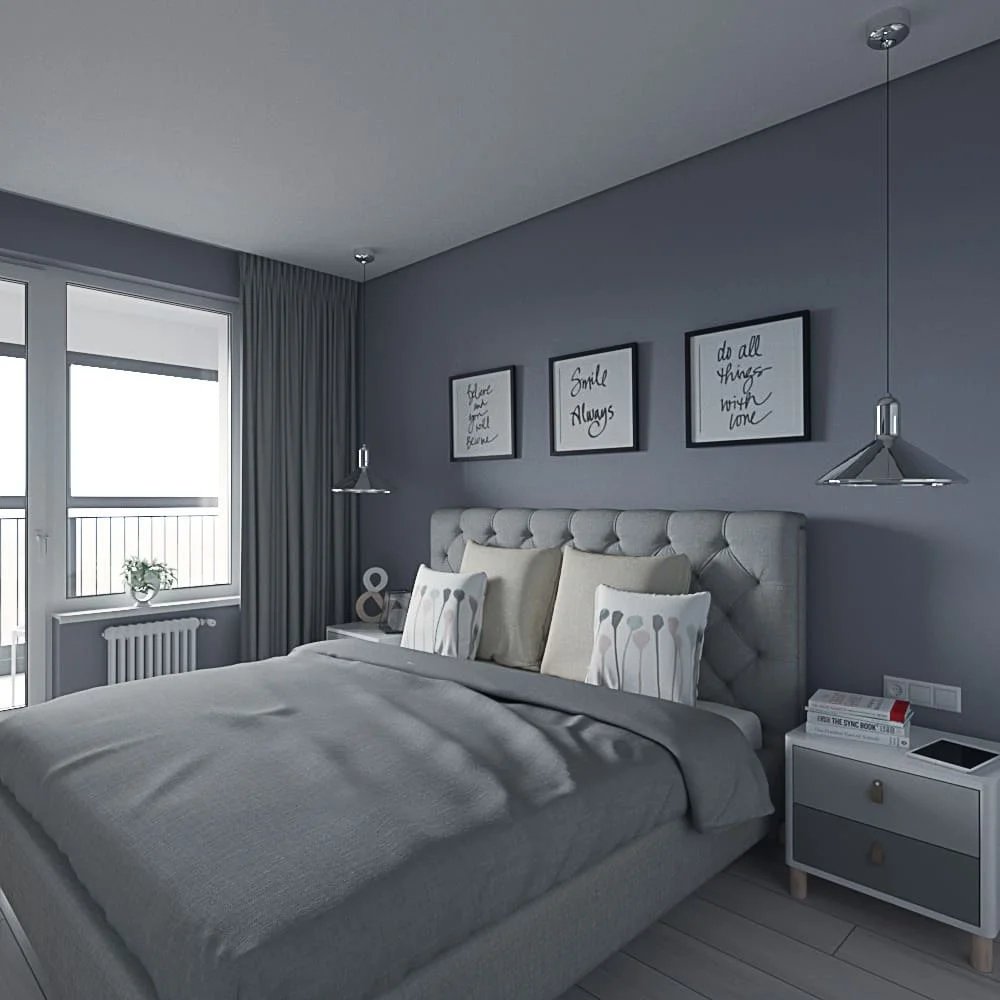
The organization here comes from restraint. There are very few pieces of furniture, and each one has an obvious role. The bedside cabinet keeps necessities contained in drawers, while the wall-mounted artwork adds personality without occupying floor or tabletop space. Even the lighting is suspended, which keeps the bedside areas visually lighter.
I find this particularly useful for a small bedroom because it demonstrates the value of getting furniture off the floor where possible. Pendant lights eliminate the need for bulky bedside lamps, and compact drawers provide practical storage without demanding much space. If I were working with a similarly small room, I would follow this principle and look for every opportunity to keep the floor area open.
Geometric Wood Panel Bedroom With Concealed Warm Lighting
This bedroom features a striking geometric wood-panel wall made from multiple sections arranged in different diagonal directions. The bed is centered directly against this feature wall, with compact bedside areas on both sides and warm lighting tracing the upper edge. A large rug defines the sleeping area, while the rest of the room remains remarkably uncluttered.
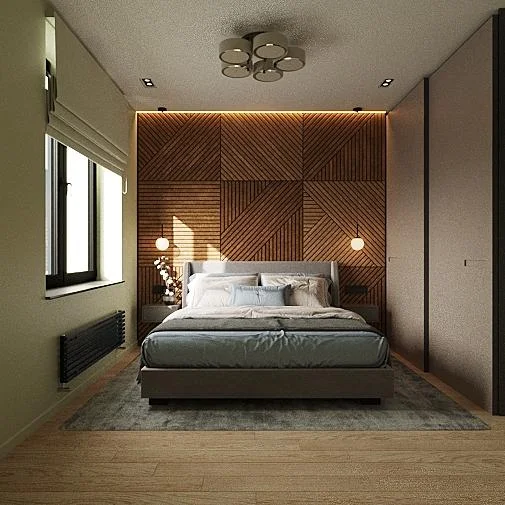
The strongest organizational idea here is the disciplined layout. The bed occupies the central position, the bedside elements remain compact, and the geometric wall provides most of the visual interest. Because the wall is so detailed, there is no need for additional artwork or decorative objects around the bed, which keeps the room from becoming visually crowded.
I would take this as a reminder that organization and decoration can support each other. A thoughtfully designed focal wall can reduce the temptation to fill every available surface with accessories. In a small bedroom, that is a real advantage. I would also keep the rug proportionate to the bed and furniture, as shown here, so the sleeping zone feels defined without making the floor look fragmented.
Modern Gray Bedroom With Two-Tone Wall Treatment
The ninth bedroom uses a sophisticated gray palette and a two-tone wall behind the bed. The upper portion is lighter, while the lower section is a deeper gray, creating a strong horizontal division. A black articulated wall lamp extends over the bed, and a dark slatted partition occupies the right side of the room. The bedding is textured in several shades of gray, while a small decorative figure sits on a compact round table to the left.
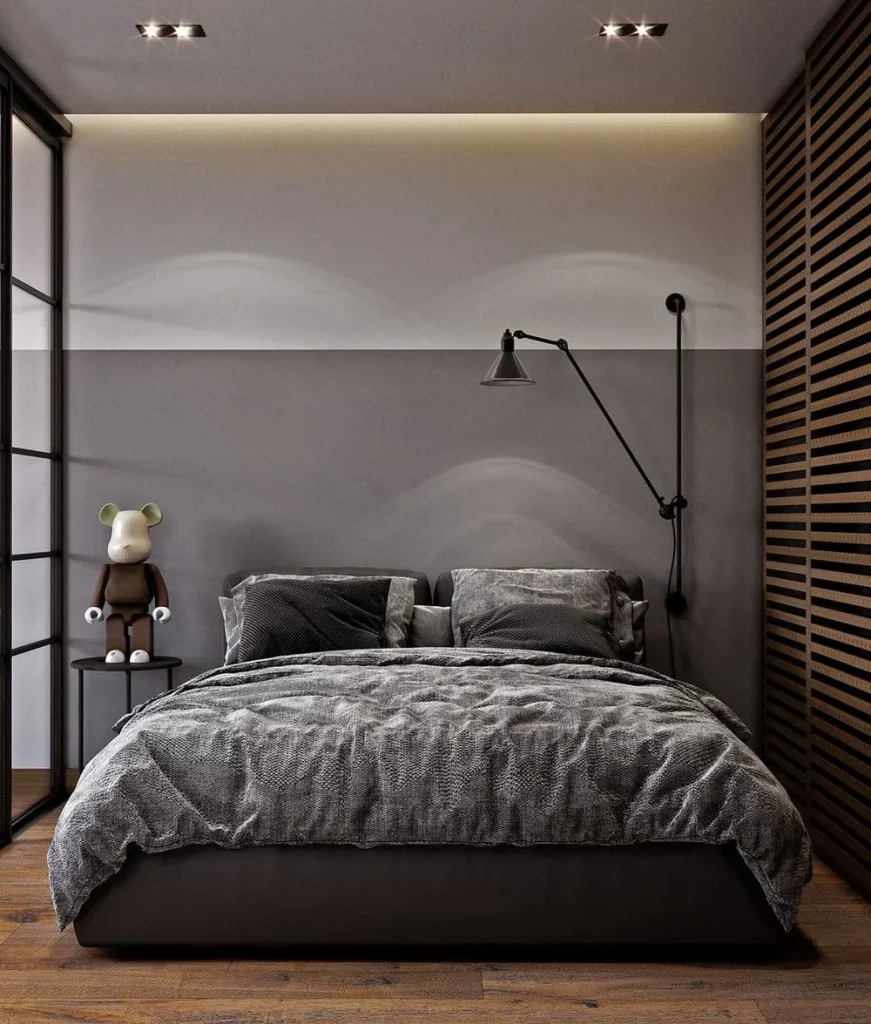
The furniture arrangement is extremely streamlined. Rather than using large bedside tables on both sides, the room relies on a small round surface and a wall-mounted adjustable lamp. The slatted partition also adds architectural definition without introducing another bulky piece of furniture. Everything stays close to the perimeter, leaving the area around the bed visually clear.
I particularly like the wall-mounted lighting solution because it combines function with flexibility. In a small bedroom, a movable reading light can be more useful than a large table lamp that consumes precious surface space. The limited palette also helps the different textures stand out without making the room feel chaotic. This is a good example of how practical choices can still have a strong design presence.
Airy Blue Bedroom With Tall Curtains and Minimal Furniture
The final bedroom feels especially airy, with pale blue walls, a white ceiling with exposed-looking beams, and very tall cream curtains surrounding the large central window. A crystal-style chandelier hangs above the bed, while a light wood wardrobe occupies the right side. The bed itself has a dark base and pale patterned bedding, creating a subtle contrast against the bright room.
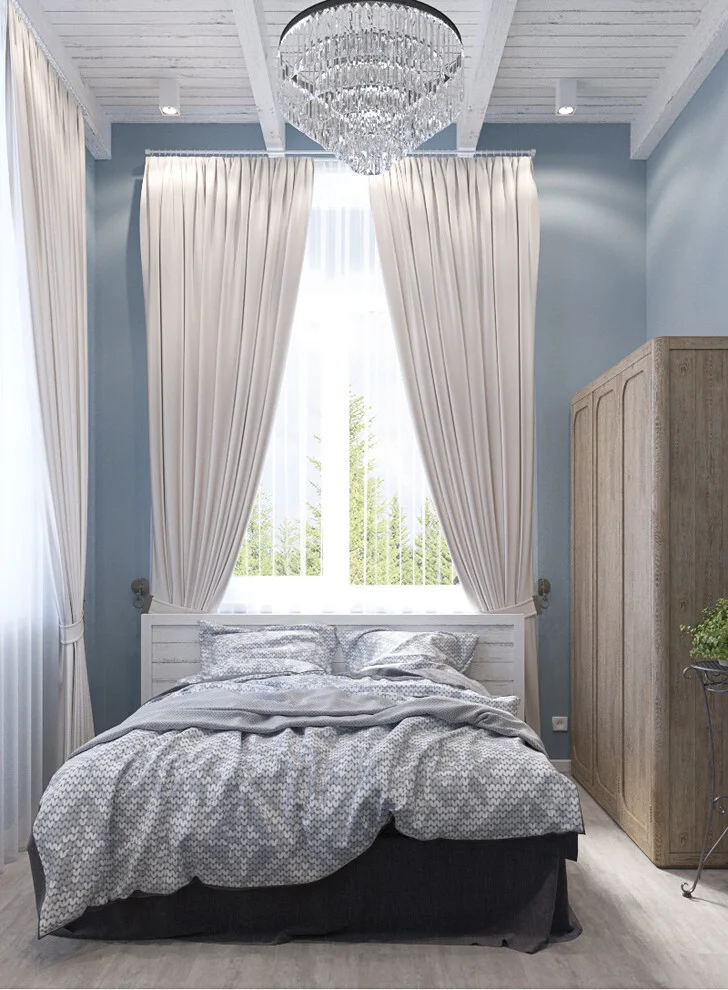
The organization is simple and effective because the room contains only the furniture needed for the main functions visible here. The wardrobe provides substantial vertical storage, while the bed remains centered beneath the window. The tall curtains emphasize the height of the room and draw attention upward, making the space feel larger without requiring additional furniture.
I would borrow the principle of vertical emphasis for any small bedroom where floor space is limited. A tall wardrobe can store more while occupying less horizontal area, and floor-to-ceiling curtains can make a compact room feel more expansive. I also like the decision to keep the rest of the furnishings relatively restrained, allowing the window, curtains, wardrobe, and chandelier to define the room without overwhelming it.
Dark Layered Bedroom With Vertical Wall Storage
I see a compact bedroom centered around a substantial upholstered bed with a patterned dark coverlet, white pillows, and a textured upholstered headboard. Behind the bed, vertical wood-look panels alternate with a textured light wall surface, creating a strong architectural backdrop. Floor-to-ceiling dark brown curtains surround the window, while a multi-arm ceiling fixture provides several downward-facing lights. The warm-toned herringbone floor adds another layer of texture beneath the bed.
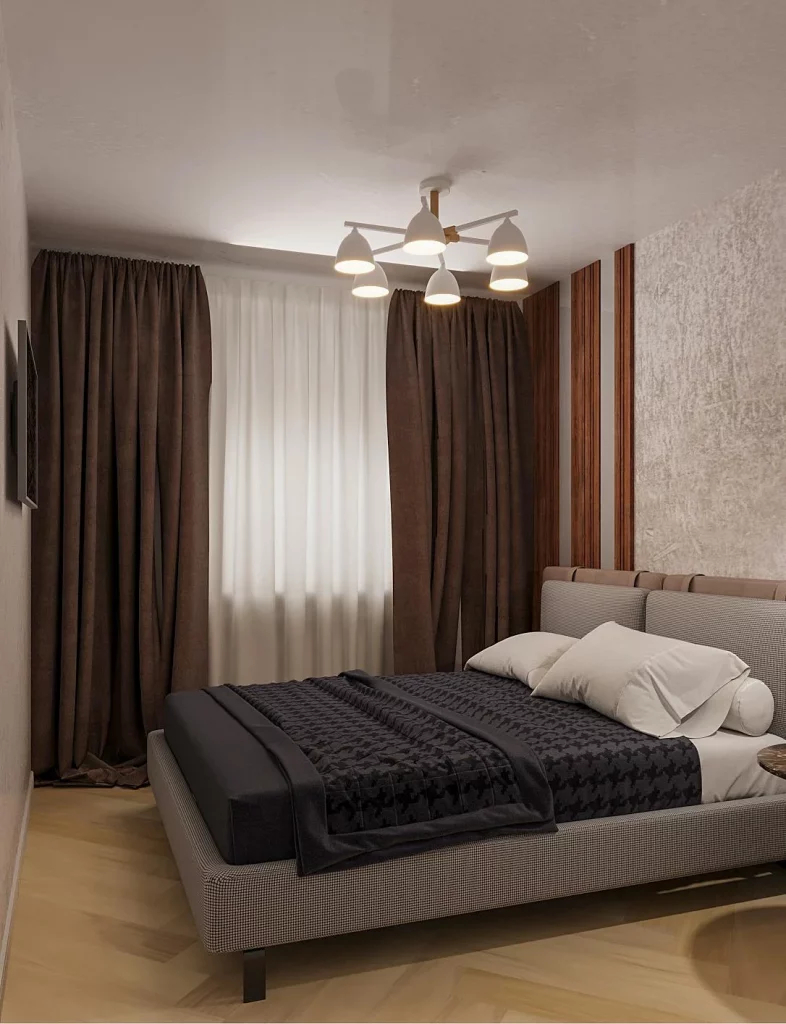
What makes this arrangement effective to me is the way the large bed remains the clear focal point without leaving the room feeling chaotic. The vertical wall panels draw the eye upward, while the long curtains emphasize the room’s height. The upholstered bed also creates a soft visual transition between the dark textiles and the lighter flooring. Even in a relatively compact room, the composition feels intentional because the larger elements are concentrated around the bed.
I would take inspiration from the principle of using vertical surfaces carefully in a small bedroom. Instead of filling every wall with separate decorative objects, I like how this room relies on a few substantial finishes to create interest. If I were recreating the feeling, I would keep the main furniture footprint simple and allow the curtains, wall treatment, and bedding to provide most of the visual character.
Geometric Accent Wall With Soft Gray And Yellow Details
This bedroom uses a restrained combination of white, gray, and yellow. The bed has a simple white upholstered headboard and is covered with a pale gray quilt, while patterned pillows introduce yellow and gray geometric details. Behind the bed, a large geometric wall pattern creates a repeating three-dimensional effect. Long curtains combine translucent white fabric with yellow and gray side panels, and small bedside tables sit neatly on either side of the bed.
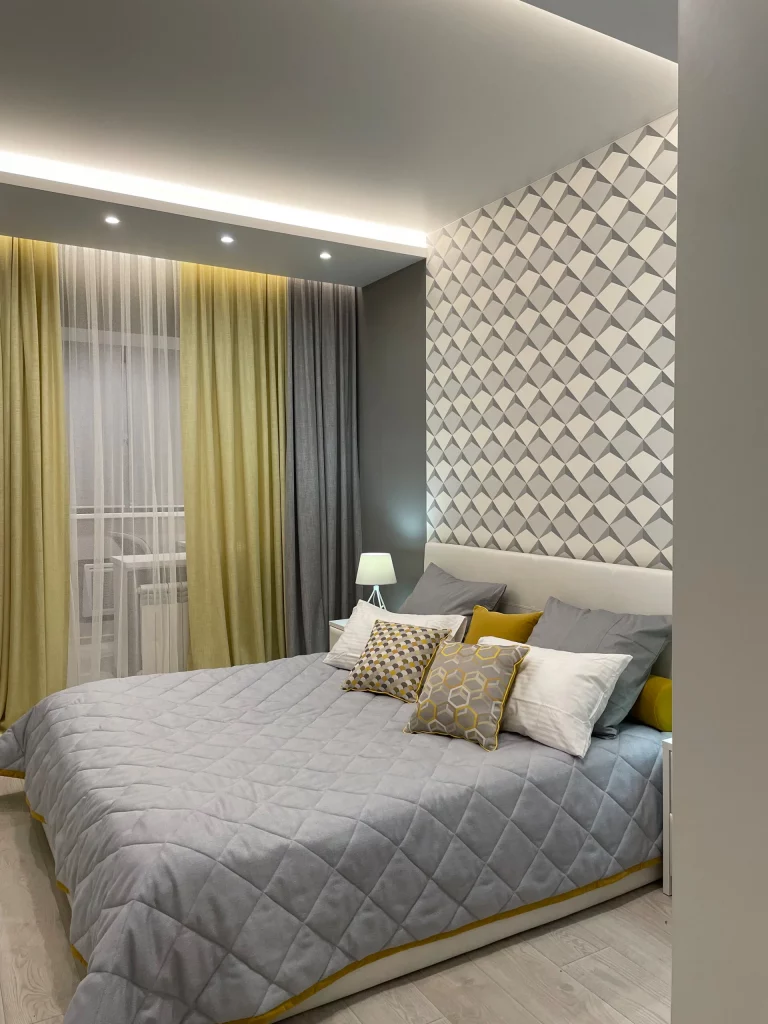
I find the organization especially successful because the room does not need many separate decorative pieces to feel finished. The patterned wall performs the role of an accent feature, while the pillows and curtains repeat its neutral-and-yellow palette. The bedside tables are compact enough to preserve circulation around the bed, and the uncluttered surface around the sleeping area keeps the room visually calm.
For a small bedroom, I would borrow the idea of coordinating several small details with one dominant wall treatment. Rather than introducing numerous colors, I prefer the controlled approach shown here. A geometric accent wall can make a room feel designed without requiring additional furniture, while matching textiles help everything look connected.
Blue Bedroom With A Patterned Headboard Wall
The third bedroom feels airy and carefully balanced through blue, white, gray, and natural wood tones. The bed sits directly against a wood-paneled section, while the upper part of the wall features a white background covered with a delicate linear geometric pattern. A rectangular blue element is positioned above the bed, and blue curtains frame the window on the right. The gray bedding and upholstered bed keep the central furniture understated.
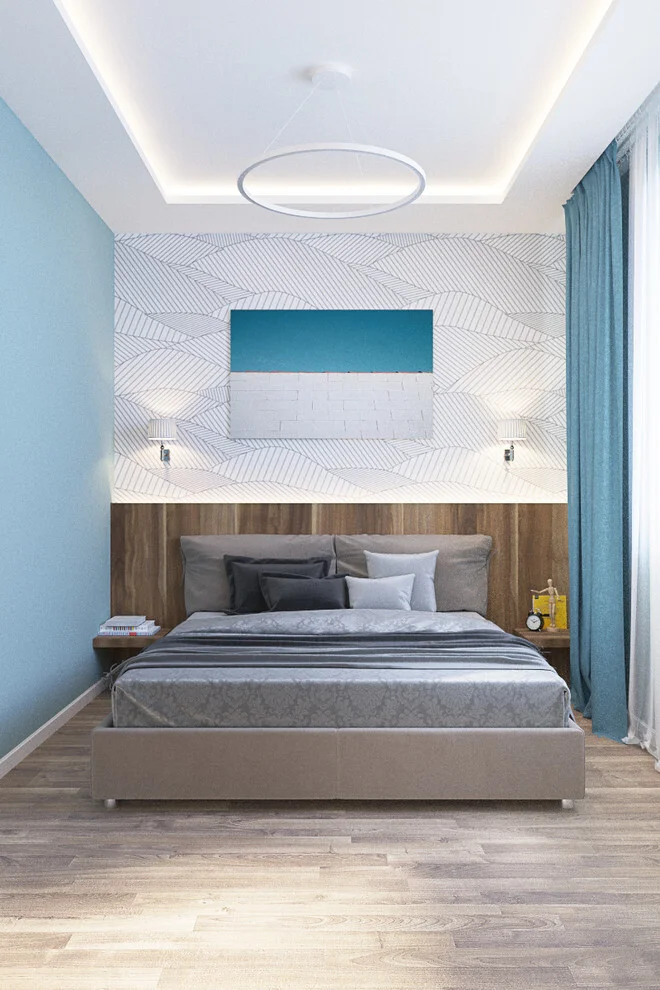
I like how the room uses the wall behind the bed to establish a visual hierarchy without adding bulky furniture. The small bedside surfaces on both sides provide space for everyday items, while the open floor around the bed remains relatively clear. The combination of vertical wood and the patterned upper wall also gives the bedroom a layered appearance without filling the room with accessories.
When I look at small bedrooms, I often pay attention to whether storage and decoration compete for the same floor space. Here, much of the visual work happens above and behind the bed. That is a useful strategy: when floor area is limited, I would look upward and use the wall as the primary place for pattern, color, and architectural emphasis.
Blue Paneled Bedroom With Compact Bedside Storage
This room combines a blue paneled wall with a light upholstered bed and a tufted headboard. Several small rounded mirrors are grouped above the bed, while wall-mounted lights sit on either side. A compact white bedside cabinet provides drawers and a surface for a few framed photographs. The large window brings in plenty of daylight through sheer curtains, while heavier beige curtains frame it. Blue and white bedding reinforces the color scheme.
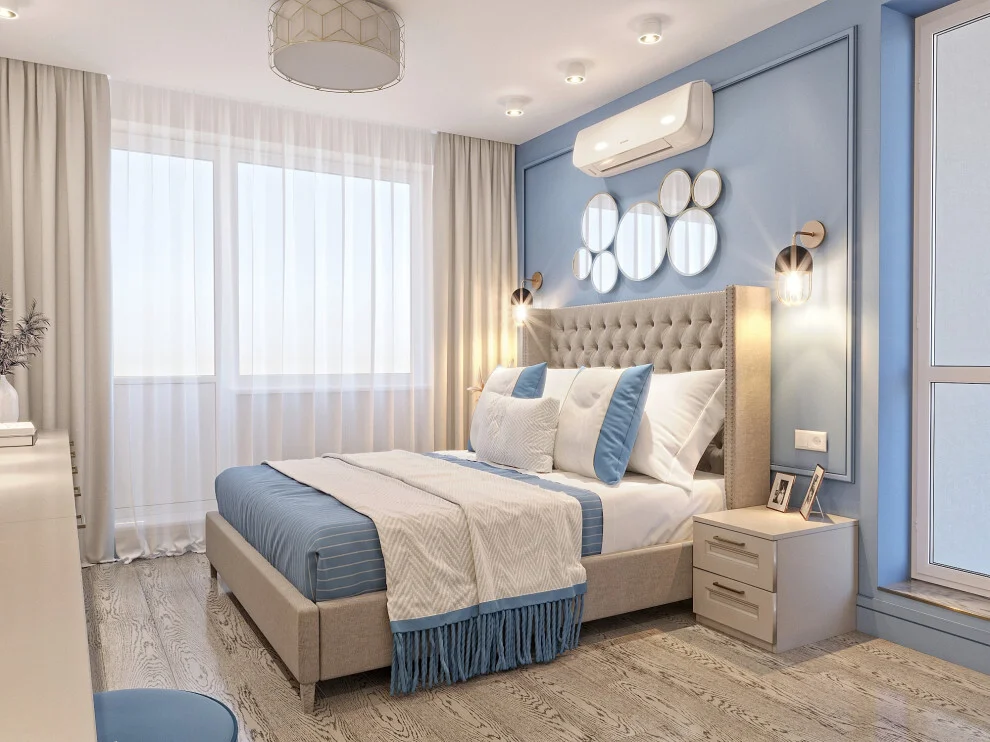
The layout works well because the bedside storage is compact and directly accessible without taking up unnecessary floor area. I also like the use of the wall above the headboard, where mirrors add visual interest without requiring another piece of furniture. The large window keeps the room feeling open, and the restrained palette prevents the multiple decorative details from becoming overwhelming.
For a small bedroom, I would consider this a good example of combining storage with visual simplicity. A small chest of drawers can handle practical necessities while also functioning as a bedside table. I would also use wall-mounted lighting whenever possible in a tight layout because it leaves the surface of the nightstand available for the things I actually use.
Soft Gray And Mauve Bedroom With A Built-In Work Area
This bedroom uses a soft gray upholstered bed with pale mauve bedding and decorative pillows. Along the wall beside the bed is a compact white desk with drawers, a chair, and a small wall-mounted shelving unit above it. Two framed abstract artworks decorate the opposite wall, while gray curtains and sheer white window coverings fill the far side of the room. A television is visible at the right edge.
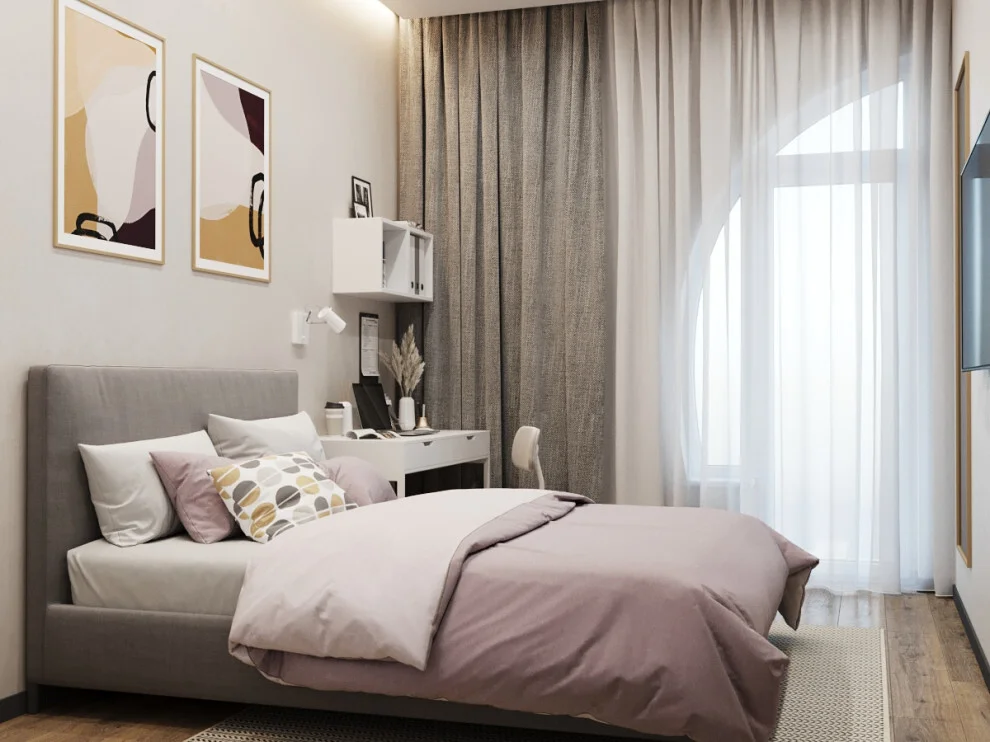
What stands out to me is the efficient combination of sleeping and working functions. Instead of introducing a separate large desk into the center of the room, the workspace is fitted into a narrow section beside the window. The wall shelves provide additional vertical organization, while the closed drawers keep everyday items contained. The result feels much more practical than a bedroom where every function requires its own bulky furniture.
I especially like this approach for anyone whose small bedroom needs to serve more than one purpose. I would keep the desk visually light and choose storage that uses the wall rather than extending deeply into the room. The soft palette also helps the workspace blend into the bedroom instead of making the room feel divided into separate zones.
Blue Framed Bedroom With Window-Facing Storage Potential
This compact bedroom has a strong blue-and-white framework, with blue trim outlining the walls, windows, and doors. A blue-painted bed with simple side rails sits beneath a window overlooking a cityscape. The wall beside the bed features a grid of padded rectangular panels in several muted colors, while small cabinets and shelves sit beneath the main window. A round hanging light occupies the center of the room, and a small round table stands near the bed.
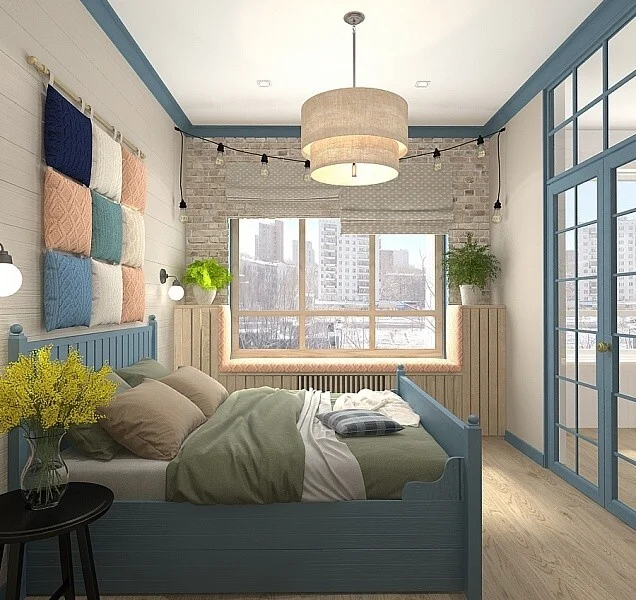
I think the organization works because the furniture is arranged around the perimeter, leaving the center relatively open. The cabinets beneath the window provide useful storage without visually dominating the room, while the compact bedside table takes up very little space. Even the wall-mounted textile panels contribute to the room’s character without occupying floor area.
If I were working with a bedroom this compact, I would pay close attention to every piece of furniture’s footprint. Low storage beneath a window can be particularly useful when the available wall space is limited. I also like how the room uses a consistent blue framework to make the different storage and furniture elements feel like part of one composition.
Calm Neutral Bedroom With Integrated Desk And Wardrobes
This bedroom makes particularly efficient use of its walls. The bed is positioned in the foreground with a simple upholstered frame and white bedding, while tall paneled wardrobes extend along the left and right sides of the room. Beneath the window is a long white desk with an iMac computer, chair, lamp, and several small work items. Beside it, an arched open shelving unit provides display and storage space. Rounded lounge chairs sit near the bed, and the overall palette remains soft white, beige, and gray with small dark red accents.
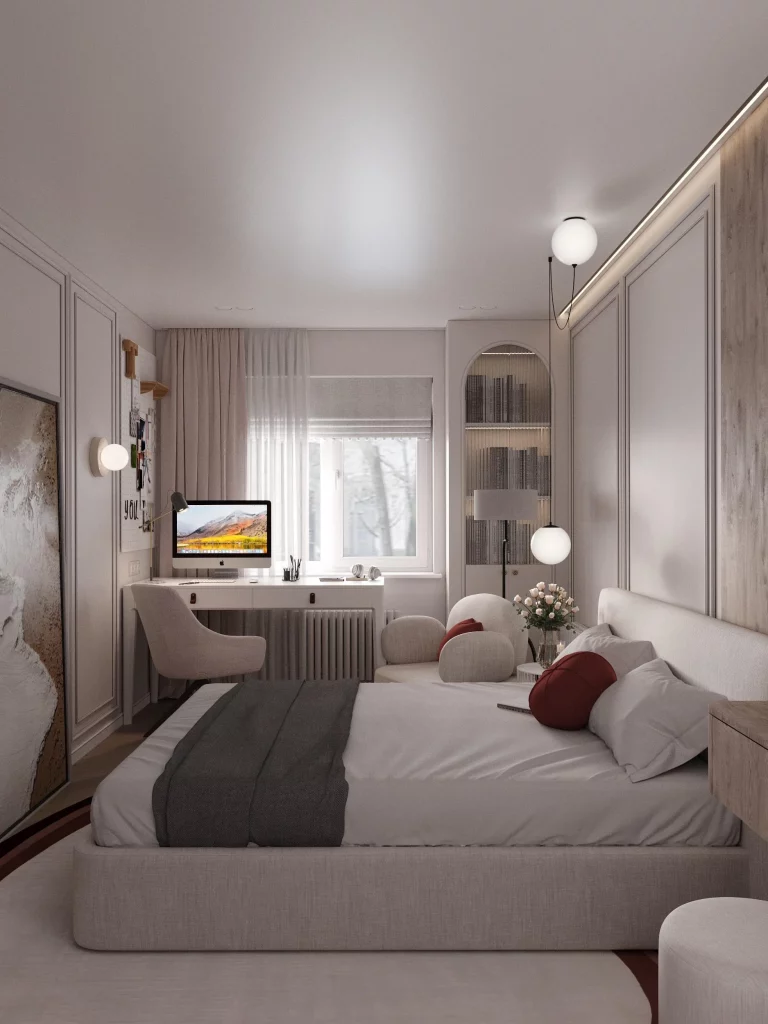
To me, this is one of the strongest examples of multifunctional organization in the collection. The wardrobes use the full vertical height of the room, the desk occupies an otherwise narrow wall beneath the window, and the shelving unit provides additional storage without requiring a large standalone bookcase. The bed remains central, but the surrounding furniture gives the room several functions without making the floor plan feel unnecessarily crowded.
This is the kind of arrangement I would study when planning a small bedroom from scratch. Full-height storage can make much better use of limited wall area than several low cabinets, especially when the room needs to accommodate clothing and a workspace. I also appreciate that the storage surfaces are mostly closed, which helps maintain a visually quiet background around the bed.
White Bedroom With Overhead Cabinet Storage
The eighth bedroom takes a very practical approach to limited space. White cabinets are mounted horizontally above the headboard, creating a continuous storage band across the wall. Small potted cacti and a few objects sit on top, while the bed below is dressed in white and beige striped bedding. A dark chest of drawers stands beside the bed, and a window with a brick surround occupies the right side of the room. The walls and larger furniture pieces remain predominantly light.
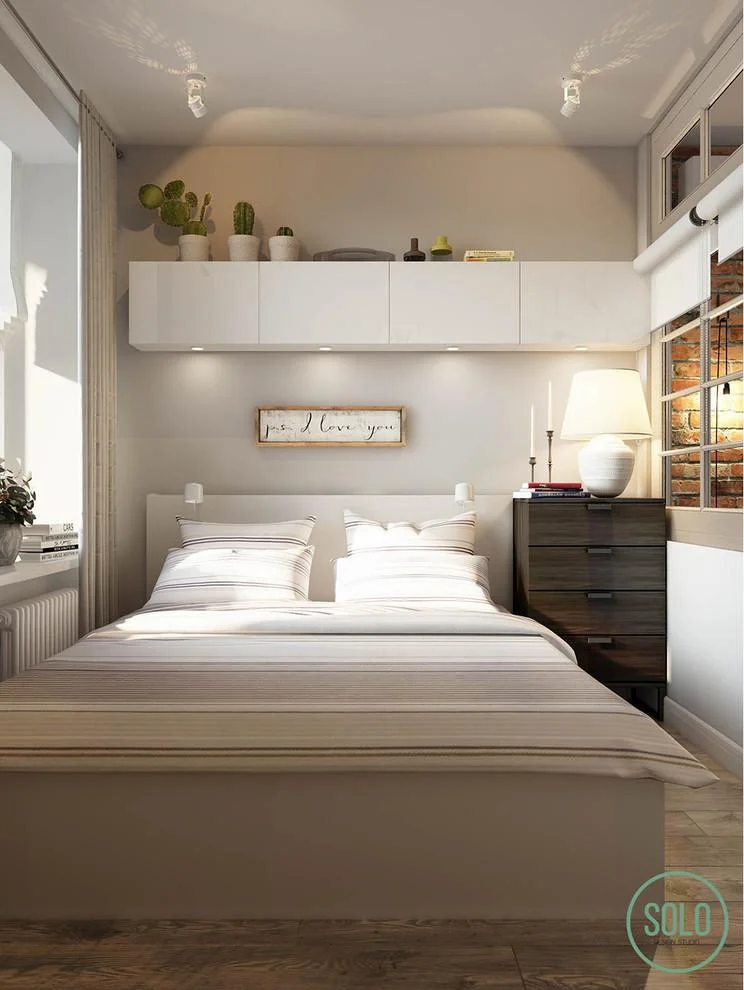
I like the way the cabinets make use of otherwise unused wall space above the bed. Because the storage is elevated and compact, the floor remains available for the bed and bedside furniture. The combination of closed cabinet fronts and a limited number of objects on top also keeps the room relatively orderly. The dark chest beside the bed adds contrast without requiring another large decorative feature.
For a small bedroom, overhead cabinetry can be a very effective organizational solution when installed safely and appropriately. I would keep frequently used items in easily accessible storage and reserve higher cabinets for belongings that do not need to be reached every day. The important lesson here is to use vertical capacity while keeping the visual composition simple.
Yellow Backlit Niche As A Functional Bedroom Feature
This bedroom is centered around a softly upholstered bed with layered gray bedding and white pillows. Behind it, a rectangular recessed display area glows with yellow lighting and contains framed artwork, a decorative bird-shaped object, and several small decorative pieces. The surrounding walls have a pale patterned finish, while two white bedside cabinets sit on either side of the bed. A black table lamp appears on the left, and a dark rug anchors the lower part of the composition.
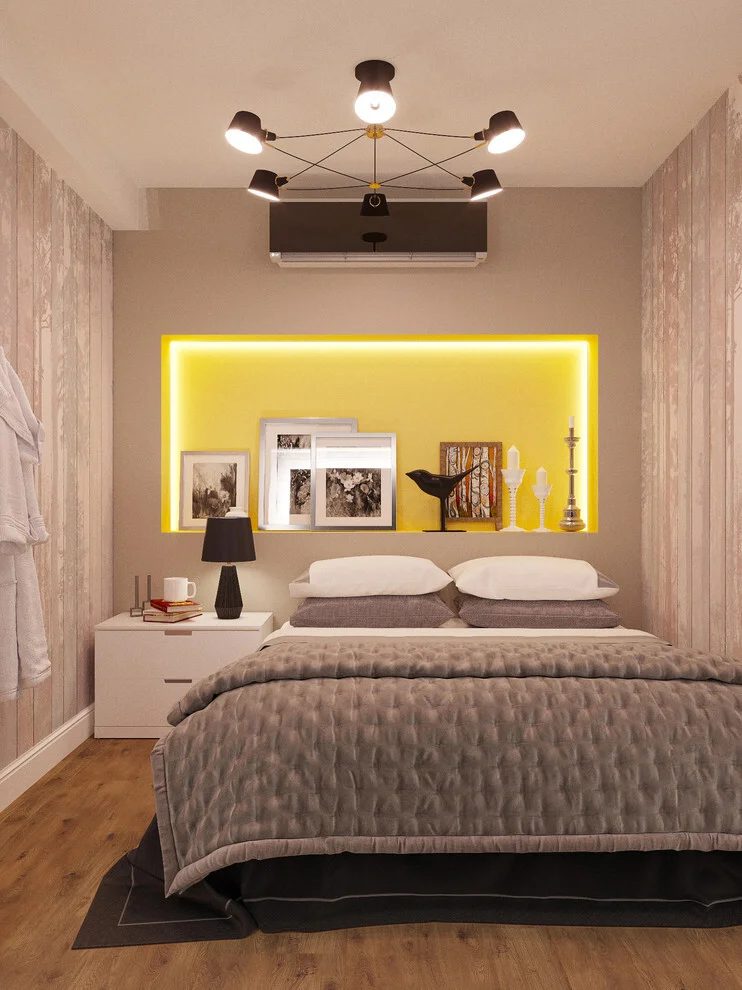
The recessed wall feature is especially useful because it combines display space with lighting instead of requiring additional furniture. I like how the bedside cabinets remain relatively simple while the illuminated niche supplies most of the room’s decorative focus. Keeping the floor mostly clear around the bed also helps the compact layout feel organized.
I would take this idea as inspiration for turning an architectural recess into a useful feature rather than filling a small bedroom with freestanding accessories. A built-in niche can hold a few carefully selected objects while keeping them visually contained. If the room already has a recessed area, I would consider using its existing shape as part of the storage and styling strategy.
Curved Headboard Bedroom With Full-Height Curtains
The final bedroom combines a sculptural curved upholstered headboard with warm wood-look wall panels behind the bed. The bedding is layered in gray and soft pink, while dark brown curtains cover much of the large window alongside sheer white curtains. A large circular ceiling fixture hangs above the bed, and a small seating or working area is visible near the window on the right. The overall palette is warm neutral with carefully controlled darker accents.
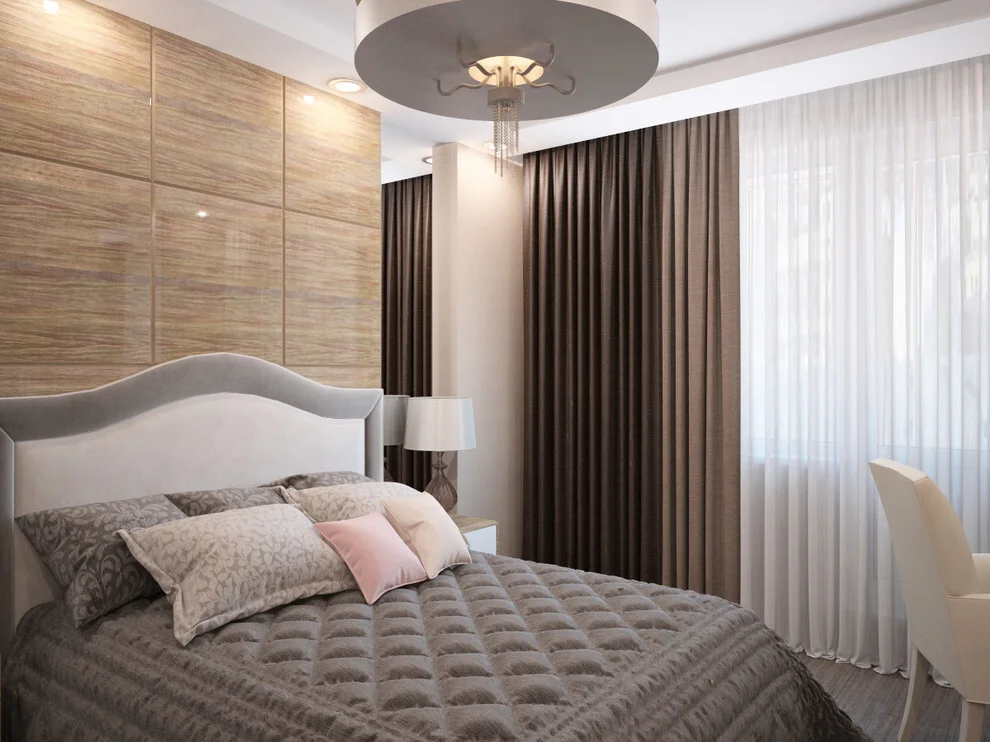
I find the composition effective because the curved headboard gives the bed a strong silhouette without relying on numerous accessories. The full-height curtains create a continuous vertical element along the window wall, while the wood-look panels provide a second large-scale texture behind the bed. The furniture arrangement leaves the main focus on the sleeping area and keeps the additional pieces near the perimeter.
For a small bedroom, I would use this room as a reminder that organization does not always mean adding more storage furniture. Sometimes the most effective solution is to simplify what is visible and allow a few substantial elements to define the space. I especially like the balance between the sculptural bed, restrained bedding, and large window treatments because it creates a cozy atmosphere without making the room feel overloaded.
Moody Blue Bedroom With Streamlined Furniture
I love the strong visual character of this bedroom, where a deep blue paneled wall frames the upholstered bed and creates a defined focal point. The bed has a rounded, padded headboard in a soft taupe-gray tone, while the bedding continues the restrained palette with gray layers and a black throw. On the left, a compact wooden vanity with a large mirror fits neatly beside the bed, accompanied by a small upholstered chair. On the right, a narrow bedside table sits against a striking monochromatic wall treatment featuring oversized leaf-like forms. Pendant lights hang around the bed, while a sculptural ceiling fixture adds another layer of illumination.
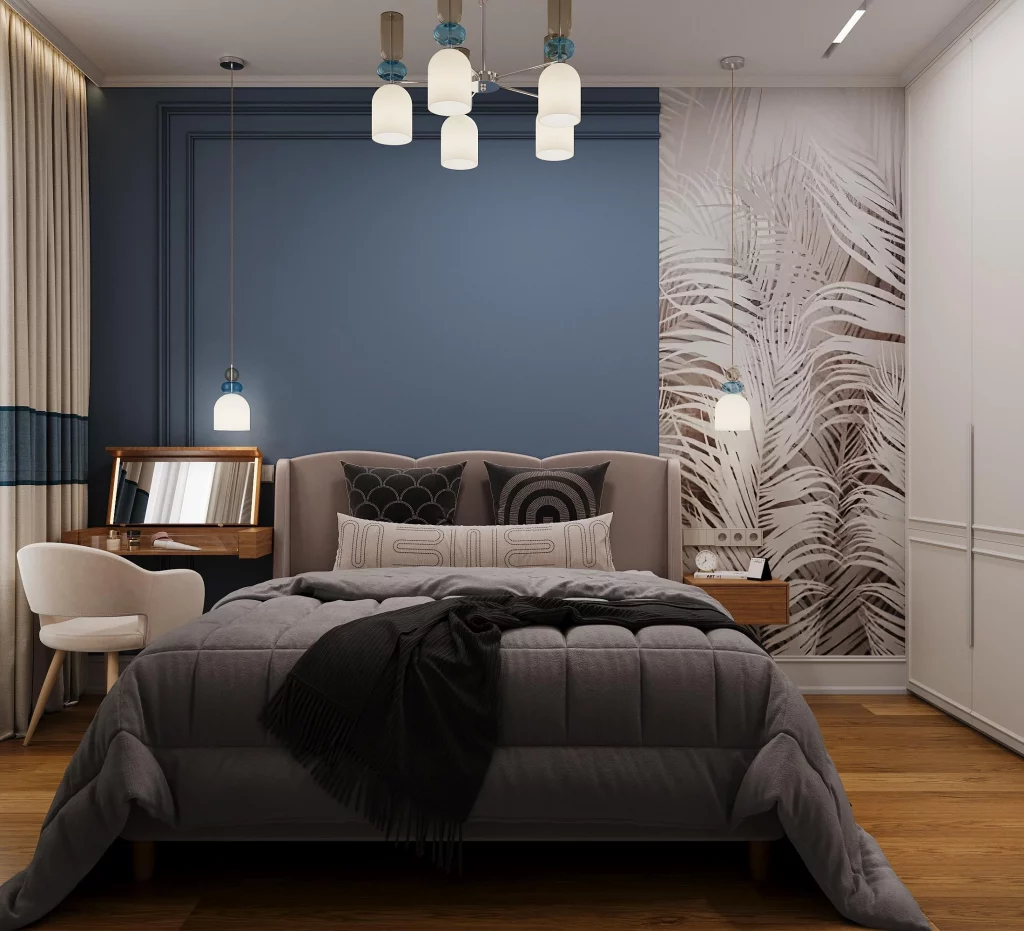
What makes this arrangement work for a space-conscious bedroom is the way the furniture stays relatively compact and purposeful. The vanity uses a narrow footprint while providing a mirror and surface for everyday items, and the small bedside table gives the opposite side of the bed a practical landing spot without visually crowding it. I also think the built-in-looking cabinetry on the right helps keep the room visually clean because the tall storage occupies the vertical space rather than extending farther into the floor area.
From my perspective, this is a good example of using a strong feature wall instead of filling a small bedroom with lots of separate decorative pieces. The deep blue wall and patterned surface already provide plenty of visual interest, so the rest of the furniture can remain simple. I would use the same principle when organizing a compact bedroom: choose one or two visually important elements, then let the remaining pieces perform their practical roles quietly.
Sunny Bedroom With a Compact Window-Side Storage Zone
This bedroom takes a warmer and more traditional approach, with a large window bringing in daylight above a wide sill. The bed is dressed in taupe bedding with a yellow patterned runner, and the upholstered headboard is finished in a cheerful yellow-green tone. A narrow built-in shelving unit rises beside the window and provides several open compartments for books, framed pieces, and small decorative objects. The chandelier overhead adds a classic touch, while the curtains frame the window without overwhelming it.
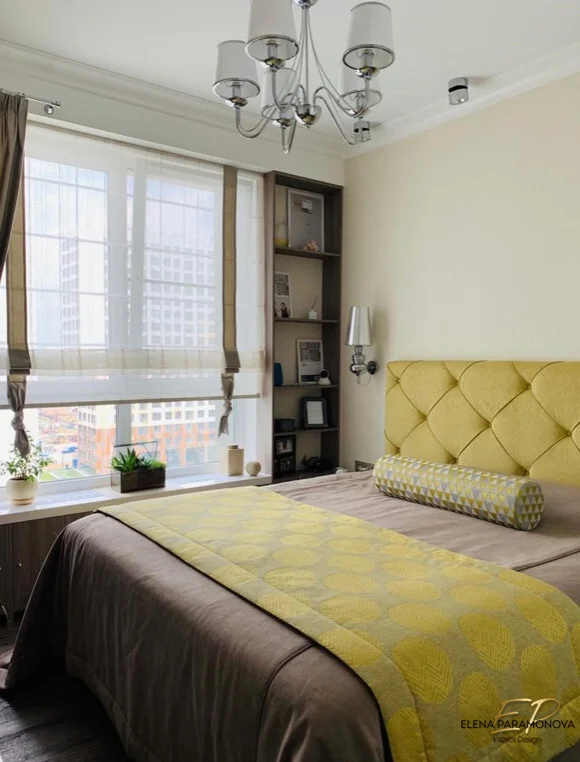
I find the shelving particularly useful in this layout because it makes use of vertical wall space beside the window rather than requiring a larger freestanding cabinet. The broad window sill also becomes a functional surface, with a few small items arranged along it. The result is a bedroom where storage and display are concentrated in specific areas instead of being scattered around the room. Even the long cylindrical bolster pillow reinforces the neat, coordinated feeling of the bed.
When I look at compact bedrooms, I always pay attention to neglected vertical areas because they can offer valuable organization without taking away floor space. This room demonstrates that a narrow shelving tower can hold everyday objects while still contributing to the design. I would keep open shelving similarly edited, displaying only the items that are genuinely useful or visually pleasing so the bedroom remains restful.
Soft Neutral Bedroom With A Curved Curtain Wall
This small bedroom feels almost cocoon-like because of its curved wall and softly gathered curtains behind the bed. The palette is dominated by creamy white and pale beige, with a white upholstered bed, multiple pillows, and a loose brown-toned throw across the duvet. A small round bedside table supports a simple lamp, while delicate metal floral wall sculptures decorate the opposite wall. The pale floor continues the light palette and helps the compact room feel open.
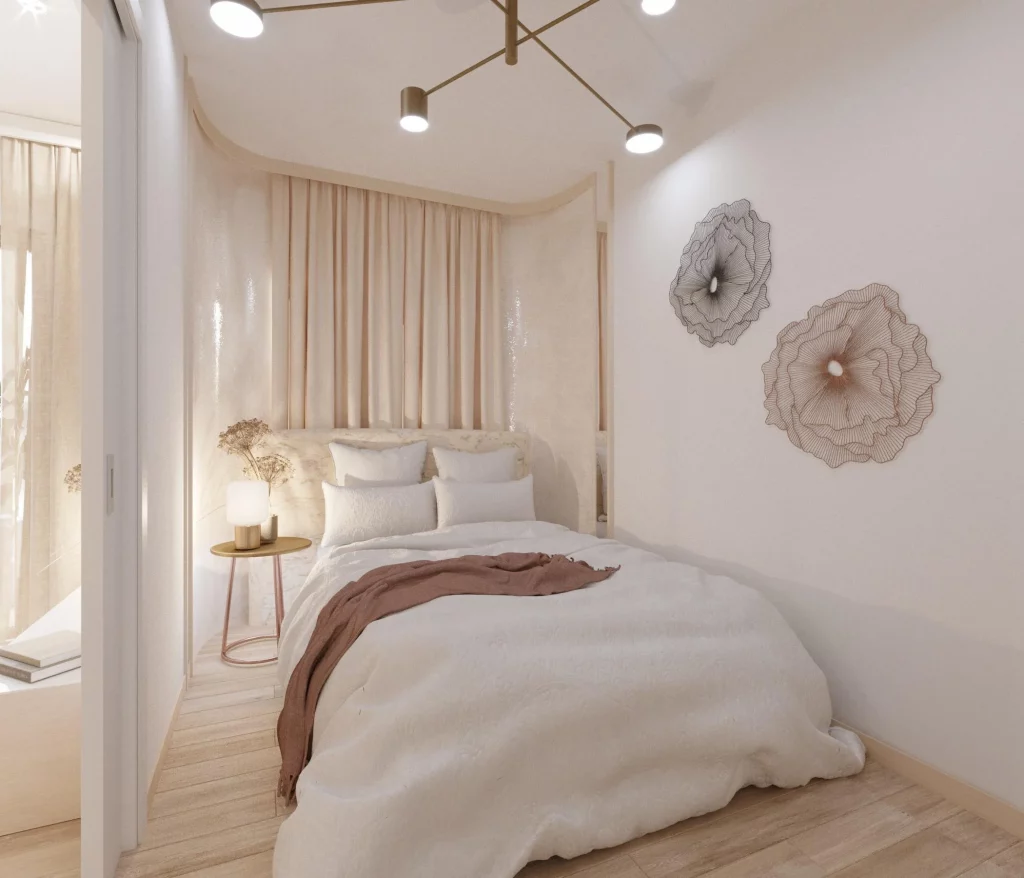
The strongest organizational idea here is restraint. There are very few pieces of furniture competing for space, and the small round table provides just enough surface beside the bed for the visible lamp and a few small objects. Instead of filling the walls with storage furniture, the design keeps the floor open and allows the curved curtain treatment to define the sleeping zone. That makes the room feel organized simply because there is little visual clutter.
For me, this is a useful reminder that a cozy bedroom does not always need more storage furniture. Sometimes reducing what is kept in the room is just as effective. I would take inspiration from this interior by choosing one compact bedside surface, keeping the bedding layers controlled, and allowing the architecture and textiles to create the atmosphere. The soft neutral palette also makes it easier for the eye to move through the room without stopping at too many contrasting elements.
Mustard Upholstered Bed With Coordinated Geometric Details
This bedroom introduces a more decorative look through a mustard-yellow upholstered bed, geometric wallpaper, and a matching three-panel artwork above the headboard. The bedding combines gray, white, navy, and mustard, creating a coordinated palette that carries through to the patterned rug. Long curtains frame a generous window, and a small bedside cabinet provides storage beside the bed. A decorative branch arrangement and wall-mounted lighting add vertical interest without requiring additional floor furniture.
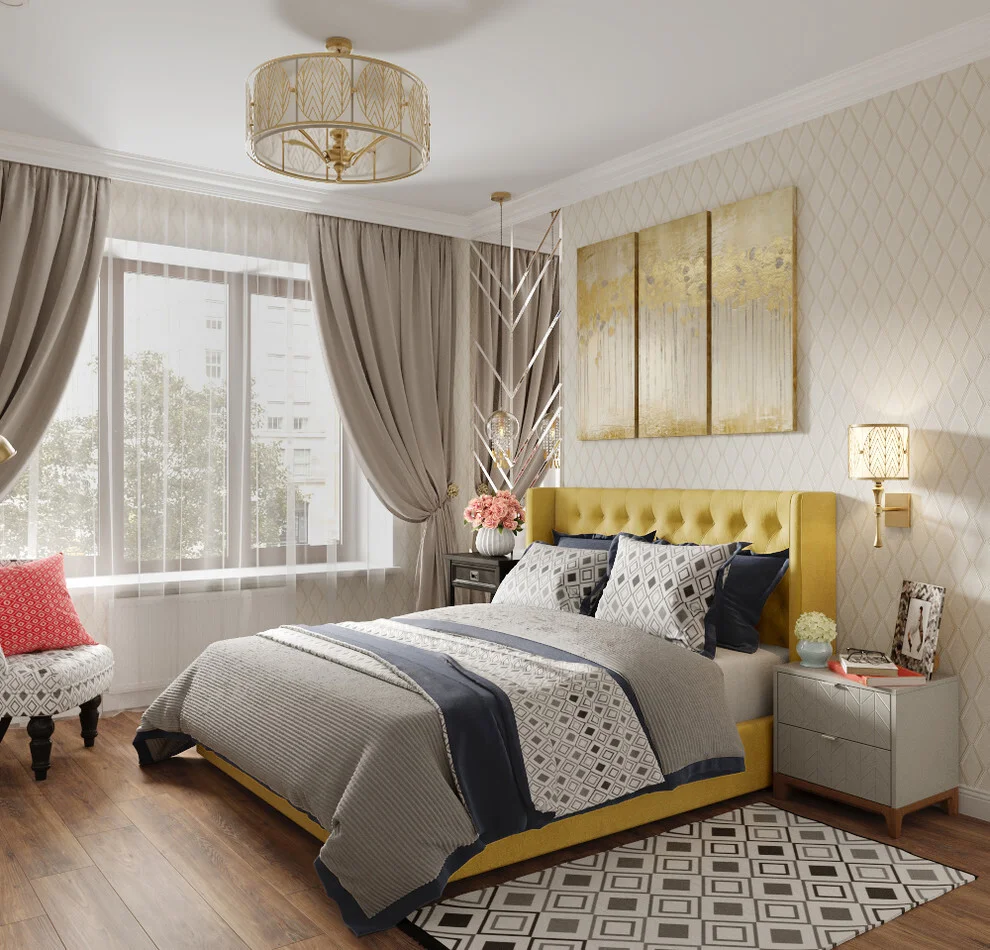
I like the way the room establishes organization through repetition. The geometric patterns appear on the wallpaper, bedding, and rug, while the limited color palette keeps all those details connected. The bedside cabinet is compact enough to sit beside the bed without disrupting circulation, and the open floor around the furniture allows the patterned rug to remain visible. Instead of relying on many accessories, the design lets the main pieces do most of the decorative work.
If I were recreating this feeling in a smaller bedroom, I would follow the same rule of coordination rather than accumulation. A strong headboard, one compact bedside cabinet, and carefully selected textiles can create a finished room without needing numerous accessories. I also think the vertical artwork above the bed is effective because it uses wall space for decoration, leaving the floor available for movement.
Light Bedroom With Built-In White Cabinetry
This bright bedroom uses an almost entirely pale palette, with a white upholstered bed, white bedside furniture, light flooring, and full-length curtains surrounding a large central window. The headboard features soft tufting and a decorative curved outline, while the bedding has a subtle pale pattern and a small light-blue cushion adds contrast. On the right, a white chest of drawers provides closed storage beneath a wall-mounted television. Matching bedside furniture on the left creates a symmetrical composition.
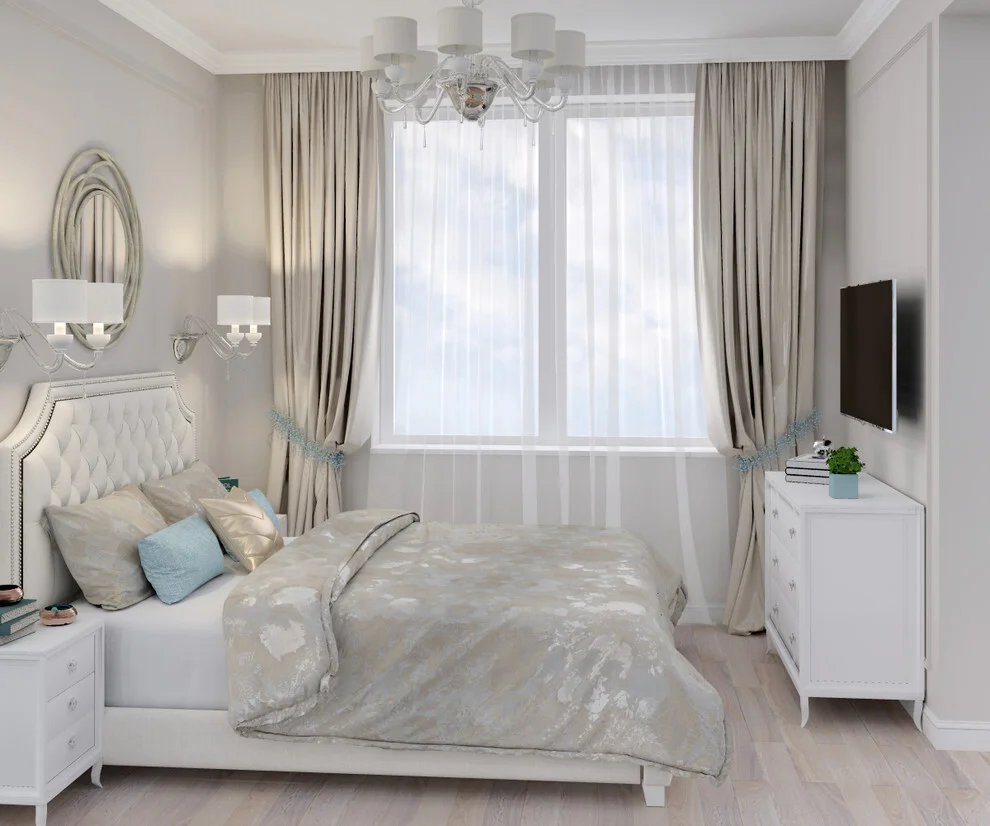
The closed storage is what stands out to me most from an organization perspective. The chest of drawers keeps belongings contained and gives the room a clean appearance, while the bedside cabinet provides another dedicated storage surface without adding visual weight. Because most of the furniture is white or very light, these pieces blend into the background rather than making the bedroom appear more crowded.
I often find that compact bedrooms benefit from closed storage because it reduces the number of objects visible at any one time. This room shows how that approach can work without making the interior feel sterile. The soft curtains, upholstered bed, patterned duvet, and pale-blue accent introduce enough texture and variation to keep the room comfortable while the storage remains visually quiet.
Small Bedroom With A Compact Desk And Coral Curtains
This bedroom has a more unusual arrangement, with the bed positioned toward the back of the room and framed by sheer coral-colored curtains. A blue upholstered headboard and matching round stool create a cozy seating detail, while a compact desk occupies the foreground on the right. A small cabinet stands near the bed, and four framed artworks are arranged in a tidy grid on the left wall. The warm wood tones of the furniture contrast with the blue seating and soft coral textiles.
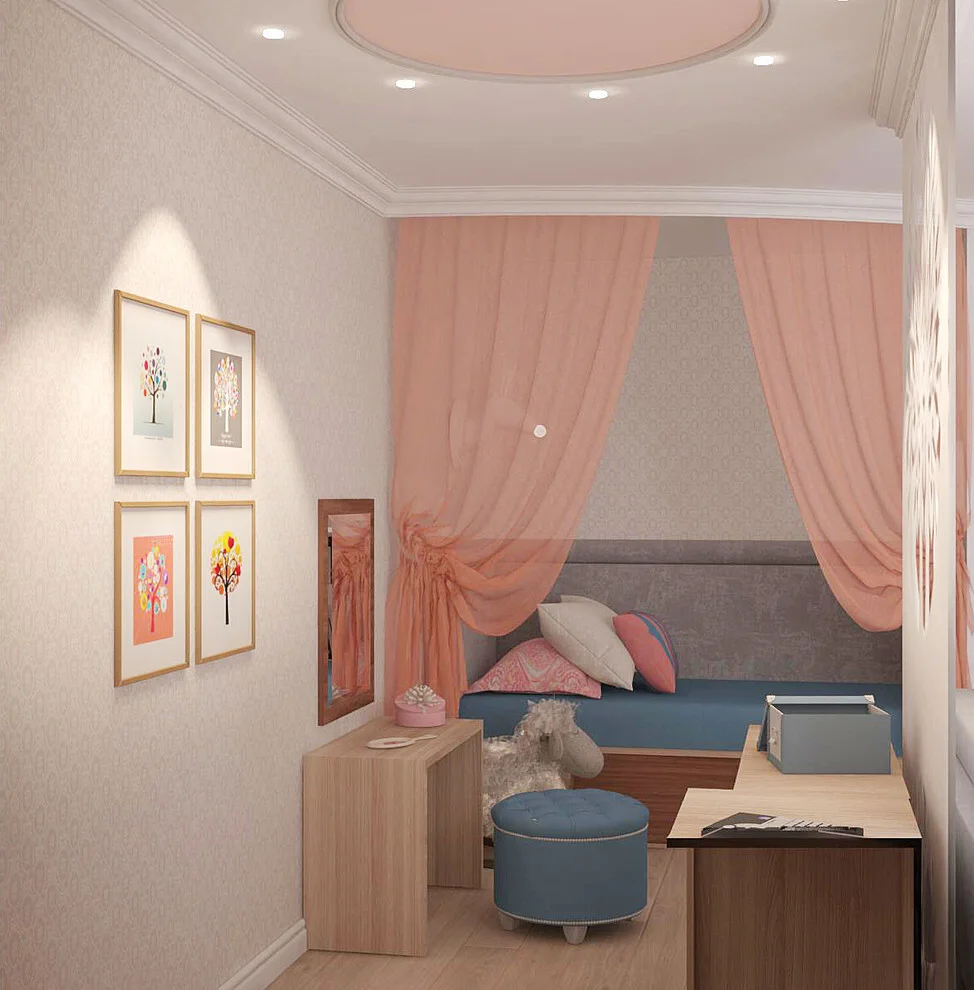
I think the most useful organization idea here is the combination of functions within a limited footprint. The room incorporates sleeping, working, storage, and a small seating area without relying on large pieces. The desk occupies a narrow section along the side, while the cabinet provides enclosed storage nearby. The framed artwork is also arranged vertically, allowing the wall to carry decorative interest without taking up any usable floor space.
This layout reminds me that a small bedroom can sometimes work harder when each zone has a clear role. I would keep the same principle when organizing a room like this: separate sleeping and working areas visually, keep furniture close to the walls, and avoid adding pieces that duplicate an existing function. The curtains around the bed also create a visual boundary, which can make a compact sleeping area feel more intentional.
Warm Bedroom With A Functional Window Bench
This bedroom makes excellent use of the area beneath a large window. The bed sits along the left side of the room, while the entire window wall incorporates a built-in bench with drawers or cabinets underneath. A collection of patterned cushions makes the bench comfortable, and tall cabinetry extends upward on either side. The room uses beige, cream, gray, and warm brown tones, with a sculptural black-and-glass ceiling light providing contrast.
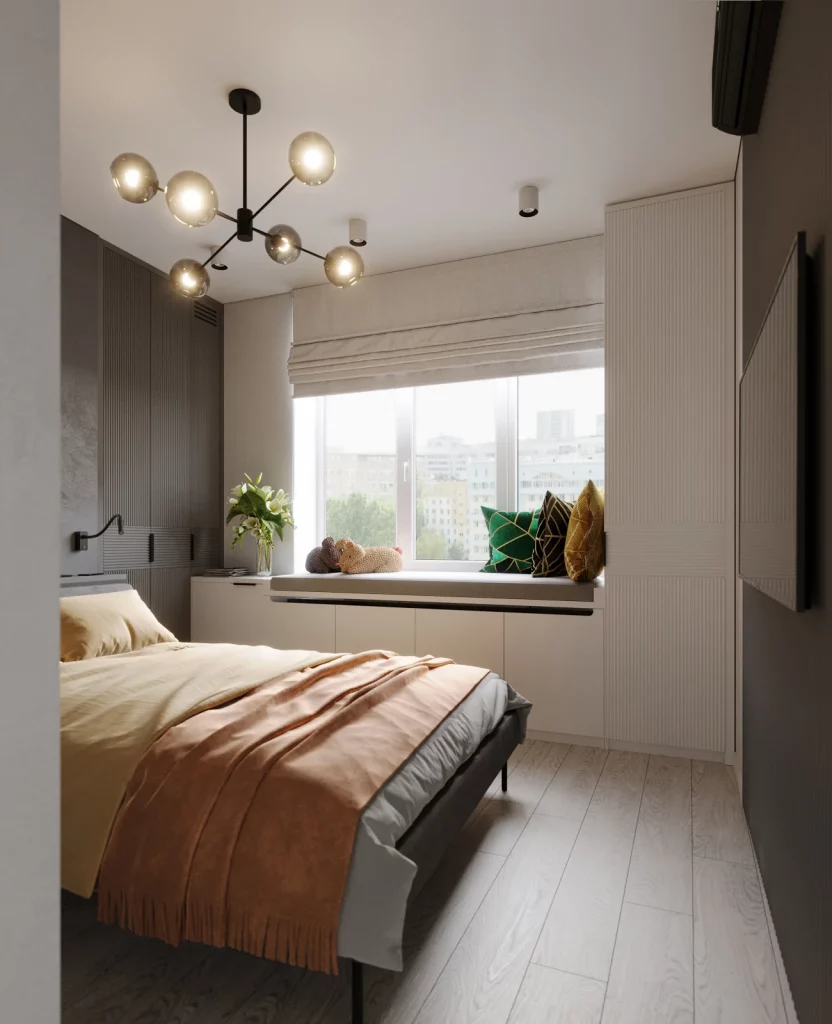
For me, the window bench is the clearest organizational feature in this image because it transforms an otherwise difficult-to-use area into functional storage and seating. The cabinetry below the window provides concealed space, while the tall units on the sides take advantage of vertical height. This is exactly the kind of arrangement that can make a smaller bedroom feel more efficient because storage is integrated into the architecture instead of occupying additional floor area.
I particularly like the way the built-ins create one continuous composition. Rather than placing a separate cabinet, chair, and storage unit around the window, the design treats the entire wall as one organized zone. If I were planning a compact bedroom, I would consider a similar approach wherever there is a large window or awkward wall section. The key is to make the storage feel like part of the room rather than an afterthought.
Elegant Bedroom With A Large Mirrored Wardrobe
This bedroom combines a soft beige palette with a dramatic mirrored wardrobe extending along the right side of the room. The upholstered bed has a tall vertically textured headboard, while a white bedside cabinet sits close to it. A large window fills the back wall with daylight, framed by layered curtains in beige and a patterned dusty-rose tone. A delicate sculptural chandelier hangs above the room, and a narrow wall shelf holds a television on the opposite side.

The mirrored wardrobe is the standout organizational solution because it provides substantial storage while visually reflecting the room. Its tall doors use the wall efficiently, and the reflective surface helps prevent such a large storage element from feeling visually heavy. The bedside cabinet is also deliberately compact, leaving the circulation around the bed open and easy to navigate.
In my experience, wardrobes are often the most challenging pieces in a small bedroom because they can dominate the room. This example shows why full-height, visually integrated storage can be a smart choice. When the storage occupies one clear wall, the rest of the bedroom can remain relatively simple. I would also keep the area around the wardrobe uncluttered so its reflective surface continues to contribute to the sense of openness.
Blue Bedroom With A Built-In Wardrobe And Work Nook
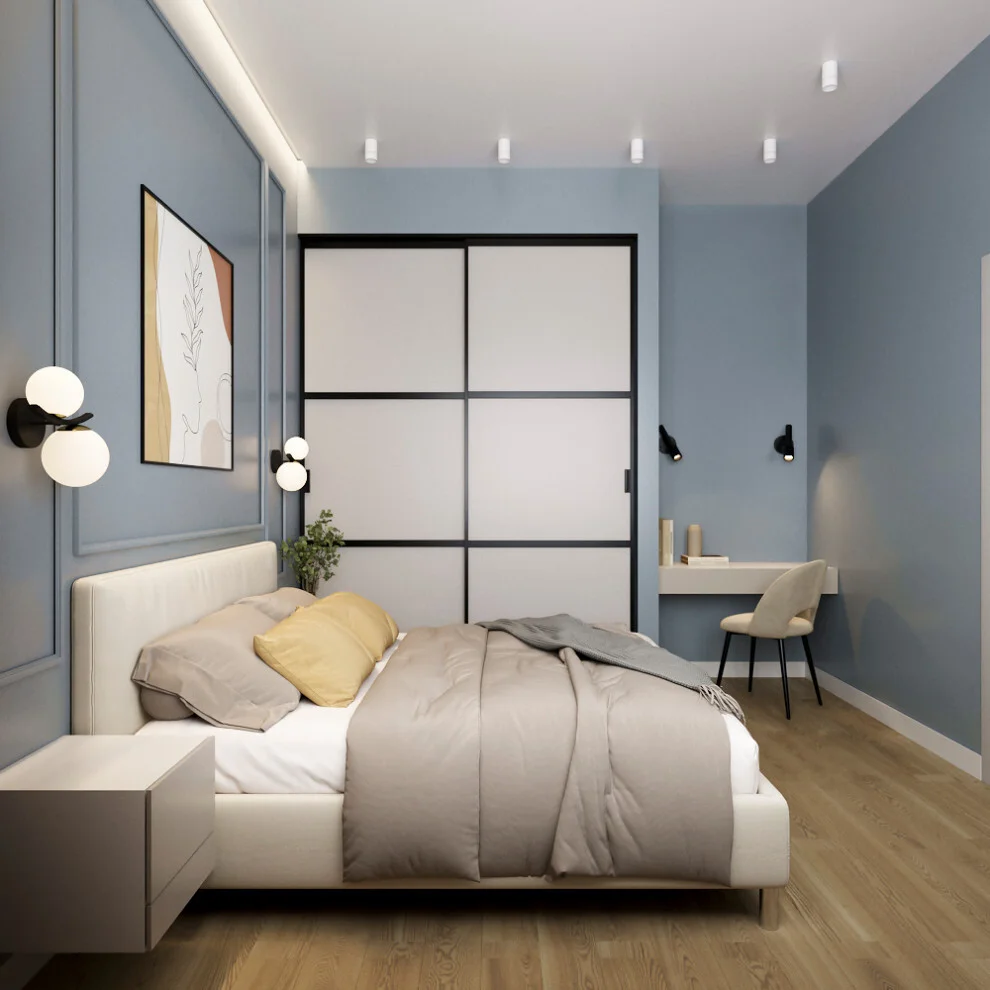
This bedroom uses a calm blue palette across the walls, with a white upholstered bed positioned in front of a paneled feature wall. A large built-in wardrobe with white doors and dark framing occupies the back wall. To the right, a narrow desk is integrated into the wall beneath a small shelf, paired with a compact chair. Black wall lights provide focused illumination around the bed and desk, while the warm wood floor adds contrast to the cool blue walls.
I think this is one of the clearest examples in the collection of using built-in elements to save space. The wardrobe takes up an entire wall but remains organized and visually controlled, while the compact desk uses a small section beside it rather than requiring a separate office area. The bedside cabinet is also narrow, and the open floor around the bed keeps circulation straightforward.
What I take from this room is the importance of combining functions rather than simply adding furniture. A wardrobe and workspace can coexist along one wall, allowing the rest of the room to remain dedicated to sleeping. For a compact bedroom, I would consider this kind of integrated arrangement whenever possible. The simple blue-and-white palette also helps the different functions feel like parts of one cohesive room.
Minimal Bedroom With A Streamlined Wall-To-Wall Storage System
The final bedroom has a clean, contemporary composition built around pale blue walls, a low white upholstered bed, and a large wardrobe with simple white panels framed in dark lines. A small white bedside cabinet sits beside the bed, while a compact desk and chair occupy the far right corner beneath a narrow shelf. Simple black wall sconces provide task lighting, and a framed line-art print adds a restrained decorative detail above the bed. Warm-toned flooring softens the cool wall color and white furniture.
The organization here is particularly effective because the room keeps its storage concentrated along one wall while preserving a clear central floor area. The wardrobe doors are visually simple, and the desk is narrow enough to fit into the remaining corner without making the room feel overloaded. Even the bedside cabinet has a compact form, giving the bed a practical companion without consuming unnecessary space.
I would use this image as a reminder that good small-bedroom organization is often about visual discipline as much as storage capacity. The room does not depend on numerous decorative objects; instead, the wardrobe, desk, bed, and lighting each have a clear purpose. I also like the restrained artwork because it adds personality without introducing another busy visual element. For anyone organizing a compact bedroom, this kind of calm, purposeful arrangement can make everyday life feel considerably easier.
Streamlined Taupe Bedroom With A Dramatic Dark Accent Wall
The first bedroom immediately feels calm and carefully edited. A taupe upholstered bed occupies the center of the room, paired with simple low-profile bedside cabinets and crisp white bedding layered with dark gray and taupe throws. Behind the bed, a deep charcoal-blue accent wall creates contrast, while a narrow illuminated edge separates it from the lighter wall beside it. Floor-to-ceiling curtains frame a large window and soften the room with their heavy vertical folds.
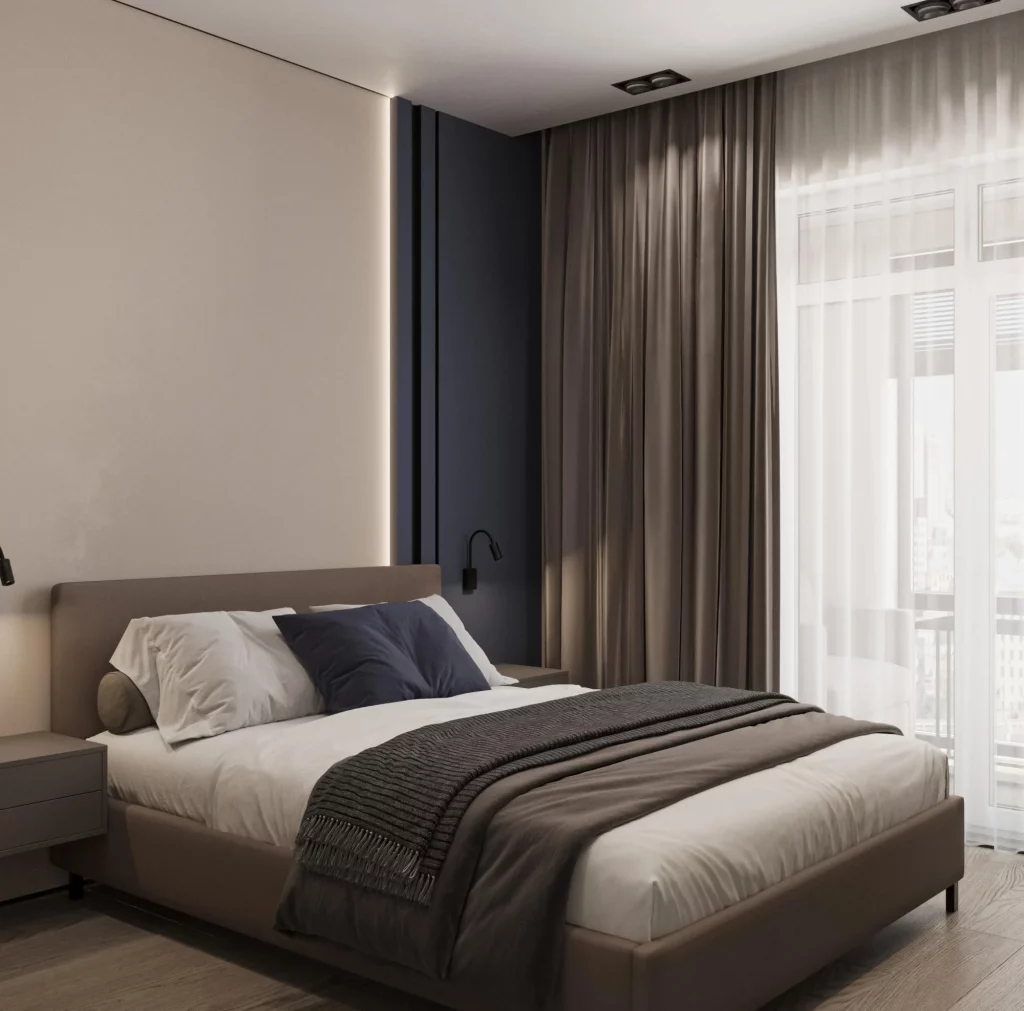
I like how little furniture is needed here to make the bedroom feel complete. The bedside cabinets provide practical surface and drawer storage without visually competing with the bed, while the restrained palette keeps the room from looking busy. The wall-mounted reading light beside the bed is another smart detail because it provides focused illumination without requiring a bulky table lamp.
From my perspective, this is a strong example of how a small bedroom benefits from visual restraint. I would keep the main furniture pieces simple and let one architectural feature, such as the dark accent wall, provide the personality. The long curtains also draw the eye upward, which can make a compact room feel taller and more finished.
Compact Bedroom With A Burgundy Bed And Statement Chandelier
This bedroom takes a much richer approach, combining a deep burgundy upholstered bed with warm taupe curtains, a large central window, and a striking multi-tiered glass chandelier. The bed sits directly in front of the window, while a slim white floating media cabinet occupies the opposite wall. Rounded bedside furniture and a mixture of patterned and solid pillows add softness, while the burgundy tones continue into the surrounding walls and textiles.
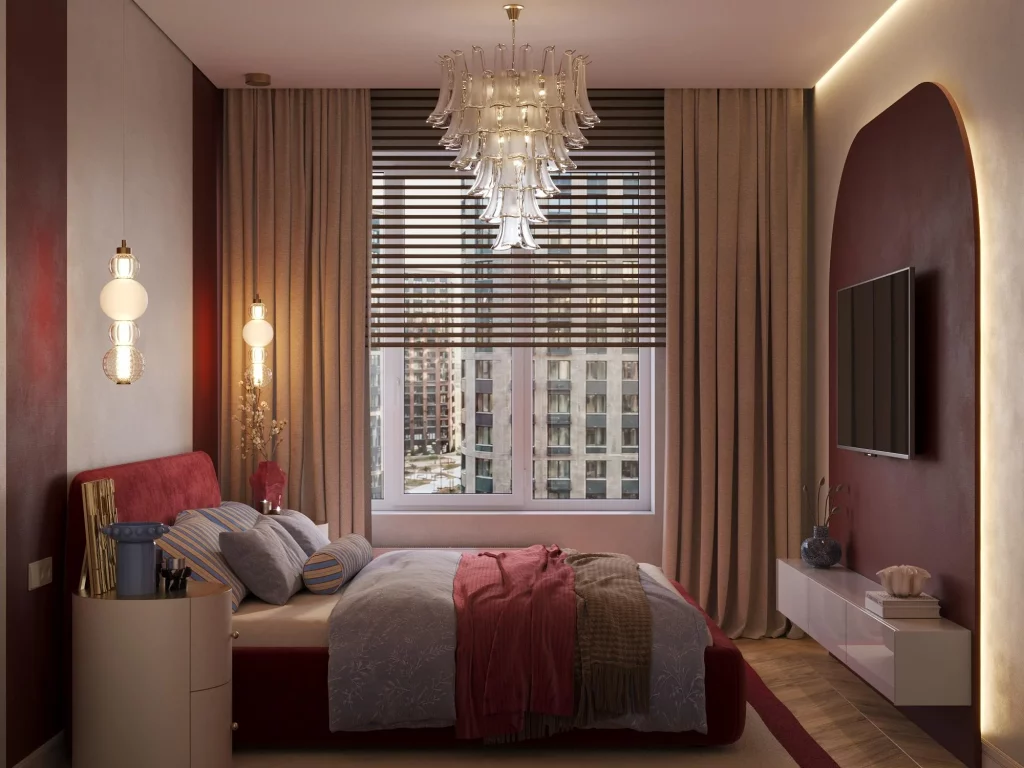
The organization feels particularly effective because the furniture is concentrated around the perimeter, leaving the central area around the bed visually open. The floating white cabinet is especially useful in a compact room because its raised installation keeps the floor visible beneath it. I also like the rounded bedside cabinet, which avoids the sharp, boxy feeling that too many rectangular pieces can create.
For a similar bedroom, I would think about furniture volume before adding decorative accessories. One substantial bed, a compact bedside unit, and a streamlined media cabinet can provide everything necessary while leaving enough breathing room. The chandelier then becomes the decorative centerpiece instead of filling the room with numerous smaller objects.
Graphic Accent Wall Bedroom With Layered Gray Textiles
Here, the most noticeable feature is the dramatic graphic wall behind the bed, covered in an abstract composition of black, white, and ochre brush-like forms. The rest of the room is much more restrained, with a pale upholstered bed, gray curtains, gray bedding, and a black bedside cabinet. A sculptural ceiling light with several directional fixtures adds another modern detail, while a tall potted tree stands beside the window.
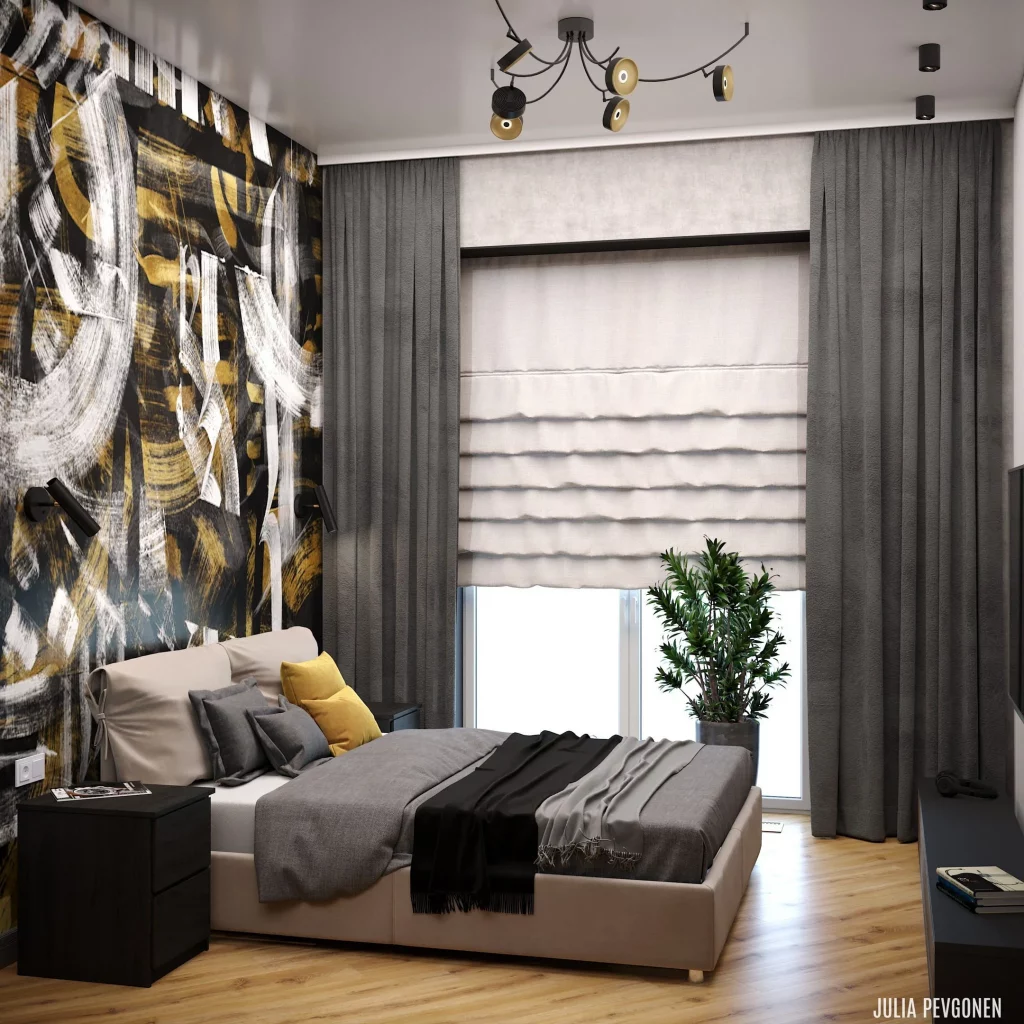
The contrast between the expressive wall and the simpler furniture makes the room feel organized rather than chaotic. I particularly like that the bedside table is compact and dark, visually connecting with the black elements in the wall. The open floor area around the bed also gives the pattern room to breathe.
When I look at a bedroom like this, I’m reminded that organization does not necessarily mean hiding every visual detail. Instead, it can mean deciding where the eye should land. With such a strong accent wall, I would keep surrounding furniture relatively uncomplicated and avoid filling every available surface.
Textured Gray Feature Wall With A Long Floating Storage Console
This bedroom uses a sophisticated gray palette, with a textured dark wall behind the bed and a long white console stretching across the opposite side. The console combines closed drawers with an open dark compartment for books, while framed artwork, decorative objects, and greenery are arranged across its surface. The bed is upholstered in a warm neutral tone and layered with gray and green textiles. Floor-to-ceiling curtains frame the windows on the left.
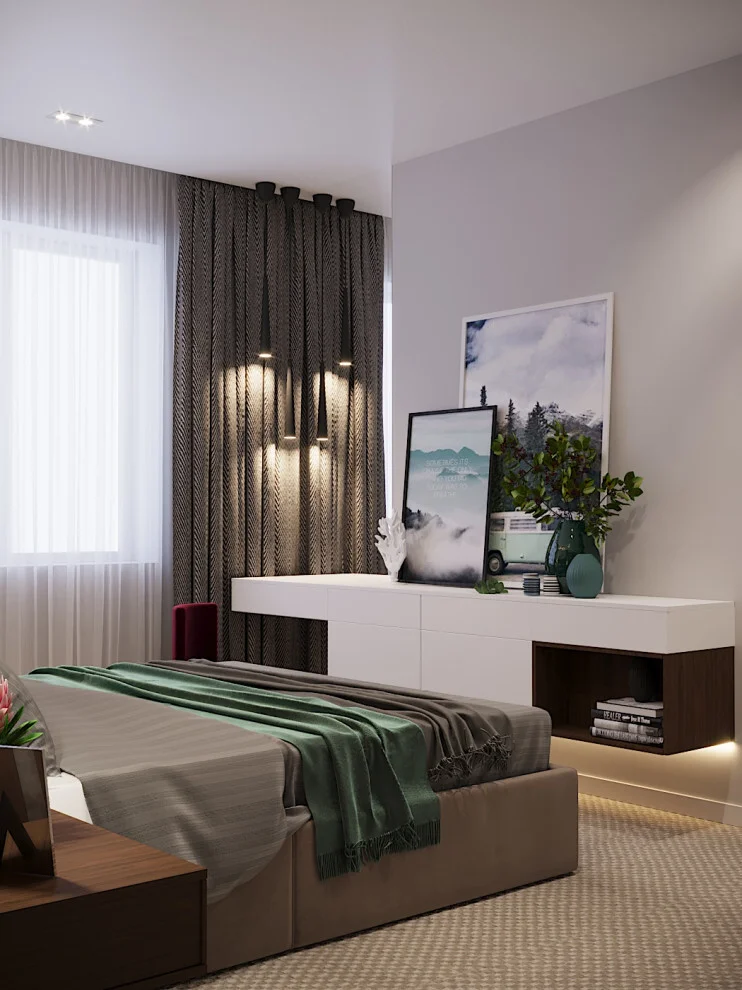
The long console is one of my favorite practical features in this room because it provides considerable storage without appearing visually heavy. Its horizontal shape balances the room and gives the wall a clean, continuous appearance. The open section also makes it possible to keep a few books accessible while most belongings remain behind closed fronts.
For a small bedroom, I would consider this kind of low, elongated storage whenever wall space allows it. It can serve several functions at once while avoiding the visual bulk of multiple separate cabinets. I also like the way the under-console lighting subtly defines the furniture without adding another large decorative object.
Warm Neutral Bedroom With Sculptural Panels And Vertical Slats
This bedroom is built around warm beige and brown tones. Large padded wall panels rise behind the bed, interrupted by narrow vertical slatted sections that add rhythm and height. A large mirror appears along the left side, while a sculptural bedside cabinet and round wall lights bring softer shapes into the otherwise linear design. The bed itself is upholstered in a matching neutral material and dressed with a brown throw and patterned runner.
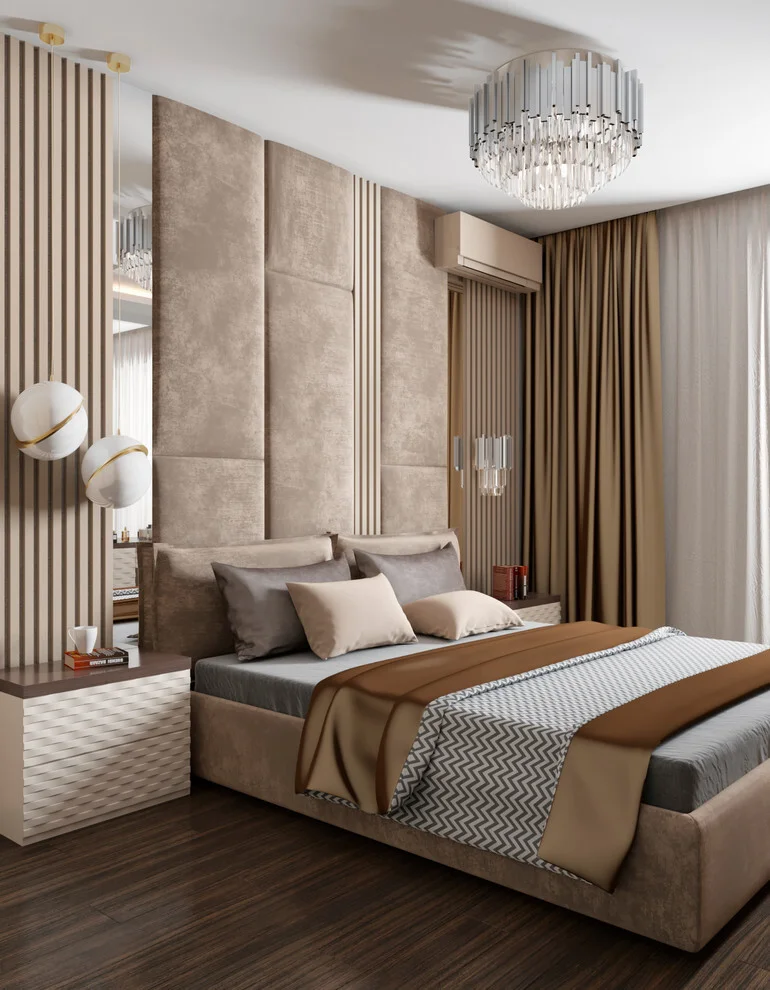
The arrangement feels efficient because the bedside storage is compact and positioned close to the bed, while the wall treatment does much of the decorative work. Instead of relying on numerous accessories, the room uses texture, repetition, and proportion to create interest. The mirrored surface on the left also helps reflect the room and visually extend the space.
I would use this approach when a small bedroom needs personality but cannot accommodate much additional furniture. A carefully designed wall behind the bed can become the main decorative feature, allowing the rest of the room to remain uncluttered. Vertical detailing is also worth considering because it naturally emphasizes ceiling height.
Elegant Plum Bedroom With Soft Curtains And Layered Lighting
This bedroom has a more romantic atmosphere, created by deep plum curtains, a purple bed covering, a softly textured gray wall, and a neutral upholstered bed. A large window fills the room with daylight, while a modern multi-light ceiling fixture provides a sculptural focal point. Tall slim floor lamps stand beside the bed, and patterned pillows introduce small touches of additional color.
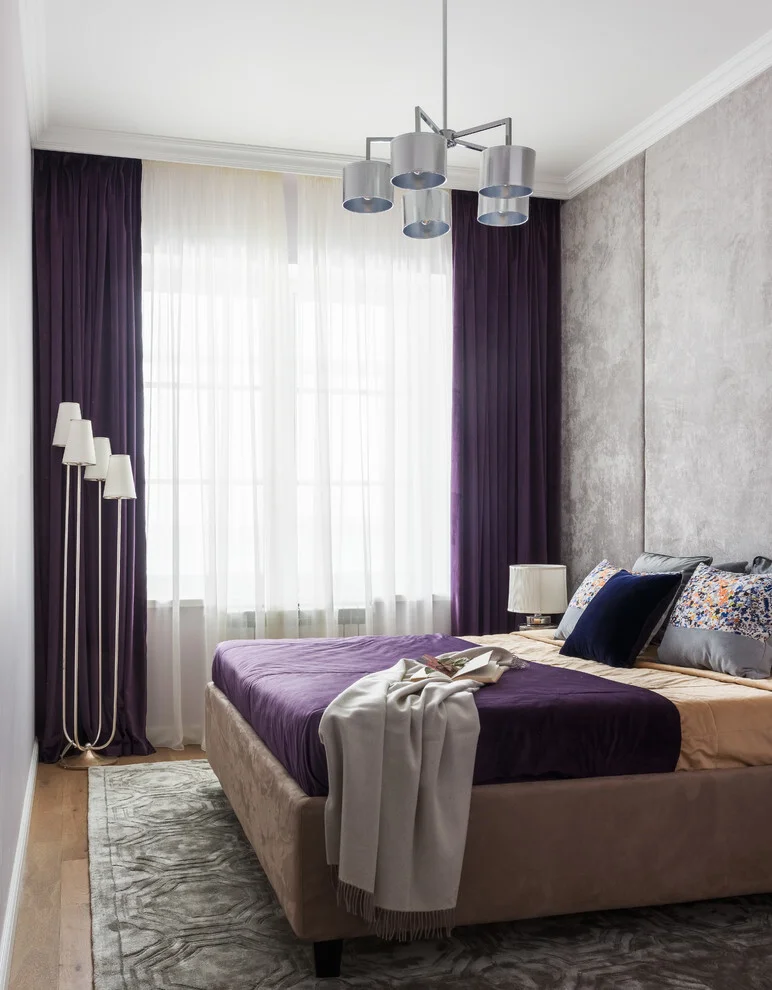
I like the way the lighting is distributed rather than concentrated in a single source. The floor lamps add height and softness beside the window, while the ceiling fixture provides a decorative centerpiece. The relatively simple bed and limited furniture prevent the strong purple textiles from overwhelming the room.
For a cozy small bedroom, I find that layered lighting can be just as important as furniture selection. Several appropriately scaled light sources can make a compact space feel more comfortable and functional at different times of day. Here, I would preserve the generous curtain height and keep the surrounding furniture visually quiet.
Minimal White Bedroom With Blue Architectural Accents
This bedroom takes a very clean contemporary direction. A low upholstered bed in soft white sits beneath a rounded blue wall feature with a small illuminated sign, while a narrow deep-blue vertical wall section appears beside the television. Long beige curtains surround the central window, and a floating dark media cabinet keeps the opposite wall visually light. A pale herringbone-style floor adds subtle texture beneath the bed.
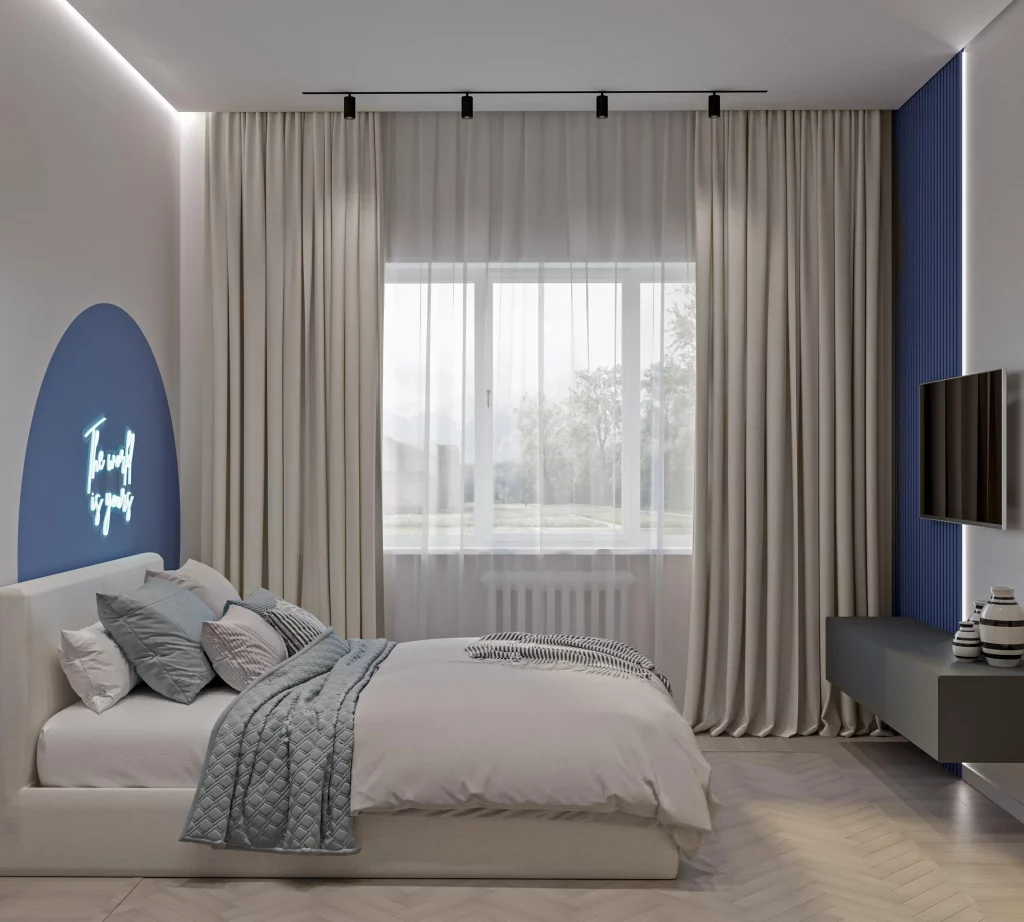
The floating furniture is particularly effective in a smaller room because the visible floor beneath it creates a sense of openness. The bed also has a low profile, which keeps the overall composition horizontal and calm. Instead of adding several storage pieces, the room relies on the streamlined media unit and the clean surfaces surrounding the bed.
I would take the same principle into a small bedroom by choosing furniture that does not visually close off the floor. Wall-mounted pieces can be especially useful when every inch matters. The blue accents also demonstrate how one controlled color can give a neutral bedroom a clear identity without requiring lots of accessories.
Soft Blue Bedroom With Mirrored Panels And Tailored Storage
This pale blue bedroom feels airy and coordinated from floor to ceiling. The upholstered bed has a geometric headboard in a matching blue tone, while the surrounding walls are finished with decorative molding and mirrored diamond-pattern panels. A round dark bedside table sits beside the bed, paired with a silver-toned lamp. Light curtains cover the window, and a framed artwork hangs centrally above the headboard.
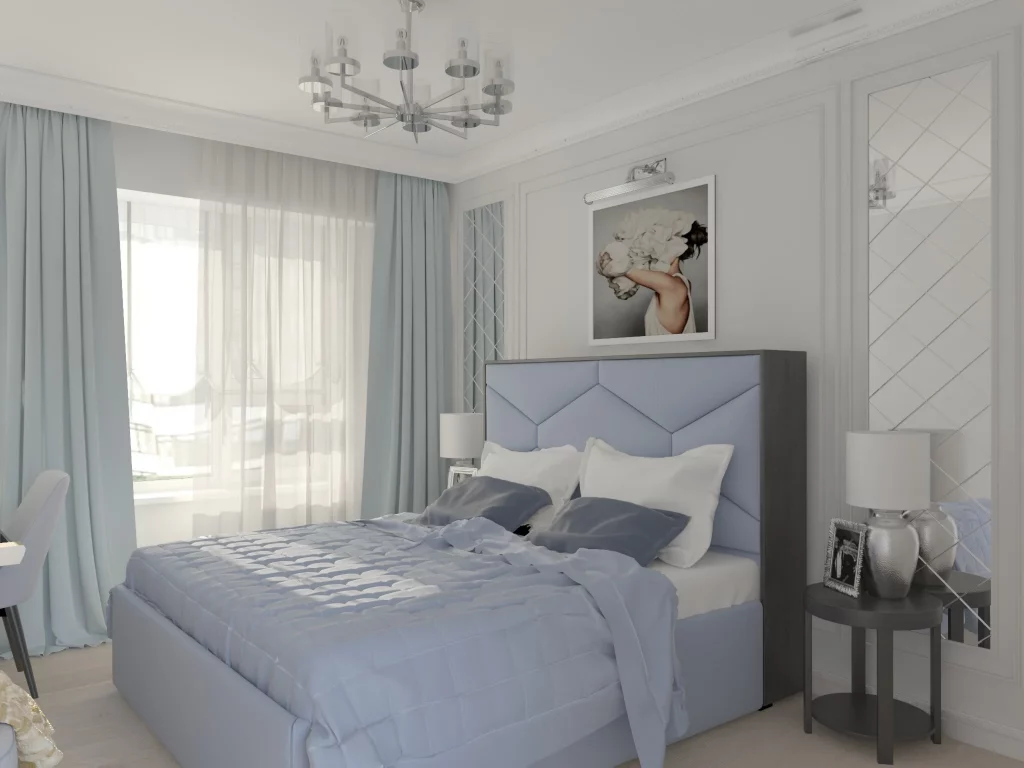
The room works because the furniture is kept relatively compact while the walls carry much of the visual detail. The mirrored panels add depth and reflect light, and the consistent pale palette prevents the decorative wall treatment from becoming visually heavy. The round bedside table is also a practical choice because its curved shape creates softer circulation around the bed.
In a small bedroom, I would be careful about mixing too many competing finishes. This room succeeds because the blue, white, silver, and reflective surfaces remain within one cohesive palette. If the goal is to create a similarly polished space, I would choose one dominant color and repeat it through the bed, curtains, and smaller textiles.
Serene Seafoam Bedroom With Symmetrical Bedside Storage
This bedroom is centered around a muted seafoam green palette, with matching bedding and walls creating a calm, enveloping effect. Three framed seaside artworks hang above the dark upholstered headboard, while two woven pendant lights hang symmetrically on either side. Small light-colored bedside cabinets sit directly beside the bed, and tall sheer curtains cover the large window along the right wall. A vertical slatted wall treatment adds warmth and texture on the left.
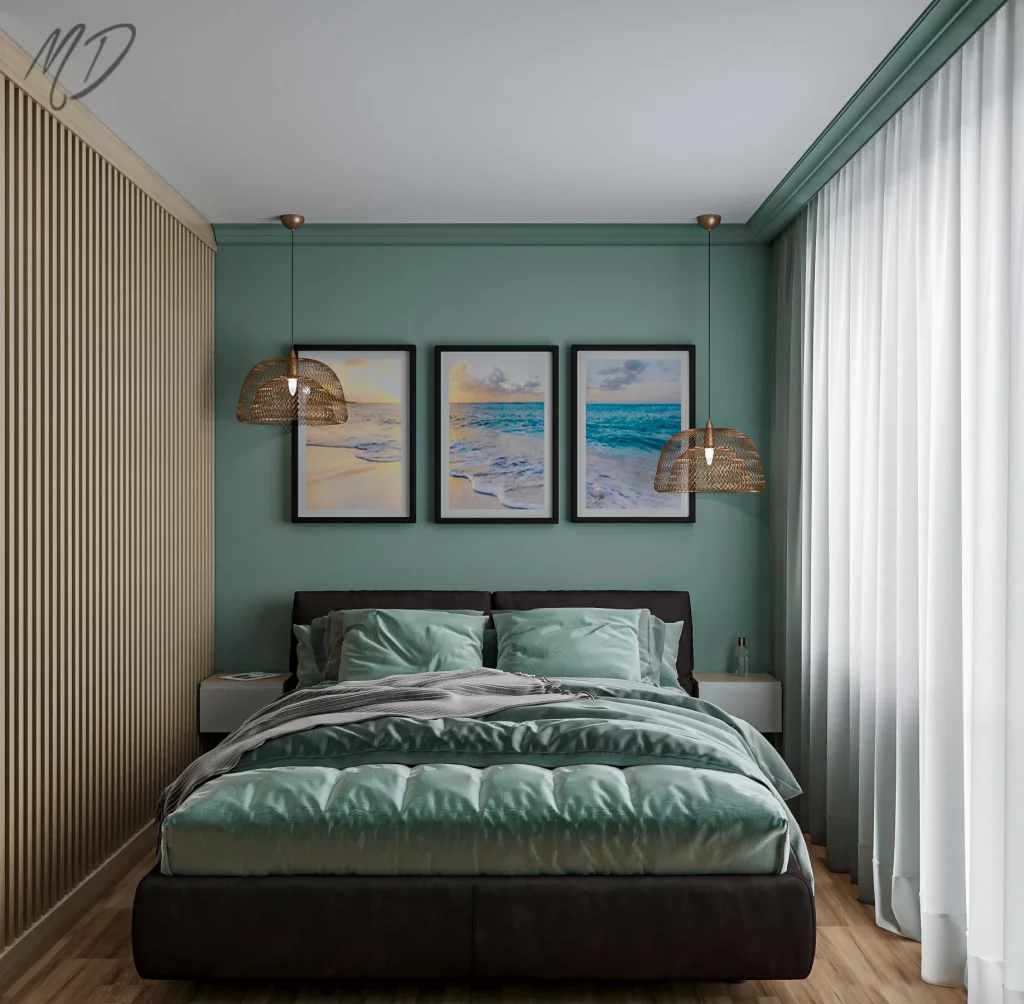
The symmetrical layout makes this compact bedroom feel exceptionally orderly. Both sides of the bed have matching storage and lighting, so there is no need for additional furniture elsewhere. The narrow bedside cabinets are enough to provide a practical landing place without taking valuable floor area.
I particularly like the balance between the strong wall color and the natural-looking woven pendant shades. For a cozy bedroom, symmetry can be an easy organizing tool because it establishes a clear visual structure. I would also keep artwork grouped rather than scattered around the room, as the three aligned frames shown here create a much cleaner composition.
Round Upholstered Bed With Built-In Book Shelving
This bedroom makes a bold statement with a large round upholstered bed placed in the center of the room. Behind it, a softly patterned pale wall provides a quiet backdrop, while built-in shelves filled with books and small illuminated objects occupy both sides. Tall draped curtains frame the window, and matching round bedside tables with lamps sit close to the bed. A large contemporary chandelier hangs overhead.
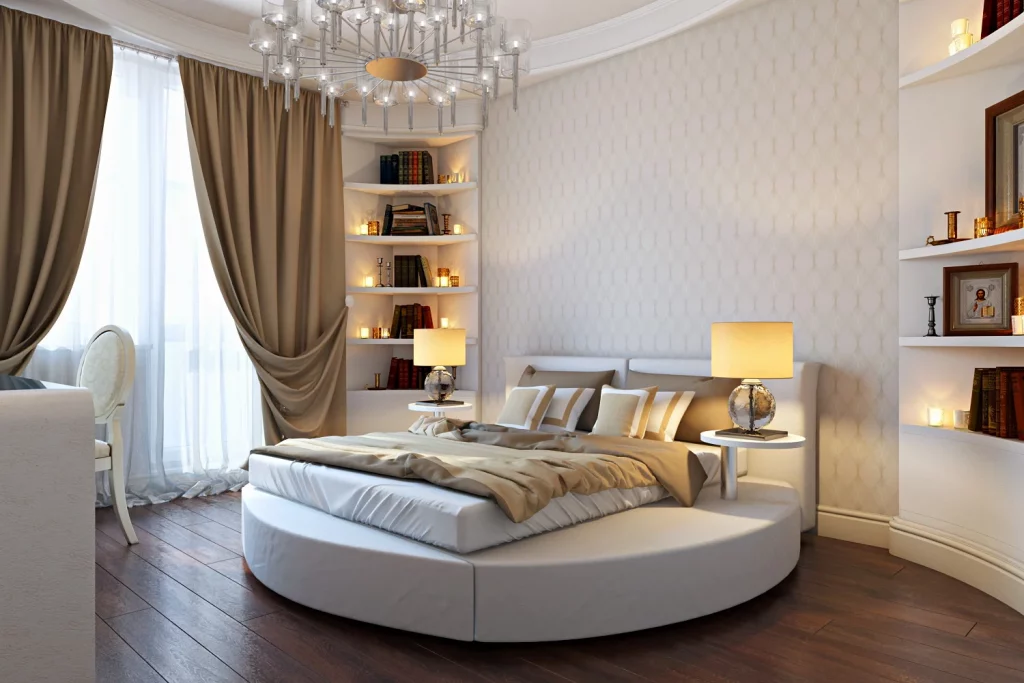
The built-in shelving is the most useful organizational feature here. Instead of adding freestanding bookcases, the storage is integrated directly into the walls, leaving the main floor area open around the unusual bed. The shelves also make everyday items accessible while giving the room a clear sense of structure.
For me, this is a great reminder that storage can become part of the architecture. If a small bedroom has awkward wall space, built-in shelving can often provide more useful capacity than several separate cabinets. The key is to keep the shelves intentionally edited, as the books and small objects shown here are arranged rather than piled randomly.
Soft Lavender Bedroom With Decorative Wall Panels
This bedroom has a distinctly delicate atmosphere, with pale lavender bedding, a curving upholstered headboard, patterned wallpaper, and mirrored decorative panels around the bed. A white vanity with drawers sits beneath the bright window, while matching bedside furniture provides additional storage. A dark chandelier and wall-mounted lamps introduce contrast without disrupting the soft color scheme.
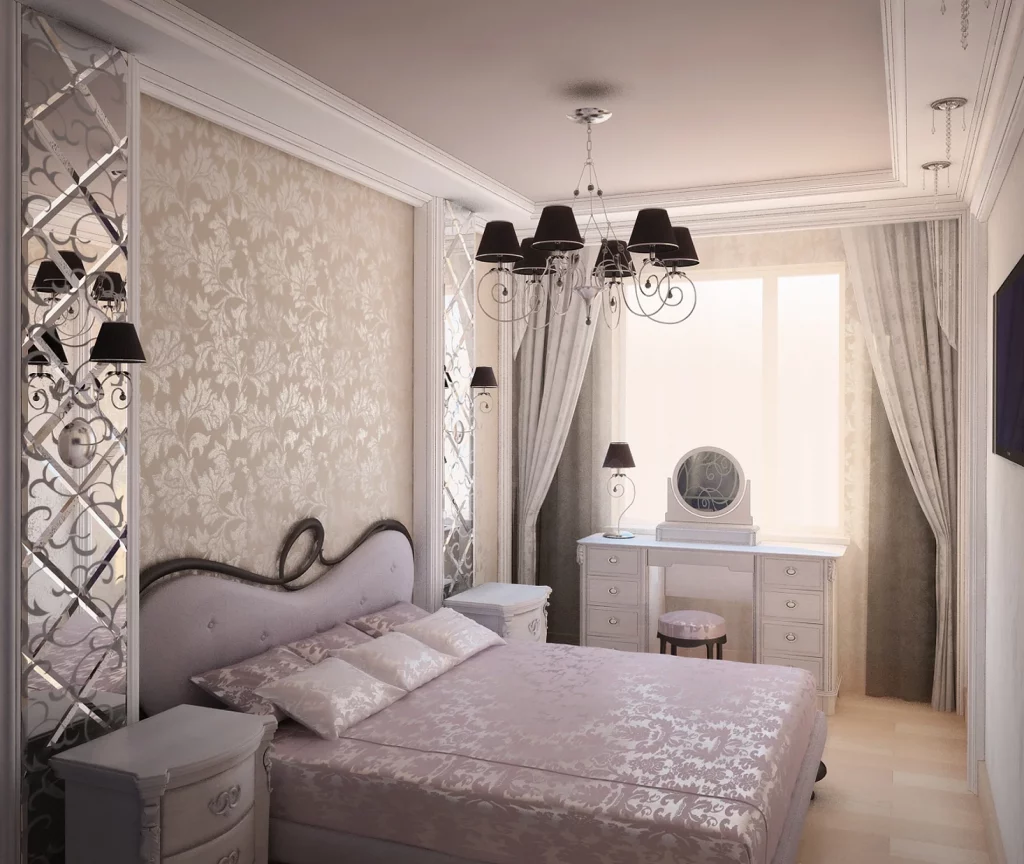
The vanity is particularly practical because it combines a dedicated surface with multiple drawers, giving the room useful organization without requiring a separate large dresser. The bedside tables also keep storage close to the bed, while the decorative wall panels provide visual interest in an area that might otherwise need additional artwork.
I would approach a small bedroom like this by assigning a specific purpose to every major piece. The bed provides the sleeping zone, the vanity creates a compact dressing area, and the bedside cabinets handle smaller daily necessities. When each item has a clear function, even a highly decorative bedroom can remain organized.
Dark Contemporary Bedroom With Low-Profile Furniture
This bedroom uses a darker palette, with deep gray-purple walls, dark trim, a black upholstered headboard, and gray bedding. A large area rug covers much of the floor around the bed, while matching bedside tables and white lamps provide contrast. Floor-to-ceiling curtains soften the window wall, and framed artwork adds a small decorative element to the surrounding walls.
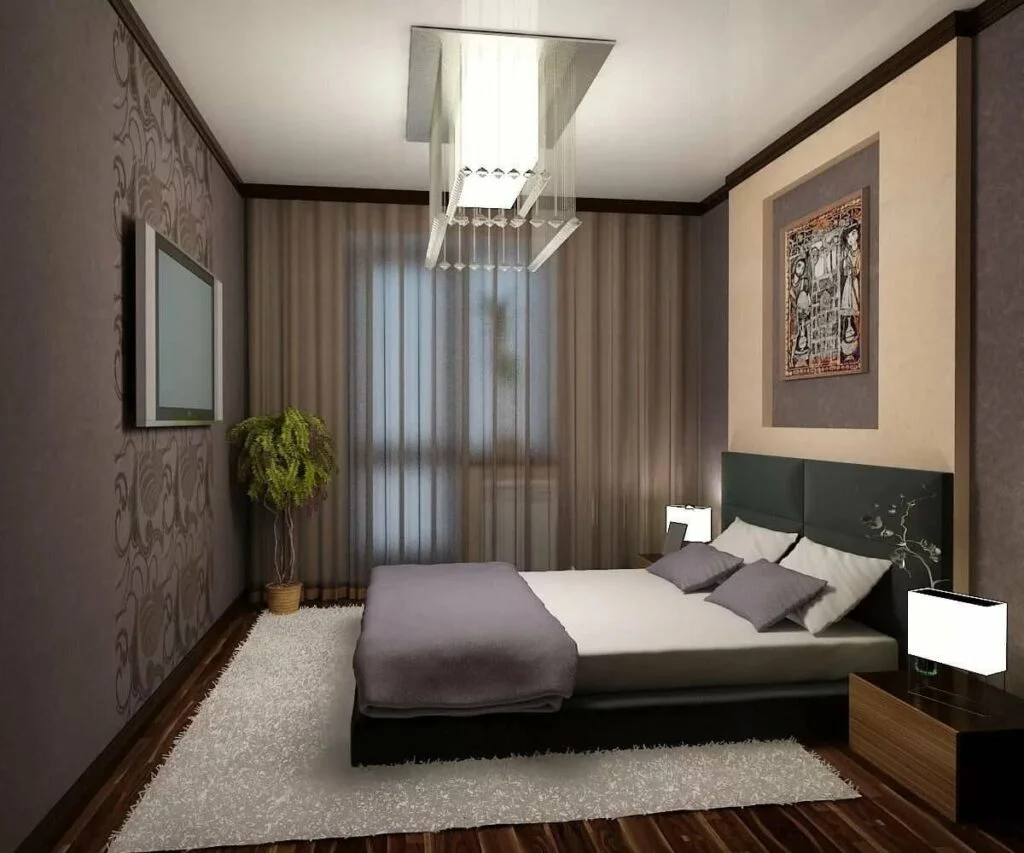
The low-profile furniture helps keep the room visually open despite the darker colors. The bedside tables are positioned close to the bed and provide practical storage without extending far into the walking area. I also like the large rug because it visually connects the furniture and makes the sleeping zone feel intentional.
Dark colors can work beautifully in a small bedroom when the composition remains controlled. In this room, the lighter bedding, lamps, and large rug keep the darker walls from feeling too heavy. I would follow that same balance rather than trying to make every surface equally dark.
White Bedroom With A Full Floral Feature Wall
This compact bedroom is dominated by a large floral mural behind the bed, filled with delicate branches and multicolored blossoms against a pale background. The rest of the room remains remarkably simple: a light upholstered bed, white bedding, small white bedside cabinets, and a tall white wardrobe on the right. Soft lavender curtains frame the window at the left.
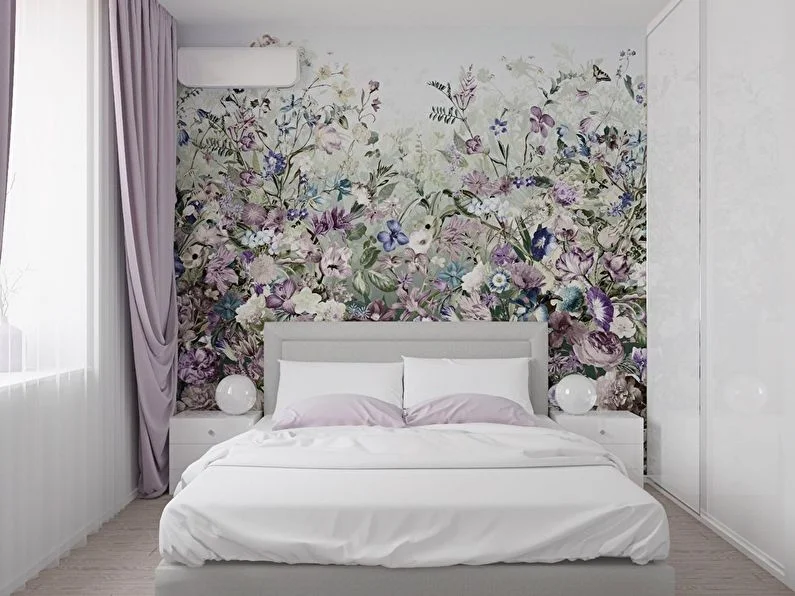
The strong feature wall eliminates the need for numerous decorative objects. The bedside cabinets are small and functional, while the full-height wardrobe provides substantial enclosed storage without introducing another contrasting color. Keeping the remaining furniture white allows the mural to remain the clear focal point.
If I were organizing a small bedroom around a feature wall like this, I would resist the temptation to add too many competing patterns. The image shows how one expressive surface can provide all the personality the room needs. Keeping the storage visually quiet is what makes the overall composition feel calm rather than crowded.
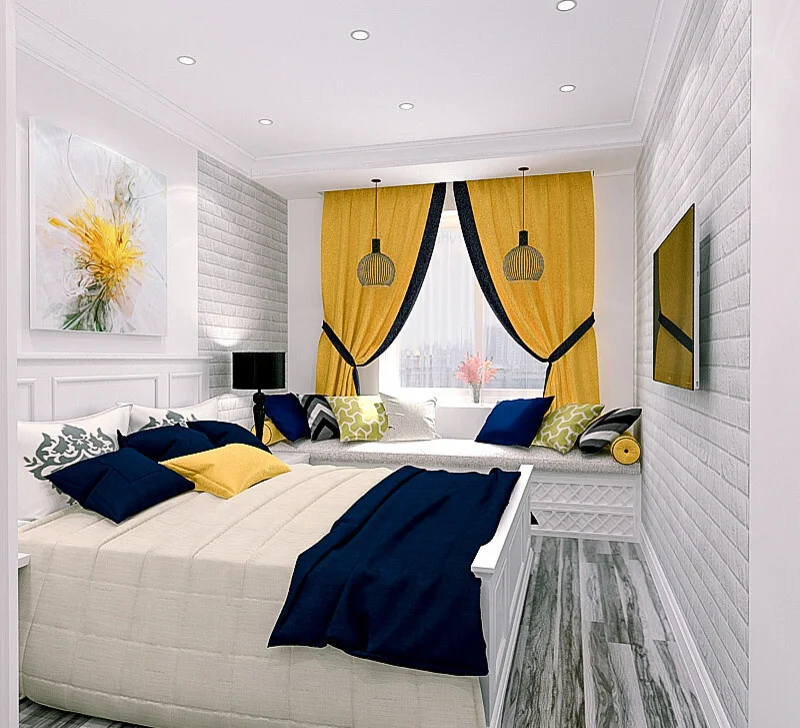
White And Navy Bedroom With A Cozy Window Bench
The final bedroom combines crisp white walls and bedding with strong navy accents. The bed is surrounded by numerous pillows in navy, white, and patterned fabrics, while the window is dressed with dramatic yellow curtains edged in dark navy. A built-in window bench with drawers provides useful storage beneath the large window, and a white paneled wall treatment adds architectural detail. The floor has a pale wood-like finish with a subtle pattern.
The window bench is the standout organization idea for me because it combines seating, visual interest, and concealed storage in one compact feature. The drawers beneath the bench can keep belongings out of sight while preserving the useful area around the window. The bed itself remains the central furniture piece, leaving the perimeter relatively open.
I would especially recommend this kind of multifunctional furniture when working with a small bedroom. A window area that might otherwise be difficult to use can become valuable storage simply by adding a properly fitted bench with drawers. The strong navy and yellow palette also shows that organization does not have to mean a plain or colorless interior.
These bedrooms show me that small-space organization is often less about having more storage and more about choosing furniture that works harder. Floating cabinets, built-in shelving, compact bedside tables, multifunctional benches, and carefully edited surfaces can all make a bedroom feel more comfortable without sacrificing personality. Which of these small bedroom organization ideas would you most like to use in your own space? Leave a comment and share your favorite room from the collection.
Organizing a small bedroom is all about making thoughtful choices that keep the space comfortable, functional, and visually calm. I love how these ideas show that smart layouts, compact furniture, vertical storage, and simple styling can make even a limited room feel inviting. With a little planning, every corner can work harder without sacrificing the cozy atmosphere. Which of these small bedroom organization ideas would you try in your own space? Leave a comment and share your favorite room or design idea.